
Heidi Ledford in Nature:
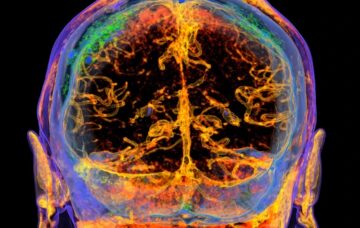 A slimy barrier lining the brain’s blood vessels could hold the key to shielding the organ from the harmful effects of ageing, according to a study in mice. The study showed that this oozy barrier deteriorates with time, potentially allowing harmful molecules into brain tissue and sparking inflammatory responses. Gene therapy to restore the barrier reduced inflammation in the brain and improved learning and memory in aged mice. The work was published today in Nature1.
The finding shines a spotlight on a cast of poorly understood molecules called mucins that coat the interior of blood vessels throughout the body and give mucus its slippery texture, says Carolyn Bertozzi, a Nobel-prizewinning chemist at Stanford University in California and a lead author of the study. “Mucins play a lot of interesting roles in the body,” she says. “But until recently, we didn’t have the tools to study them. They were invisible.”
More here.
Enjoying the content on 3QD? Help keep us going by donating now.
 F
F Democrats, let the Republicans’ own undertow drag them away. At this rate, the Trump honeymoon will be over, best case, by Memorial Day but more likely in the next 30 days. And in November 2025, we start turning the tide with what will be remembered as one of the most important elections in recent years: the Virginia governor’s race. From tax enforcers to rocket scientists, bank regulators and essential workers — the Trump administration is hellbent on
 The nine Sámi languages still in use have an extensive vocabulary for snow — everything from åppås, untouched winter snow without tracks; to habllek, a light, airy dust-like snow; and tjaevi, flakes that stick together and are hard to dig.
 “T
“T On one of her signature songs, the restless, almost phosphorescent 1976 anthem
 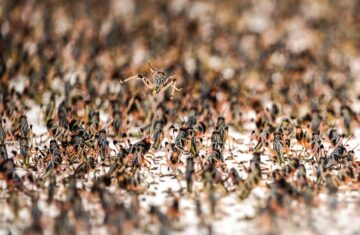 Among the most spectacular phenomena in nature is the sight of millions of desert locust (Schistocerca gregaria) juveniles marching together, flowing like a river through the arid habitat of North Africa and consuming vegetation as they go before molting to become devastating swarms of winged adults. Understanding how and why locusts exhibit aligned collective motion is vital for predicting and managing outbreaks. However, present knowledge of the rules that govern the emergence of such complex, patterned behavior and decision-making is based on a handful of theoretical models that recapitulate only some aspects of the observed behavioral patterns. On page 995 of this issue, Sayin et al. (
 Every week at the office, you and your fellow employees have meetings to discuss progress on group projects and to divide tasks efficiently. Perhaps in the evening, you go home and cook dinner with your partner. At least once in your life, you might have seen a team of firefighters work together to extinguish a fire at a burning house and rescue those inside. You have probably also witnessed or participated in political demonstrations aimed at bettering the treatment of those in need. These are all examples of human cooperation toward a mutually beneficial end. Some of them seem so commonplace that we rarely think of them as anything special. Yet they are. It is not obvious that any of the other great ape species cooperate in such a way – spontaneously and with individuals they have never before met. Though there has been some evidence of cooperation in other great apes, the interpretation of studies on ape cooperation has also been contested. In the human case, cooperation is unequivocal.
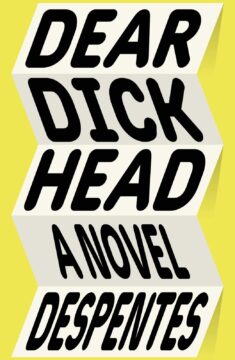 IN A 2019 INTERVIEW with Lauren Elkin, the writer Virginie Despentes remarked of #MeToo that something was missing from the movement, “disconcerting” stories that didn’t fit into an increasingly streamlined regime of victimhood: “I want to see an uprising of loose women,” she said. “It’s really important to give voice to people practicing a sexuality that isn’t quite—correct.” Despentes broke onto the scene with 1993’s notorious Baise-moi (Fuck Me in English, though some markets have translated the title as Rape Me instead), an unhinged fever dream of a novel following two women—one a prostitute, the other the survivor of a gang rape loosely based on Despentes’s own—on a robbery, fucking, and killing spree. The movie, when Despentes adapted it with filmmaker and porn actress Coralie Trinh Thi in 2000, was the first to be banned in France in twenty-eight years. In response to accusations that the film wasn’t art but pornography, Trinh Thi scoffed that it couldn’t possibly be porn—it wasn’t produced “for masturbation.”
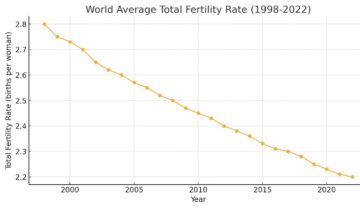 Human populations will start to decrease globally in a few more decades. Thereafter fewer and few humans will be alive to contribute labor and to consume what is made. However at the same historical moment as this decrease, we are creating millions of AIs and robots and agents, who could potentially not only generate new and old things, but also consume them as well, and to continue to grow the economy in a new and different way. This is a Economic Handoff, from those who are born to those who are made.