It’s Not All Lightbulbs

W Patrick McCray in Aeon:

[C]onsider the Otts. Somewhere in Kansas during the early years of the Great Depression, Bill Ott and his daughter Lizzie did something different with their car. By removing the rear tyre and adding a drive belt, they built a homemade car-powered washing machine. As an ‘innovation thought leader’ at Davos or TED might say, the Otts hacked the automobile and re-invented the washing machine. Stated simply – they innovated. So how come you haven’t heard of the Otts? Because the Great White Man narrative of innovation ignores the critical role that anonymous, unrecognised people such as Bill and Lizzie Ott play in the incrementalism that is the real stuff of technological change. Most of the time, innovators don’t move fast and break things.

Over the past two centuries, almost all professional scientists and engineers have worked not to cut down the old trees of technologies and knowledge and grow new ones, but to nurture and prune the existing ones. In corporate-based science and technology, disruption is very rare, continuity rules, and makes change and advance possible. At different times in history, such disruption was even discouraged. At the great industrial labs of the early 20th century, companies such as General Electric (GE) or AT&T didn’t want their engineers and scientists to create excessive technological novelty – tens of millions of company dollars had been invested to build existing technological systems. Instead, research managers such as Willis R Whitney, head of GE’s research, sought incremental improvements that would marginally advance the company’s technologies and extend its intellectual property regime.

More here.
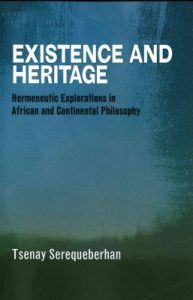
The Contesting Memory of African Philosophy

Richard Marshall interviews Tsenay Serequeberhan in 3:AM Magazine:
3:AM: You approach philosophy, and in particular African philosophy, from a hermeneutical perspective, a tradition that you place Heidegger as being an important (though personally odious) figure. So, can you first say why you think a Heideggerian and Gadamerian hermeneutics is the best approach to contemporary African philosophy, especially given that it is a tradition heavily indebted to a specific Eurocentric and Germanic orientation in its beginnings?

TS:  In responding to this question, I would like to begin by pointing out the obvious. From an Africanist perspective—of any strip—most of the European philosophical tradition is rather odious. Indeed, as I have shown, by exploring destructively the historical-political perspectives of Kant, Hegel, and Marx, the views of these icons of the Occidental tradition are saturated with a Eurocentrism which they take to be consubstantial with the humanity of the human as such. And it is not only them. If one is willing to do the detailed destructive leg-work, one will see that the Occidental tradition is grounded on a metaphysics that privileges the Christian West. By contrast, Heidegger (his personal and odious political blunders not withstanding) articulates a question—the being question— that systematically undermines this tradition by putting it into question and pointing out that it, this tradition, has forgotten/covered-over what it means to be.

Now, an African philosophical perspective, that takes itself seriously, must engage the question of being—i.e., what to be means—for contemporary Africa, since colonialism, above all else, destroyed the differing modes of African being-in-the-world. Indeed, the struggle for African freedom (which presently has achieved only the status of formal independence) is aimed at precisely this; reclaiming the African experience of being from within the context of our contemporary world. This is what Amilcar Cabral means by “return to the source.”

More here.

V. S. Naipaul and the American Right

Mark Ames in Jacobin:

Although a reactionary, Naipaul was never a lackey like today’s right-wing “intellectuals”; he never shied away from describing the brutality of colonialism (unlike bootlicking scum like Dinesh D’Souza, who never missed an opportunity to glorify his white right-wing masters for colonizing India, despite the tens of millions of Indians who died of famine in the Raj).

Naipaul continues:

And at last Cleaver stood up. He was tall beside the CIA man. He was paunchy now, even a little soft-bellied. His blue shirt had a white collar and his dark red tie hung down long. The touch of style was reassuring.

Somebody asked about his political ambitions. He said he wanted to get on the Berkeley city council. And then, inevitably, someone asked about his attitude to welfare. His reply was tired; he gave the impression of having spoken the words many times before. “I’m passionately opposed to the welfare system because it’s made people a parasitic dependency on the federal system. . . . I want to see black people plugged into the economic system. . . . Welfare is a stepping-stone to socialism because it teaches people the government is going to solve our problems.”

That was more or less it. It seemed to be all that was required of “Eldridge,” that statement about socialism and welfare. And soon the session was declared closed. A repeat began to be prepared. As in a fair, shows were done over and over again, and in between business was drummed up.

Naipaul is so affected by the sight of this conquered, lobotomized-Republican Eldridge Cleaver that he goes back again to Cleaver’s Black Panther days and finds himself not just empathizing but actually appreciating Cleaver’s literary and intellectual talents, something Naipaul couldn’t see back in the sixties:

. . . Away from the dark corner, Cleaver, placid, gray-haired, leaned against a wall. Two or three journalists went to him. But the very simplicity of the man on display made the journalists ask only the obvious questions, questions that had already been asked.

More here.

Yuval Noah Harari extract: ‘Humans are a post-truth species’

Yuval Noah Harari in The Guardian:

A cursory look at history reveals that propaganda and disinformation are nothing new, and even the habit of denying entire nations and creating fake countries has a long pedigree. In 1931 the Japanese army staged mock attacks on itself to justify its invasion of China, and then created the fake country of Manchukuo to legitimise its conquests. China itself has long denied that Tibet ever existed as an independent country. British settlement in Australia was justified by the legal doctrine of terra nullius (“nobody’s land”), which effectively erased 50,000 years of Aboriginal history. In the early 20th century, a favourite Zionist slogan spoke of the return of “a people without a land [the Jews] to a land without a people [Palestine]”. The existence of the local Arab population was conveniently ignored.

In 1969 Israeli prime minister Golda Meir famously said that there is no Palestinian people and never was. Such views are very common in Israel even today, despite decades of armed conflicts against something that doesn’t exist. For example, in February 2016 MP Anat Berko gave a speech in the Israeli parliament in which she doubted the reality and history of the Palestinian people. Her proof? The letter “p” does not even exist in Arabic, so how can there be a Palestinian people? (In Arabic, “F” stands for “P”, and the Arabic name for Palestine is Falastin.)

In fact, humans have always lived in the age of post-truth.

More here.

A Songwriting Mystery Solved: Math Proves John Lennon Wrote ‘In My Life’

From NPR:

Lennon-McCartney is likely one of the most famous songwriting credits in music. John Lennon and Paul McCartney wrote lyrics and music for almost 200 songs and The Beatles have sold hundreds of millions of albums. The story goes that the two Beatles agreed as teenagers to the joint credit for all songs they wrote, no matter the divide in work.

Over the years, Lennon and McCartney have revealed who really wrote what, but some songs are still up for debate. The two even debate between themselves — their memories seem to differ when it comes to who wrote the music for 1965’s “In My Life.”

If the songwriters’ memories (perhaps tainted by the mind-altering era they were writing in) have failed, how can this mystery ever be solved? Well, we can get by with a little help from math.

Mathematics professor Jason Brown spent 10 years working with statistics to solve the magical mystery.

More here.

Why America Needs Medicare for All

Meagan Day and Bhaskar Sunkara in the New York Times:

A growing majority of Americans agree: Health care shouldn’t be a business. They’re finally coming around to the idea that it can and should be a public good instead — something we can all turn to when the need arises.

The favorite right-wing argument against Medicare for All — the most popular approach to universal, publicly financed heath care — is that it’s too expensive. More on those costs in a moment. But first, we should note that our current health care system is actually the most expensive in the world by a long shot, even though we have millions of uninsured and underinsured people and lackluster health outcomes.

This is partly because a lot of that money doesn’t go directly toward keeping people healthy. Instead it goes to the overhead costs required to keep businesses running. These include exorbitant executive salaries, marketing to beat out the competition, the labor-intensive work of assessing and denying claims and so on. None of these would be a factor in a single-payer, Medicare for All system. Taiwan and Canada both have single-payer systems, and both spend less than 2 percent of total expenditures on administrative costs — and so does the United States’s current Medicare program. By contrast, private insurers in the United States spend as much as 25 percent on overheads.

But the most important way Medicare for All would save money isn’t by slashing administrative costs.

More here.

The Answer to Combating the Next ISIS Could be Found in Indonesia

Ty Joplin in Albawaba:

Jihadi violence ebbs and flows, with groups rising and falling in prominence as they gain and lose followers and legitimacy. Al Qaeda, once the premium jihadi brand that local groups scrambled to associate with, was made to look stale and outdated by the explosive rise of ISIS. As ISIS fades, many around the world are holding their breath for the next global terror group.

But some Indonesian families have associated themselves with radical extremism for decades, spanning generations.

Inside the terror networks of Indonesia, a global lesson is laid bare; that even though particular manifestations of violent jihad come in waves, the ideology can remain firmly entrenched. Indonesia’s long history of radical violence and of families fostering extremist sentiments can serve as a blueprint to understand how jihadism remains resilient, and how it can be combated at its core.

More here.

Erdogan’s Ottomania

Hakan Yavuz in Boston Review:

Turkey is entering a new era. Following a failed military coup against President Recep Tayyip Erdoğan in 2016, a referendum last April approved sweeping constitutional amendments amidst a government-declared state of emergency and allegations of electoral misconduct. The changes call for a super-executive presidency without robust checks and balances. And as a result of June’s presidential elections, not only is the government being reorganized under Erdoğan’s authoritarian leadership, but Turkish society is being recreated in his vision of the Ottoman past.
In speech after speech, Erdoğan has called Turkey’s identity essentially Ottoman (Osmanlılık). The premise has policy implications both at home and abroad. It is supposed to follow that Turkey has a right, if not a duty, to defend the rights of Muslims in former Ottoman territories. It was Erdoğan who supported the independence of Albanian Muslims in the Republic of Kosovo, telling a cheering crowd in the capital of Priština that “Turkey is Kosovo and Kosovo is Turkey.” His language is similar when it comes to the Palestinians: they, too, are claimed as Ottoman Muslims. If there is a master key to this code of the New Turkey, it is a reimagined Ottoman-Islamic identity—one pioneered by Turgut Özal in the 1980s as prime minister and then president, and now reconstituted for the twenty-first-century by Erdoğan and his fellow Justice and Development Party (AKP) member Ahmet Davutoğlu.

The Ottoman Empire dissolved in 1922. It was superseded by the Republic of Turkey, whose first president, Mustafa Kemal, embarked on a sweeping program of secular, westernizing reforms—a period known as the Atatürk era. The Ottoman Caliphate was abolished, Islamic canon law was replaced with a secular civil code, and women were granted full political rights.

What does Ottomanism signify nearly a century later?

More here.

From Hemingway to HG Wells: The books banned and burnt by the Nazis

Alex Johnson in The Independent:

A Farewell to Arms by Ernest Hemingway
How I Became a Socialist by Helen Keller
The Iron Heel, The Jacket and Martin Eden by Jack London
Deutsche Ansprache: ein Appell an die Vernunft (An Appeal to Reason) by Thomas Mann
All Quiet on the Western Front by Erich Maria Remarque
The Outline of History by HG Wells
Monographs about Marc Chagall and Paul Klee
All works published before 1933 by Sigmund Freud, Bertolt Brecht, Stefan Zweig, John Dos Passos and thousands of others

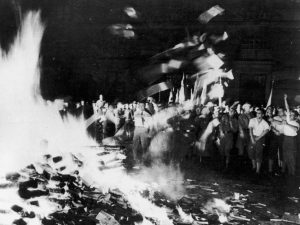
No to decadence and moral corruption! Yes to decency and morality in family and state! I consign to the flames the writings of Heinrich Mann, Bertolt Brecht, Ernst Gläser, Erich Kästner
​Joseph Goebbel​, 10 May 1933, Berlin

It is impossible to put together an exhaustive list of all the books burnt by the Nazis between 1933 (when burnings started in earnest) and 1945, but estimates put it at well over 4,000. Herrmann and a 1935 issue of Die Bucherei, the Nazi journal for lending libraries, featured a list of guidelines for deciding which books and writers were fit for the flames. This included anything written by Jewish authors (irrespective of the subject), all pacifist literature, all Marxist literature and anything by foreigners or German emigrants in a foreign country badmouthing the new Germany. More specifically, anything supporting the Weimar Republic, primitive Darwinism, or encouraging decadent art was also doomed.

More here.

Sunday Poem

Dominion

God separated the light from the darkness,
but I have a light switch.
Once there was morning and evening,
but now someone has torn the heart out of a mountain,
and they’re burning it for me.

God gave every green and growing thing,
every seed and every fruiting tree,
to all the beasts and birds for food,
but my desire sets the market price.
The patents are in my name.

If Noah had known what I know
about ventilated barns and gestation crates
he could have fit more than two of every animal in that ark.
He could have made them forget
they were animals at all.

I surveyed creation. I saw that it was profitable.
My ads fall from satellites like doves.
You’d be surprised what I can turn into a weapon.
You’d be surprised how many people
will wave my flag as they die.

God divided the light from the darkness,
but I have a light switch, a patent, a nation, a bomb,
I have mountains to burn and rivers to dye red and gray.
The old world has passed away. This is my new heaven and new earth.
Let all the people say “Amen.”

by Claire Hermann
from Split This Rock


Saturday, August 11, 2018

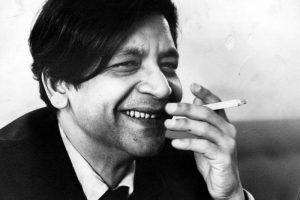
VS Naipaul dead: Nobel Prize-winning British author dies aged 85

Tom Barnes in The Independent:

Nobel Prize-winning British novelist VS Naipaul has died at his home in London at the age of 85, his family have said.

The Trinidadian-born author, most famous for his seminal 1961 novel A House for Mr Biswas, died peacefully on Friday, his wife Lady Naipaul announced.

“He was a giant in all that he achieved and he died surrounded by those he loved having lived a life which was full of wonderful creativity and endeavour,” she said in a statement.

Naipaul published more than 30 works spanning both fiction and nonfiction in a career spanning 50 years.

Born into an Indo-Trinidadian family in Trinidad and Tobagoin 1932, the author’s earlier, comic novels were often set in the Caribbean nation.

In 1948 he won a government scholarship to read English at Oxford‘s University College, where he suffered a nervous breakdown.

More here.

Are We All ‘Harmless Torturers’ Now?

Paul Bloom and Matthew Jordan in the New York Times:

There is a dial in front of you, and if you turn it, a stranger who is in mild pain from being shocked will experience a tiny increase in the amount of the shock, so slight that he doesn’t even notice it. You turn it and leave. And then hundreds of people go up to the dial and each also turns it, so that eventually the victim is screaming in agony.

Did you do anything wrong? Derek Parfit, the influential British philosopher who died in January 2017, called this the case of the Harmless Torturer. Parfit first considered a simpler scenario in which a thousand torturers each turn the dial a thousand times on their own victim. This is plainly terrible. But then he explores a contrasting case where each of the torturers turns a dial a thousand times — each turn shocking a different one of the thousand victims. The end result is the same; a thousand people in agony. And yet morally it feels different, since nobody, individually, caused any real harm to any single individual.

This seems like the sort of clever technical example that philosophers love — among other things, it’s a challenge to a utilitarian view in which the wrongness of an act is reduced to its consequences — but one with no actual real-world relevance. But the world has changed since Parfit published his scenario in 1986.

More here.

Maria Konnikova Shows Her Cards

Claudia Dreyfus in the New York Times:

As a science writer at The New Yorker, Maria Konnikova, 34, focuses on the brain, and the weird and interesting ways people use their brains.

Dr. Konnikova is an experimental psychologist trained at Columbia University. But her latest experiment is on herself. For a book she’s researching on luck and decision-making, Dr. Konnikova began studying poker.

Within a year, she had moved from poker novice to poker professional, winning more than $200,000 in tournament jackpots. This summer Poker Stars, an online gaming site, began sponsoring Dr. Konnikova in professional tournaments.

We spoke recently for two hours at the offices of The Times. An edited and condensed version of the conversation follows.

More here.

The perfect guide to a book everyone should read

Frances Wilson in Spectator:

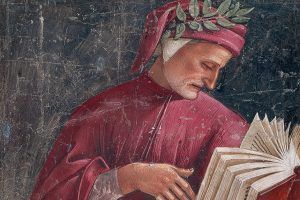
The Divine Comedy is a book that everyone ought to read,’ according to Jorge Luis Borges, and every Italian has read it. Dante’s midlife crisis in the dark wood, his journey down the circles of hell, up the ledges of Purgatory and into the arms of Beatrice is mother’s milk to Italian schoolchildren. Today lines from La divina commediaare printed on T-shirts; before the war, as Primo Levi recalled, there were ‘Dante tournaments’ on the streets of Turin, where one boy would recite the start of a canto and his rival would try to complete it. I had two Italian students in an English literature seminar last year who sniggered when I mentioned the once standard Penguin translation of the Comedy by Dorothy L. Sayers, inventor of the Dante-loving Lord Peter Wimsey. ‘Dante in translation,’ they explained, ‘isn’t the real Dante.’ But, as Ian Thomson shows, the real Dante is hard to find even in Italian. Over 800 pre-Gutenberg editions of La divina commedia are known to exist, most marred by errors and nibbled by rats, but because none is in Dante’s hand we can’t be sure what he actually wrote. An example of the way his poem was doctored by the copiers can be seen by the fact that it was Boccaccio (author of The Decameron and Dante’s first biographer) who added the divina to what Dante had simply called La commedia.
As Thomson explains, by ‘comedy’, Dante did not imply that he was trying to be funny, although he very often is, particularly when he details the punishments meted out to his enemies in Hell. A comedy was a story with a happy ending, but Dante also referred his readers to the fact that this was ‘low’ rather than ‘high’ literature, written not in Latin but the Tuscan vernacular and therefore accessible to weavers, brewers, workers and even women. The reason Dante still matters, Thomson argues, is not because readers today ‘fear damnation or are moved by the beauty of the Christian revelation, but because he wrote the story of an ordinary man — an Everyman — who sets out hopefully in this life in search of renewal’.

More here.

‘The Billionaire Raj’ explores India’s new wealth – and the corruption it breeds

Steve Donoghue in The Christian Science Monitor:

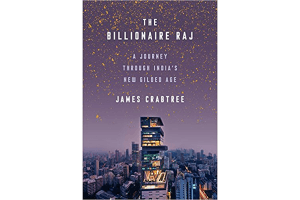
James Crabtree’s The Billionaire Raj: A Journey Through India’s New Gilded Age devotes the bulk of its length to the new cadre of super-rich that has arisen in India’s newly resurgent economy, but it opens with an important point: India is still an intensely poor country. The average citizen earns less than $2,000 a year, and the low-end of what constitutes the richest one percent of the country is only around $33,000. The richest one percent of the country owns more than half the nation’s wealth; it’s a starker income disparity than virtually any other country on Earth.

As in most such cases, the income gap is braced and fueled by immense wide-scale graft, and readers at the outset of Crabtree’s book are left with no illusions about the state of the economy underlying this new oligarchy of super-wealth. “There is every reason to believe that, without intervention, the gap between India’s rich and the rest will keep widening,” Crabtree writes, pointing in every chapter to the symbiotic link between unregulated mega-wealth and rampant corruption. The balance between these two forces is the thematic balance of the entire book, and according to the author, it “lies at the heart of the struggles of India’s industrial economy.”

In fast-paced evocative prose, Crabtree, a professor at the Lee Kuan Yew School of Public Policy at the National University of Singapore and a former Mumbai bureau chief for the Financial Times, describes some of the foremost players in that continuous struggle at the heart of India’s booming but troubled economy. For good or ill, the billionaires are the stars of this show – colorful, conflicted figures like “onetime billionaire brewer and airline magnate” Vijay Mallya, the self-dubbed “King of Good Times” who at his peak of power and infamy, “was ringmaster of his own circus: a bon vivant and hard drinker; a man of coteries and Gatsby-style parties and famously ill-disciplined timekeeping.” Mallya had once been India’s richest man, until forced into exile by corruption scandals.

More here.

What’s Wrong with Privatizing Public Lands

Mrill Ingram in The Progressive:

In his new book, In Defense of Public Lands: The Case against Privatization and Transfer (Temple University Press), Steven Davis, political science professor at Edgewood College in Madison, Wisconsin, takes on the “privatizers.” His book is an even-handed and thorough look at public lands in the United States. Although public support for wilderness, national parks, and other public lands is high, Davis is rightly concerned that these open spaces—from national parks like Yosemite to county-owned lands—face serious threats.

The sentiments that led to the Sagebrush Rebellion and Wise Use Movement are not in the past, Davis tells us. In his first chapter, “Public Land and its Discontents,” Davis details how, since the gains of the Tea Party in 2010, those against public lands have the support of a large number of office-holders in state and federal legislatures. “What was previously seen as the intemperate agitation of fringe activists is now the standard stuff of political platforms, floor debates, and campaign speeches,” he writes.

The Republican Party’s 2012 platform, for example, stated, “Congress should reconsider whether . . . federal government’s enormous landholdings and control of water in the West could be better used for ranching, mining, or forestry through private ownership.”

More here.