
Amitava Kumar at CNN:
 On October 10, 1953, V.S. Naipaul sent a telegram home to his family in Trinidad. At that time, Naipaul was an indigent student at University College, Oxford; he had arrived in England on a scholarship and had begun writing brief pieces for the BBC’s Caribbean Voices program. Naipaul, who won the Nobel Prize in Literature in 2001, died Saturday in London at the age of 85.
On that day in October 1953, Naipaul was only 21 years old and he had just received the news of his father’s death. His telegram read:
= HE WAS THE BEST MAN I KNEW STOP EVERYTHING I OWE TO HIM BE BRAVE MY LOVES TRUST ME = VIDO
Naipaul didn’t go home; he wouldn’t, in fact, return until several more years had passed. But he paid homage to his father by making him the central character of his fourth novel, “A House for Mr Biswas,” which is regarded by many as one of the greatest novels written in English. Like Mr Biswas in the novel, Naipaul’s father had been born poor. He struggled to discover a vocation and, for a while, succeeded as a journalist.
More here.
 Humor me please, and consider the pun. Though some may quibble over the claim, the oft-maligned wordplay is clever and creative, writer
  The case seems like a familiar story turned on its head:
  T
T Mary-Kay Wilmers has been the editor of the London Review of Books since 1992, and has just celebrated her 80th birthday; almost a decade ago, she published
 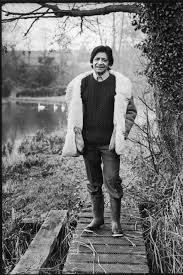 Naipaul and C.L.R. James were educated at the same colonial school. The high quality of teaching in classics and English literature left its mark on both men. Both of them came to England. There the similarity ends. James moved to Marxism and became a great historian in that tradition. Naipaul put politics on the back-burner, joined the lesser ranks of vassalage (the BBC) and cultivated a cultural conservatism that later became his hallmark both politically and socially. The classical heritage of the European bourgeoisie had completely bewitched him. He saw it as the dominant pillar of Western civilisation and this led him to underplay, ignore and sometimes to justify its barbaric sides both at home and abroad.
 IN 1970, when artist Robert Smithson first set his gaze on the Great Salt Lake’s Rozel Point Peninsula, he knew that he’d found the right site. Smithson was among a vanguard of artists in the late ’60s moving their work out into the landscape, freeing it from the containment of the gallery. Now he was determined to build an earthwork on a massive scale. Smithson had specific requirements: he wanted the color red — like the salt lakes he’d read about in Bolivia, their surface tinged in carnelian tones by micro-bacteria in the water. He wanted remote and he wanted vast — few to no markers of human artifice — to fuck with the viewer’s sense of scale. He wanted a site that would itself inform what he wanted to build.
 Was it a chance encounter when you met that special someone or was there some deeper reason for it? What about that strange dream last night—was that just the random ramblings of the synapses of your brain or did it reveal something deep about your unconscious? Perhaps the dream was trying to tell you something about your future. Perhaps not. Did the fact that a close relative developed a virulent form of cancer have profound meaning or was it simply a consequence of a random mutation of his DNA? We live our lives thinking about the patterns of events that happen around us. We ask ourselves whether they are simply random, or if there is some reason for them that is uniquely true and deep. As a mathematician, I often turn to numbers and theorems to gain insight into questions like these. As it happens, I learned something about the search for meaning among patterns in life from one of the deepest theorems in mathematical logic. That theorem, simply put, shows that there is no way to know, even in principle, if an explanation for a pattern is the deepest or most interesting explanation there is. Just as in life, the search for meaning in mathematics knows no bounds.
 Even as we want to do the right thing, we may wonder if there is “really” a right thing to do. Through most of the twentieth-century most Anglo-American philosophers were some sort of subjectivist or other. Since they focused on language, the way that they tended to put it was something like this. Ethical statements look like straight-forward propositions that might be true or false, but in fact they are simply expressions or descriptions of our emotions or preferences. J.L. Mackie’s “error-theory” version, for example, implied that when I say ‘Donald Trump is a horrible person’ what I really mean is ‘I don’t like Donald Trump’. If we really believed that claims about what is right or wrong, good or bad, or just or unjust, were just subjective expressions of our own idiosyncratic emotions and desires, then our shared public discourse, and our shared public life, obviously, would look very different. One of Nietzsche’s “terrible truths” is that most of our thinking about right and wrong is just a hangover from Christianity that will eventually dissipate. We are like the cartoon character who has gone over a cliff but is not yet falling only because we haven’t looked down. Yet.
 Our first act of communication is to look in each other’s eyes, or not to. Many descriptors center subtly on the gaze: I might be shifty if I’m looking away from you too often and too purposefully, diffident if I cast downward when I ought to be looking you in the eyes, or unsettling if I never stop looking at you.

 The major “National-Socialist Underground” trial
  Colin Marshall in The LA Review of Books: