
Costica Bradatan in the Los Angeles Review of Books:
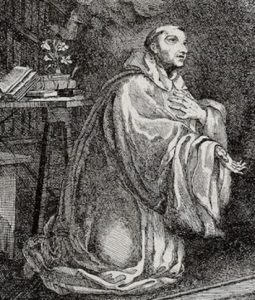 WHAT IF KNOWLEDGE — the real, redeeming variety — is not power, but the opposite of it? If, for instance, to become properly human we need to run away from power as much as we can? Indeed, what if our highest accomplishment in this world came from radical self-effacement, the lowest existential station we could possibly reach?
If there is one trait that all forms of life share, it must be self-assertion. From the simplest to the most complex, all living entities seek to persist in their state and reproduce. And doing so requires pushing relentlessly against other entities, often to the point of annihilating them. That makes life a scene of cruelty of cosmic proportions. But “cruel” may be the wrong word, for it applies human judgment to something that, by definition, is anything but human. The process of life unfolds beyond any human concerns — spontaneously, blindly, tyrannically. Humans are caught up in it just like any other species. Far from having a say in the process, we are used and abused by it — brought into being, instrumentalized, and discarded. We think we fall in love, but that’s just one of the tricks life uses to reproduce itself; we devise some better tool and think ourselves smart, blissfully ignorant that we are just playing life’s game of self-assertion. We live in a comic farce and call it happiness.
When it reaches Homo sapiens self-assertion takes a specific form: power.
More here.
 All revolutions come to an end, whether they succeed or fail.
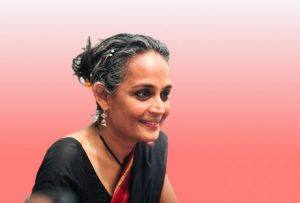 Arundhati Roy: That was fourteen years ago! The updates now would include the ways in which big capital uses racism, caste-ism (the Hindu version of racism, more elaborate, and sanctioned by the holy books), and sexism and gender bigotry (sanctioned in almost every holy book) in intricate and extremely imaginative ways to reinforce itself, protect itself, to undermine democracy, and to splinter resistance. It doesn’t help that there has been a failure on the part of the left in general to properly address these issues. In India, caste—that most brutal system of social hierarchy—and capitalism have fused into a dangerous new alloy. It is the engine that runs modern India. Understanding one element of the alloy and not the other doesn’t help. Caste is not color-coded. If it were, if it were visible to the untrained eye, India would look very much like a country that practices apartheid.
 In early 2017, epidemiologist Rory Collins at the University of Oxford in the United Kingdom and his team faced a test of their principles. They run the UK Biobank (UKB), a huge research project probing the health and genetics of 500,000 British people. They were planning their most sought-after data release yet: genetic profiles for all half-million participants. Three hundred research groups had signed up to download 8 terabytes of data—the equivalent of more than 5000 streamed movies. That’s enough to tie up a home computer for weeks, threatening a key goal of the UKB: to give equal access to any qualified researcher in the world. “We wanted to create a level playing field” so that someone at a big center with a supercomputer was at no more of an advantage than a postdoc in Scotland with a smaller computer and slower internet link, says Oxford’s Naomi Allen, the project’s chief epidemiologist. They came up with a plan: They gave researchers 3 weeks to download the encrypted files. Then, on 19 July 2017, they released a final encryption key, firing the starting gun for a scientific race.
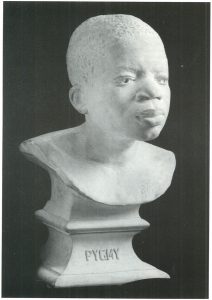 In the summer of 1904, Ota Benga was bought in the Congo from slave traders for a pound of salt and a bolt of cloth. The man who purchased him was an American entrepreneur and explorer named Samuel Phillips Verner. Verner was under contract to bring pygmies for display at the St. Louis World Fair. Later, Verner was awarded a gold medal for his services to the young discipline of anthropology.
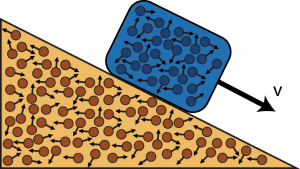 One of the hardest things to explain is why complex systems are actually different from simple systems. The problem is rooted in a set of ideas that work together and reinforce each other so that they appear seamless: Given a set of properties that a system has, we can study those properties with experiments and model what those properties do over time. Everything that is needed should be found in the data and the model we write down. The flaw in this seemingly obvious statement is that what is missing is realizing that one may be starting from the wrong properties. One might have missed one of the key properties that we need to include, or the set of properties that one has to describe might change over time. Then why don’t we add more properties until we include enough? The problem is that we will be overwhelmed by too many of them, the process never ends.
  In
In 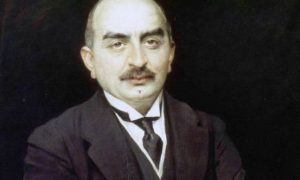 What does the life of an Ottoman-born ethnic Armenian oil tycoon have to teach us about the modern world? Quite a lot, it turns out, judging by this fascinating biography of
 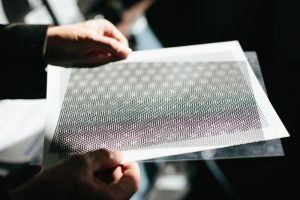 It was the closest that physicist Pablo Jarillo-Herrero had ever come to being a rock star. When he stood up in March to give a talk in Los Angeles, California, he saw scientists packed into every nook of the meeting room. The organizers of the American Physical Society conference had to stream the session to a huge adjacent space, where a standing-room-only crowd had gathered. “I knew we had something very important,” he says, “but that was pretty crazy.”
 Is there any way to intervene usefully or meaningfully in public debate, in what the extremely online Twitter users are with gleeful irony calling the ‘discourse’ of the present moment?
 As the West becomes
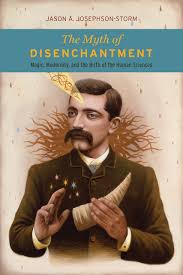 To catch up those who are unfamiliar with my book, The Myth of Disenchantment is rooted in the following observation: Many theorists have argued that what makes the modern world “modern” is that people no longer believe in spirits, myth, or magic — in this sense we are “disenchanted.” However, every day new proof arises that “modern” thinkers do in fact believe in magic and in spirits, and they have done so throughout history. According to a range of anthropological and sociological evidence, which I discuss in the book, the majority of people living in Europe and North America believe (to varying degrees) in the following: spirits, witches, psychical powers, magic, astrology, and demons. Scholars have known this was true of much of the rest of the globe, but have overlooked its continued presence in the West.