James K. Galbraith at the Institute for New Economic Thinking:
 Thomas Piketty and his colleagues[1] have produced a new exposition of their empirical work, entitled the World Inequality Report 2018 (hereafter: WIR). Their purpose is to showcase the exploration of income and wealth inequalities begun with the World Top Incomes Database (Atkinson and Piketty 2010) and theorized in Piketty’s epic Capital in the XXI Century (2014). In particular the WIR concentrates on the presentation of measures and evidence; the stated goal is to inform a “deliberative process” with “more rigorous and transparent information on income and wealth” than has been available to date. In a review article published on-line and open access in Development and Change on December 24, 2018, I initiate this “deliberative process” by examining the WIR data and the claims made for it.
The ground-breaking, systematic and transparent methodology on which the WIR rests is largely the use of tax records–specifically income tax records–mined to show the income shares of tranches of the income-earning population: top one percent, top ten percent, next forty percent, and bottom fifty percent are the usual divisions. These Piketty and his colleagues argue are more complete, comprehensive, and comparable across countries and through time than the generally-used alternative, which is household or person-based surveys.
More here.
 In July of 1316, a priest with a hankering for fresh apples sneaked into a walled garden in the Cripplegate area of London to help himself to the fruits therein. The gardener caught him in the act, and the priest brutally stabbed him to death with a knife—hardly godly behavior, but this was the Middle Ages. A religious occupation was no guarantee of moral standing.
 Forward-thinking companies strive to be socially responsible. Beer commercials exhort us to drink responsibly. And every parent wants their kid to be more responsible. All in all, responsibility is a good thing, right? It is, until it’s not. What to do when you have too much of a good thing? This week, Savvy Psychologist Dr. Ellen Hendriksen offers four signs of over-responsibility, plus three ways to overcome it. Being a responsible person is usually a good thing—it means you’re committed, dependable, accountable, and care about others. It’s the opposite of shirking responsibility by pointing fingers or making excuses. But it’s easy to go too far. Do you take on everyone’s tasks? If someone you love is grumpy, do you assume it’s something you did? Do you apologize when someone bumps into you? Owning what’s yours—mistakes and blunders included—is a sign of maturity, but owning everybody else’s mistakes and blunders, not to mention tasks, duties, and emotions, is a sign of over-responsibility.
 In the animal world, monogamy has some clear perks. Living in pairs can give animals some stability and certainty in the constant struggle to reproduce and protect their young—which may be why it has evolved independently in various species. Now, an analysis of gene activity within the brains of frogs, rodents, fish, and birds suggests there may be a pattern common to monogamous creatures. Despite very different brain structures and evolutionary histories, these animals all seem to have developed monogamy by turning on and off some of the same sets of genes. “It is quite surprising,” says Harvard University evolutionary biologist Hopi Hoekstra, who was not involved in the new work. “It suggests that there’s a sort of genomic strategy to becoming monogamous that evolution has repeatedly tapped into.” Evolutionary biologists have proposed various
  The science-fiction writer and futurist Stanisław Lem was well acquainted with the way that fictional worlds can sometimes encroach upon reality. In his autobiographical essay “
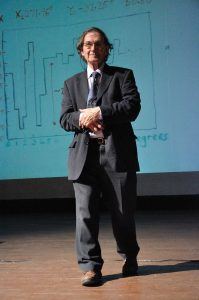 Sir Roger Penrose has had a remarkable life. He has contributed an enormous amount to our understanding of general relativity, perhaps more than anyone since Einstein himself — Penrose diagrams, singularity theorems, the Penrose process, cosmic censorship, and the list goes on. He has made important contributions to mathematics, including such fun ideas as the Penrose triangle and aperiodic tilings. He has also made bold conjectures in the notoriously contentious areas of quantum mechanics and the study of consciousness. In his spare time he’s managed to become an extremely successful author, writing such books as The Emperor’s New Mind and The Road to Reality. With far too much that we could have talked about, we decided to concentrate in this discussion on spacetime, black holes, and cosmology, but we made sure to reserve some time to dig into quantum mechanics and the brain by the end.
 For fifteen years the writer Varlam Shalamov was imprisoned in the Gulag for participating in “counter-revolutionary Trotskyist activities.” He endured six of those years enslaved in the gold mines of Kolyma, one of the coldest and most hostile places on earth. While he was awaiting sentencing, one of his short stories was published in a journal called Literary Contemporary. He was released in 1951, and from 1954 to 1973 he worked on Kolyma Stories, a masterpiece of Soviet dissident writing that has been newly translated into English and published by New York Review Books Classics this week. Shalamov claimed not to have learned anything in Kolyma, except how to wheel a loaded barrow. But one of his fragmentary writings, dated 1961, tells us more.
 My students and I were in the midst of studying Learning from Las Vegas when the news came of Robert Venturi’s death. We had just absorbed an extraordinary lecture tour of his mother’s house, in all its faux–New England simplicity, which harbored so many allusive surprises; now the book, published in 1972, was revealing itself to be a profoundly American source for the cultural-studies movement whose genealogy we had for so long attributed to the Birmingham School. It also turns out to have been one of the underground blasts that signaled the beginning of postmodernism.
 The grand term ‘intellectual property’ covers a lot of ground: the software that runs our lives, the movies we watch, the songs we listen to. But also the credit-scoring algorithms that determine the contours of our futures, the chemical structure and manufacturing processes for life-saving pharmaceutical drugs, even the golden arches of McDonald’s and terms such as ‘Google’. All are supposedly ‘intellectual property’. We are urged, whether by stern warnings on the packaging of our Blu-ray discs or by sonorous pronouncements from media company CEOs, to cease and desist from making unwanted, illegal or improper uses of such ‘property’, not to be ‘pirates’, to show the proper respect for the rights of those who own these things. But what kind of property is this? And why do we refer to such a menagerie with one inclusive term?
 For all its economic might, Germany’s main centrist parties are
  The latest TV series by charming, tidy-up guru Marie Kondo
  A deep-learning algorithm is helping doctors and researchers to pinpoint a range of rare genetic disorders by analysing pictures of people’s faces. In a paper