
by Emily Ogden
So little cause for carolings
Of such ecstatic sound
Was written on terrestrial things
Afar or nigh around,
That I could think there trembled through
His happy good-night air
Some blessed Hope, whereof he knew
And I was unaware.
—Thomas Hardy, “The Darkling Thrush,” 1900
The year and the century are dying; everything else is already dead. In Thomas Hardy’s “The Darkling Thrush” (1900), it is a dim day in the dimmest part of the year. Sunset will come early; night in Dorset, England, where Hardy lived, will last sixteen hours. A thrush sings, unwarrantably, of “joy illimited.” Why in the world? Or is his reason not of this world? Is he better informed than we? May we hope? Hardy’s subject is the close relationship between our own ignorance and our belief in another’s knowledge. To realize that we don’t know something is to realize that someone else might. To think that what the other knows might be good, might even be divine good, in spite of the earth’s sorry state—well, that is to celebrate Christmas.
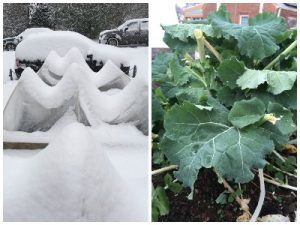
“The Darkling Thrush” was first published on December 29, 1900, under the title “By the Century’s Deathbed.” There is a horticultural term for the season Hardy was then living at his house in Dorset, and that we in the Northern hemisphere are living now: the Persephone Days, named for the goddess of spring’s annual rape at Hades’ hands. You are in the Persephone Days, according to gardener Eliot Coleman, when fewer than ten of the twenty-four hours are light. Why ten hours? Because vegetables mostly slow or stop their growth with any less. “The ancient pulse of germ and birth / [is] shrunken hard and dry,” as Hardy wrote. Plenty of vegetables are cold tolerant. I have kale plants in my front yard now that can withstand a 10º F night. Darkness, however, stunts them. The problem winter poses for our survival is not the freezing of water. It’s the freezing of time. I’ll eat only what reaches maturity before the annual darkness comes.
Or I can always go to Whole Foods. Shopping and other glamours flurry about in the foreground these dark days, distracting us from Sol’s deadly swing toward Capricorn. Black Friday roughly coincides with the start of the Persephone Days; in Norfolk, Virginia (36.8º N latitude), they coincide exactly. Black Friday is itself a kind of heretical outgrowth from Advent, a time of holy anticipation; some of us confusedly observe them both by receiving toy catalogs, letting ourselves buy cheese balls from festive displays, and growing tired of ecstatic carolings. Call it Advert. If you were in America four weeks ago, you may have found the retail festival the most noticeable of the three, followed by the liturgical holiday, with the horticultural one coming in a distant third, if at all. But that’s the whole point of the first two: to be noticeable. So as not to notice the other thing. The very intensity of the annual danse macabre shows we have not entirely forgotten our fear of the dark. Read more »
 In 2018, Earth picked up about 40,000 metric tons of interplanetary material, mostly dust, much of it from comets. Earth lost around 96,250 metric tons of hydrogen and helium, the lightest elements, which escaped to outer space. Roughly 505,000 cubic kilometers of water fell on Earth’s surface as rain, snow, or other types of precipitation. Bristlecone pines, which can live for millennia, each gained perhaps a hundredth of an inch in diameter. Countless mayflies came and went. As of this writing, more than one hundred thirty-six million people were born in 2018, and more than fifty-seven million died.
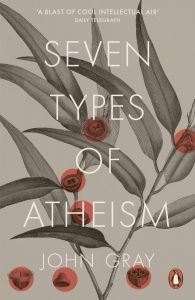 It is simultaneously awkward and exciting to read about your own consciously and responsibly adopted beliefs as something to be anatomized. It is also something atheists are not always much disposed to. On the contrary, perhaps: many forms of atheism present themselves as a consequence of free thought, of emancipation from tradition. The internal logic of their arguments prescribes that while religious beliefs, being non-rational, are in need of cultural or psychological explanation, atheism is really just what you will gravitate towards once you finally start thinking. One question here will be whether this is necessarily the case.
 Certain phrases choke us with their ubiquity at some point:
 As we approach the end of the year, it’s that time again. Not to flip the page to the next month, but to buy a new calendar. (Who am I kidding? It’s probably only me and your grandmother who still uses paper wall calendars…) And also to reflect.
  Guinea and Redhead were part of a large food chain. Beyond campus’ freshly-baked sidewalks, a Cowboy Mafia ferried contraband from the south. They landed small prop planes on ranch land outside of town, cut powder with dental anesthetics and broke up the bales. Their wares clumped on our cafeteria trays and glinted in tiny screw-top bottles. The capo, a local big-hat business man,who ran a palatial kicker-dance hall and owned the ranch. That legit business and his crew’s discipline kept them out of jail. Maybe a hat full of cash in the bargain.
 The new year approaches and with it comes our annual habit of self-promises in the form of New Year’s resolutions. Statistically speaking, though, 2019 won’t be your year. While many of us start strong, we tend to flounder come February, and studies cite the failure rate to be anywhere from 80 to 90 percent.
 The ongoing three-way public-relations car wreck involving Washington, Facebook, and

 On February 22, 1942, the Austrian writer Stefan Zweig and his second wife went to the bedroom of a rented house in Petrópolis, Brazil. They lay down—she in a kimono, he in a shirt and tie—after taking an enormous dose of barbiturates. When news of their suicides broke, it was reported as a matter of worldwide significance. The New York Times carried the news on its front page, alongside reports of the rout of Japanese forces in Bali and of a broadcast address by President Roosevelt. An editorial the next day, titled “One of the Dispossessed,” saw in Zweig’s final act “the problems of the exile for conscience sake.” Zweig, a Jew, had left Austria in 1934, living in England and New York before the final move to Brazil, and his work had been banned and vilified across the German-speaking world. In his suicide note, he spoke of “my own language having disappeared from me and my spiritual home, Europe, having destroyed itself.” He concluded, “I salute all my friends! May it be granted them yet to see the dawn after the long night! I, all too impatient, go on before.”
 I am glad,’ wrote the acclaimed American philosopher Susan Wolf, ‘that neither I nor those about whom I care most’ are ‘moral saints’. This declaration is one of the opening remarks of a landmark essay in which Wolf imagines what it would be like to be morally perfect. If you engage with Wolf’s thought experiment, and the conclusions she draws from it, then you will find that it offers liberation from the trap of moral perfection. Wolf’s
  Over the weekend, the New York Times Book Review
 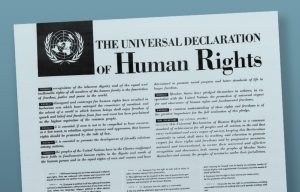 Q: In simple terms, what defines a human right?
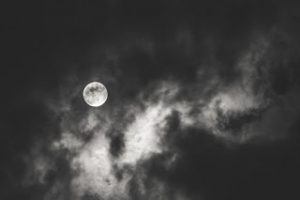 The clock says 3:30 am. Is that early or late? Wrapped in a blanket I go into the living room. I open the door and step onto the patio. It’s too warm for December. An almost full moon blurs into the clouds. In the distance, the highway hums.