
Matt Richtel in The New York Times:
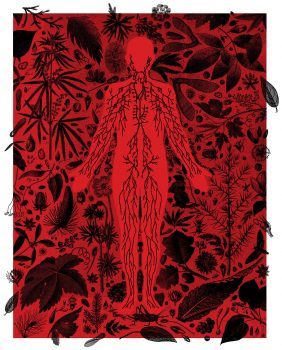 Should you pick your nose? Don’t laugh. Scientifically, it’s an interesting question. Should your children pick their noses? Should your children eat dirt? Maybe: Your body needs to know what immune challenges lurk in the immediate environment. Should you use antibacterial soap or hand sanitizers? No. Are we taking too many antibiotics? Yes. “I tell people, when they drop food on the floor, please pick it up and eat it,” said Dr. Meg Lemon, a dermatologist in Denver who treats people with allergies and autoimmune disorders. “Get rid of the antibacterial soap. Immunize! If a new vaccine comes out, run and get it. I immunized the living hell out of my children. And it’s O.K. if they eat dirt.”
Dr. Lemon’s prescription for a better immune system doesn’t end there. “You should not only pick your nose, you should eat it,” she said. She’s referring, with a facetious touch, to the fact our immune system can become disrupted if it doesn’t have regular interactions with the natural world. “Our immune system needs a job,” Dr. Lemon said. “We evolved over millions of years to have our immune systems under constant assault. Now they don’t have anything to do.” She isn’t alone. Leading physicians and immunologists are reconsidering the antiseptic, at times hysterical, ways in which we interact with our environment. Why? Let us turn to 19th-century London.
The British Journal of Homeopathy, volume 29, published in 1872, included a startlingly prescient observation: “Hay fever is said to be an aristocratic disease, and there can be no doubt that, if it is not almost wholly confined to the upper classes of society, it is rarely, if ever, met with but among the educated.”
More here.
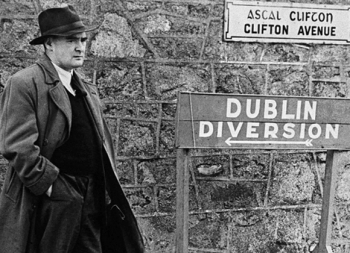 Thrumming discreetly in the deep regions of Addenbrooke’s Hospital here in Cambridge, the X-ray projectors continue to chase a dodgy little cancer from one of my facial cavities to the next, so I am still catching up with Christmas. One of my presents was The Collected Letters of Flann O’Brien, edited by Maebh Long, who must have wondered, towards the end of her task, what kind of nut-bag she had taken on. Justifiably regarded as an adornment to Irish literature, O’Brien was a funny novelist who was even funnier as a columnist, but there is nothing funny about hearing a grown mind fooling around with the word “nigger.” In his later years O’Brien, in his correspondence, did so habitually, although we perhaps need to see his bad habit in the oblique light cast by the further fact that he never gave up on the idea that St Augustine might have been black.
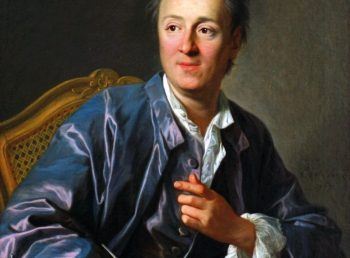 Perhaps most intriguingly, Diderot’s near-contemporary the Marquis de Sade used materialist philosophy not only to attack religion but also to subvert the optimistic visions of the Encyclopedists. Unlike Diderot, who never resolved the conflict between a materialist world-view and humanist hope, de Sade was ready to follow his philosophy to the end, however grim the conclusion might be.
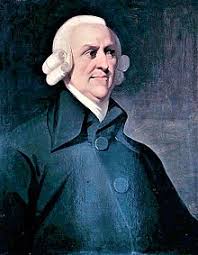 I just read Adam Smith’s The Wealth of Nations for the first time. Not every word. It’s over a thousand pages, and there are long “Digressions” (Smith’s term) on matters such as the history of the value of silver, or banking in Amsterdam, which I simply passed over. I was mainly interested in what Smith has to say about work, so I also merely skimmed some other sections that seemed to have little relevance to my research. Time and again, though, I found myself getting sucked into chapters unrelated to my concerns simply because the topics discussed are so interesting, and what Smith has to say is so thought-provoking. Reading the book is also made easier both by Smith’s admirably lucid writing and by the brief summaries of the main claims being made that he inserts throughout at the left-hand margin.


 About 75 percent of Americans
  Pinker does get a lot of press, though most-covered doesn’t always mean most-loved. While Enlightenment Now received ecstatic blurbs — Bill Gates called it his “favorite book of all time” — other assessments were less kind. A New York Times reviewer panned it as “disdainful and condescending — sympathetic to humanity in the abstract but impervious to the suffering of actual human beings.” The dismissive term
  Late last month, in between the firestorm over Congresswoman Ilhan Omar’s comments about AIPAC’s influence being “all about the Benjamins” and the firestorm over her comments about “allegiance to a foreign country,” the United Nations
  I approached
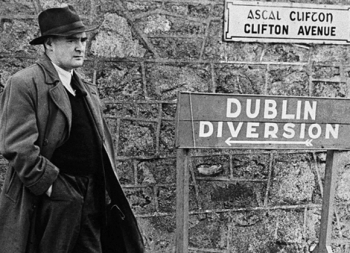 Thrumming discreetly in the deep regions of Addenbrooke’s Hospital here in Cambridge, the X-ray projectors continue to chase a dodgy little cancer from one of my facial cavities to the next, so I am still catching up with Christmas. One of my presents was The Collected Letters of Flann O’Brien, edited by Maebh Long, who must have wondered, towards the end of her task, what kind of nut-bag she had taken on. Justifiably regarded as an adornment to Irish literature, O’Brien was a funny novelist who was even funnier as a columnist, but there is nothing funny about hearing a grown mind fooling around with the word “nigger.” In his later years O’Brien, in his correspondence, did so habitually, although we perhaps need to see his bad habit in the oblique light cast by the further fact that he never gave up on the idea that St Augustine might have been black.
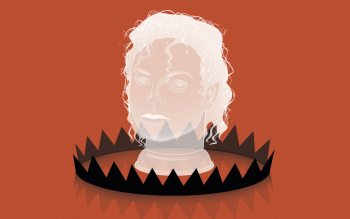 Diamond Joe Esposito was once plain Joseph Carmine Esposito, an Italian-American mechanic’s son growing up in Chicago during the Second World War. In the paranoid 1950s, he was drafted into service and sent to West Germany, where he met and befriended Elvis Presley. After their discharge, the singer employed him as his road manager and they remained close until the end – at least, the premature, undignified end of Presley’s life on 16 August 1977. Esposito was among the first to see his still-young body sprawled on the floor of his bathroom, beside some vomit and a book about the Turin shroud. Ten years later, Esposito was in the service of another king – this time the king of pop, Michael Jackson, for whom he was overseeing the logistics of the Bad tour. Jackson was another kind of pop star altogether, and big on a scale that would surely have been unimaginable even for Presley. But his confounding descent from great American icon to lonely, seedy, delusional butt of lazy comedians’ jokes would follow – with considerably more darkness – the template established by the first rock ’n’ roll icon. Neverland substituted for Graceland, the powerful sedative propofol for sundry uppers and downers, yet the grand narratives rhymed. When Esposito encountered Jackson at the peak of his powers, did he think, “Here we go again”?