
by Gabrielle C. Durham
 I teach two kinds of group exercise classes, and part of the certification processes for both disciplines devoted no small amount of attention to how to speak to your minions, uh, students.
- Negative forecasting is a no no. (Example: “Don’t think about the searing pain you’re probably feeling” is not considered positive forecasting.)
- Use the imperative rather than the interrogative. (Examples: “1, 2, 3, lift those legs behind your neck. Now!” vs. “Could you please move this way, pretty please?”)
- Try not to use overly involve anatomical terms, especially when referring to the butt. (Example: Use “seat” rather than almost any other term that all students would understand and potentially complain about. It’s happened.)
To be fair, the setting for such interactions matters. I teach in a gym, so word of mouth is terrifically important to getting bodies in the room, and you never know when you are going to offend someone with an offhand remark. At the studio where I also torture people for money, I have a bit more leeway with such rules. I’m still not supposed to say that a particular move will hurt or cause pain. Other rules include expectations such as: Don’t kill your client directly, try not to insult the client, come on time, wear clothing, et cetera.
Most dance classes, such as Zumba, NIA, Polynesian, or hip-hop, but not ballet, require almost no words, so that’s a factor that you can reasonably eliminate from this consideration of how language is used. If you can find the beat and see the instructor reasonably well, you can follow along as expertly as you can manage. When I took ballroom dancing, this was not the case, but the less said about that, the better. Read more »
 “…And now to introduce our second panelist: Martha. Martha does believe that academic philosophy is worth pursuing, and she has – of course – written a book about it. Martha, can you briefly summarize your argument?”
 My answering machine whirrs. From an echoing room, the chainsaw-voice shouts into a speaker phone:
 Abdullah, the delightful septuagenarian protagonist of Hussain M. Naqvi’s latest novel The Selected Works of Abdullah the Cossack, might be a ‘Cossack’ (having successfully imbibed his way to earning that name), but Naqvi himself is nothing short of a veritable Vaslav Nijinsky when it comes to negotiating the balletics of Pakistani Anglophone writing. Erudite yet entertaining, the Cossack’s story, in spite of his literally heavyweight frame and metaphorically heavyweight influence, gracefully pirouettes its way through the landscape of both Abdullah’s witty mind as well as the geographical terrain of Karachi in general, and Garden East in particular.
 As a student at Princeton, Merwin studied under John Berryman and R. P. Blackmur. After graduating in 1948, his travels would take him through Europe before he landed in the south of France. Michael Wiegers
  When Laila Lalami’s 2014 novel The Moor’s Account was short-listed for a Pulitzer Prize, jurors called its tale of a 16th century Spanish expedition to Florida “compassionately imagined out of the gaps and silences of history.” Five years on, Lalami turns that same compassion to the silences of the present. In her timely fourth novel, The Other Americans, she follows an investigation into the death of an elderly Moroccan immigrant in an apparent hit-and-run and its impact on a California desert town.
 In 1995, if you had told
  Identity politics is one of the defining – and one of the most divisive – issues of our age. And no identity is more contested or fought over than white identity. For some it is a means of giving voice to a group whose identity has previously been denied. For others it is simply as an expression of racism.
 WHAT A STRANGE
 As a general rule it is true that if you eat vastly fewer calories than you burn, you’ll get slimmer (and if you consume far more, you’ll get fatter). But the myriad faddy diets flogged to us each year belie the simplicity of the formula that Camacho was given. The calorie as a scientific measurement is not in dispute. But calculating the exact calorific content of food is far harder than the confidently precise numbers displayed on food packets suggest. Two items of food with identical calorific values may be digested in very different ways. Each body processes calories differently. Even for a single individual, the time of day that you eat matters. The more we probe, the more we realise that tallying calories will do little to help us control our weight or even maintain a healthy diet: the beguiling simplicity of counting calories in and calories out is dangerously flawed. The calorie is ubiquitous in daily life. It takes top billing on the information label of most packaged food and drinks. Ever more restaurants list the number of calories in each dish on their menus. Counting the calories we expend has become just as standard. Gym equipment, fitness devices around our wrists, even our phones tell us how many calories we have supposedly burned in a single exercise session or over the course of a day.
 Last April, in the famous Faraday Theatre at the Royal Institution in London, Carlo Rovelli gave an hour-long lecture on the nature of time. A red thread spanned the stage, a metaphor for the Italian theoretical physicist’s subject. “Time is a long line,” he said. To the left lies the past—the dinosaurs, the big bang—and to the right, the future—the unknown. “We’re sort of here,” he said, hanging a carabiner on it, as a marker for the present. Then he flipped the script. “I’m going to tell you that time is not like that,” he explained.
 The pub is warm and beery. Grog glasses—drained, foam stained—scatter sticky veneer. Red-wine lips, hoppy breath, a slurry of slurring; laughter like gunfire, craic-ing off the wood panels, mirror walls and ranks of whiskey bottles. Bar talk is of theology and adultery, literature and death, soap and sausages. Everything and nothing, discussed or daydreamed over a quick cheese sandwich. A nothing old day. But the stuff of life—infinitesimal yet essential—all the same . . .
 One of the key misconceptions about solar geoengineering — putting aerosols into the atmosphere to reflect sunlight and reduce global warming — is that it could be used as a fix-all to reverse global warming trends and bring temperature back to pre-industrial levels.
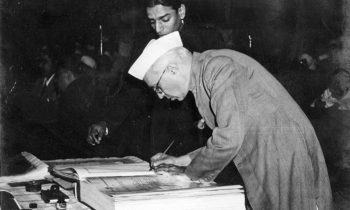 The United States and India, two of the world’s largest and oldest democracies, are both governed on the basis of written constitutions. One of the inspirations for the Constitution of India, drafted between 1947 and 1950, was the US Constitution. Both Indians and Americans revere their ‘constitutional rights’ – especially the ‘fundamental right’ of free speech, and the separation of state and religion. Both countries support critical traditions that focus on particular clauses of the constitution. In India, Article 356, which allows for the suspension of state legislative assemblies to permit ‘direct rule by the centre’, has provoked considerable critique, while in the US, the Second Amendment is a source of perpetual political and legal discord. The Indian and US supreme courts both enjoy the power of judicial review, to declare acts of other branches of government illegitimate, and so a measure of ‘supremacy’ over their respective legislative branches. For this reason, both constitutions are ‘undemocratic’ in their arrogation of too much political power to the judicial bench – a group of unelected public servants.