Bharat Bandh: Why Workers Brought India to a Halt for Two Days in the largest strike in history

Akhil Kumar in The Wire:

Issuing a clarion call against the Modi government, an estimated 200 million workers across various sectors successfully carried out a two-day nationwide strike on January 8-9. They were protesting against the government’s ‘anti-labour’ policies and alleged that the ruling party favours corporates over the interests of the vulnerable working class.

While finance minister Arun Jaitley doesn’t see any ‘real issues’ in the protest and hints at it being the Left’s attempt to stoke ‘symbolic unrest’ to ensure their survival, striking workers assert the Modi government is apathetic towards them.

Alleging arrogance and contempt towards workers, trade union leaders claim the Modi government has been ignoring their 12-point charter of demands that raises issues of unemployment, price rise, minimum wages, pension, increasing contractualisation, disinvestment, universal social security cover, strict compliance with labour laws and FDI. “The Modi government is not interested in even meeting union representatives,” a union leader told The Wire.

More here.
Earth’s magnetic field is acting up and geologists don’t know why

Alexandra Witze in Nature:

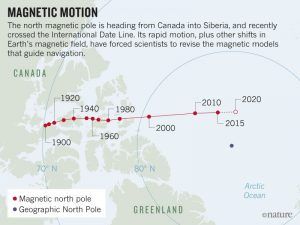
Something strange is going on at the top of the world. Earth’s north magnetic pole has been skittering away from Canada and towards Siberia, driven by liquid iron sloshing within the planet’s core. The magnetic pole is moving so quickly that it has forced the world’s geomagnetism experts into a rare move. On 15 January, they are set to update the World Magnetic Model, which describes the planet’s magnetic field and underlies all modern navigation, from the systems that steer ships at sea to Google Maps on smartphones. The most recent version of the model came out in 2015 and was supposed to last until 2020 — but the magnetic field is changing so rapidly that researchers have to fix the model now. “The error is increasing all the time,” says Arnaud Chulliat, a geomagnetist at the University of Colorado Boulder and the National Oceanic and Atmospheric Administration’s (NOAA’s) National Centers for Environmental Information. The problem lies partly with the moving pole and partly with other shifts deep within the planet. Liquid churning in Earth’s core generates most of the magnetic field, which varies over time as the deep flows change. In 2016, for instance, part of the magnetic field temporarily accelerated deep under northern South America and the eastern Pacific Ocean. Satellites such as the European Space Agency’s Swarm mission tracked the shift.
More here.

Friday Poem

Confessional

I confess to having abused the ordinary details
of personal days, to having used the world less,
the self more, to the womanly flaw of regarding
private hours as the primary province

of knowledge. Dear critic, appalled
by female details, the minutia of a childless
and husbandless bluestocking strewn across
that unspoiled landscape of literature, you are

right to side with Bly, legislate against
the blight of first person pronouns. Dump
those babies in the great pit of poetic dross.
Away with these maudlin cravings, these

not new, even if cleverly disguised contributions
to the egotistical minus the sublime. All those weak
moments when I deferred to the memory
of an actual lover. Then to have covered

it up with the thin dirt of allusion, invoking Keats
or Wordsworth in concert with some man
done gone and left me. I ought to be shot
like the old dog I am, irascible, blind,

given to biting the hand that feeds, guilty
of living on the grim edges, having wished
to be the center of attention. You, dear critic,
and my father, win: I was simply not marriageable.

Read more »

Thursday, January 10, 2019

Her Left Hand, the Darkness

Alison Smith in Granta:

In 1987, my first year in college, I happened upon a notice outside of the English department for a winter session opportunity: escorting a visiting artist during a week-long interdisciplinary conference held at my school, the University of Rochester. I ran my finger down the list of artists’ names until it stopped on one: Ursula K. Le Guin.

At eighteen, I had never met a published author (unless you count the time I stood in line for an hour to have Kurt Vonnegut sign my copy of Slaughterhouse-Five), and this was not any published author, this was Le Guin. I scanned the notice for application information. Applicants were required to write an essay on why they would be a good student guide and to list their preferred artists. The deadline was that day. I sat down in the hallway and scribbled out a plea on the back of the notice. I don’t remember what I wrote, but I am sure I mentioned my worn copy of The Left Hand of Darkness and the first line, which I had memorized. A line that contained a thrilling twist on the nature of reality: ‘I’ll make my report as if I told a story, for I was taught as a child on my homeworld that Truth is a matter of the imagination.’

I slipped the paper under the door – the office had already closed. A week later I received a call from the department secretary. I had been assigned an artist. ‘Who?’ I asked, gripping the receiver. There was a pause. I heard papers shuffling, and then: ‘Ursula K. Le Guin.’

More here.

The Real Problems with Artificial Intelligence

Sabine Hossenfelder in Back Reaction:

In recent years many prominent people have expressed worries about artificial intelligence (AI). Elon Musk thinks it’s the “biggest existential threat.” Stephen Hawking said it could “be the worst event in the history of our civilization.” Steve Wozniak believes that AIs will “get rid of the slow humans to run companies more efficiently,” and Bill Gates, too, put himself in “the camp that is concerned about super intelligence.”

In 2015, the Future of Life Institute formulated an open letter calling for caution and formulating a list of research prioritiesIt was signed by more than 8,000 people.

Such worries are not unfounded. Artificial intelligence, as any new technology, brings risks. While we are far from creating machines even remotely as intelligent as humans, it’s only smart to think about how to handle them sooner rather than later.

However, these worries neglect the more immediate problems that AI will bring.

More here.

Picturing Baghdad: Despite their traumatic history, Iraqis are finding individual and civic solutions to their country’s political failures

Julie David de Lossy at the website of the International Crisis Group:

Iraq has endured decades of sanctions, war, invasion, regime change and dysfunctional government. These span Saddam Hussein’s dictatorship, a devastating eight-year war with Iran in the 1980s and crippling UN sanctions throughout the 1990s. Those difficult years gave way to the traumas of the 2003 U.S.-led invasion and its chaotic aftermath, which brought the insurgents of the Islamic State to the outskirts of the Iraqi capital Baghdad in 2014.
While governments form and collapse behind the blast walls of Baghdad’s Green Zone, life in the rest of the city has grown resilient to the disruptions of politics. Iraqis are finding individual and civic solutions to collective problems that politicians and state are failing to address.

Crisis Group photographer Julie David de Lossy joined our Senior Iraq Adviser Maria Fantappie in the city in October and November 2018. Her images portray a people whose public spaces – main streets, coffee houses and marketplaces – bear the scars of all its upheavals. But they also communicate Iraqis’ ambition to overcome them and capture moments in their search for normalcy against enormous odds.

More here.  [Thanks to Wolf Böwig.]

On money, debt, trust and central banking

Keynote speech by Claudio Borio at the website of the Bank for International Settlements:

Few issues in economics have generated such heated debates as the nature of money and its role in the economy. What is money? How is it related to debt? How does it influence economic activity? The recent mainstream economic literature is an unfortunate exception. Bar a few who have sailed into these waters, money has been allowed to sink by the macroeconomics profession. And with little or no regrets.
Today, I would like to raise it from the seabed. To do so, I will look to an older intellectual tradition in which I grew up. I would thus like to revisit the basics of monetary economics and draw lessons that concern the relationship between money, debt, trust and central banking.

I approach the topic with some trepidation. So much has been written by scholars much better equipped than me, including a number in the audience. Still, I hope to shed some new light on some old questions. A number of the points I will be making are well known and generally accepted; others more speculative and controversial.

My focus will be the on the monetary system, defined technically as money plus the transfer mechanisms to execute payments.2 Logically, it makes little sense to talk about one without the other. But payments have too often been taken for granted in the academic literature, old and new. In the process, we have lost some valuable insights.

Let me highlight three takeaways.

More here.

Victor Klemperer’s dispatches from interwar Germany

Peter E. Gordon in The Nation:

It was slightly more than a century ago, in November 1918, that revolution swept through Germany, bringing chaos to a country that, in the final days of World War I, was already in desperate straits and verging on collapse. Although it was obvious to nearly everyone that the war was lost, the fighting staggered on, even as a growing pacifist movement issued the cry for “Peace, Freedom, Bread!” In Kiel on the Baltic Sea, sailors at the docks refused the order for a last battle and went into open mutiny, while soldiers and revolutionary workers in Berlin called for a general strike. Kaiser Wilhelm II, an absurd and incompetent militarist, at last faced the truth that his time was up and abdicated the throne, leaving confusion in his wake. On November 9, Philipp Scheidemann, a member of the Social Democratic Party of Germany (SDP), seized the moment to declare the founding of a new republic.
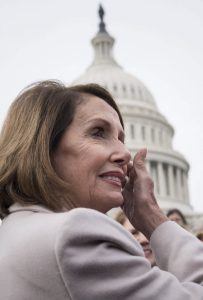
Because of the civil unrest in Berlin, the members of the fledgling government gathered to sign the new constitution in Weimar, a town some 300 kilometers to the southwest best known as the birthplace of German classicism. The Weimar Republic might have marked a peaceful transition—the founding of Germany’s first democracy. But the revolution was not finished. Just two hours after Germany had been declared a republic, Karl Liebknecht, leader of the anti-war Spartacus League, declared the founding of the Free Socialist Republic of Germany, a rival government that drew its strength from below and called for a shift in political power to the workers’ councils, following the model of the Russian soviets. The country lurched from monarchy to democracy not once, but twice.

More here.

The Lobbyists Blocking the Doorway

Thomas B. Edsall in the New York Times:

Speaker Nancy Pelosi and the idealistic class of 64 Democratic House freshmen are armed with a reform agenda.

This includes H.R. 1, a 571-page bill that addresses voting rights, corruption, gerrymandering and campaign finance reform as well as the creation of a Select Committee on the Climate Crisis — a first step toward a “Green New Deal.”

Proponents of this ambitious project face a determined adversary, however — the top ranks of the interest group establishment, skilled in co-opting liberal members of Congress and converting initiatives to square with the interests of corporate America.

The upper stratum of the Washington lobbying community often exercises de facto veto power over the legislative process, dominating congressional policymaking, funneling campaign money to both parties and offering lucrative employment to retiring and defeated members of the House and Senate.

Lobbyists exercise this power across the course of a member’s career. “Whoever is elected is immediately met with a growing lobbying onslaught by the same big players,” write Lee Drutman, a senior fellow at New America, Matt Grossmann, a political scientist at Michigan State and Tim LaPira, a political scientist at James Madison University, who have contributed a chapter to “Can America Govern Itself?” a book edited by Francis Lee and Nolan McCarty that is coming out in June.

More here.

Thursday Poem

we have always been

Frenzy deep down, quiet on the out, we were tangle,
caught between woman and man, impossibility and lack,

no gender a tongue knew name, the richness of body
plundered by language, left aching for touch and a place

at the human table. Hysterical, i’d obsess over lip smear,
panic and pull at my hair. But you natured within, lifted

our skin and found the bones holding, gauzy, gossamer,
fanned tender with air, also liver, fascia, spleen, our

heart. Sweet Tangle, i felt you, yet deceived myself
they are nothing, a newborn ghost crawling away where

slur shame and knuckles couldn’t knock. Haunted boy,
some lives come full stop, sputter, jump, dress and go.

We don’t have to tear self apart. Even gender can
change. This isn’t quite a eulogy, you won’t mourn this

body, but lay it down for the other, tap soil, gnaw roots,
swallow jade and shadow your eyes. Intuit our body,

geologic, history pre and post. See them fissure. Watch us
rupture. Understand us, together, if the world allows.


Let me love you the way you loved me, held me when
i sought bourbon erase, against every blade of glass

i could turn back on myself, the flint sparked to burn this
house to cinder, to unintelligible bone. i want us together,

like we’ve always been, mystic and rare as Datura blooming
along Brooklyn sidewalks pocked and cracked, damp earth,

city sweat, bus fumes, rose water, gates ajar, palimpsest.
i want us in sunlight, ready to wash the sky clean.

by Xtian W
from Pank Magazine
13.1 / Spring / Summer 2018


Debussy’s Radical Search for Simplicity

Jack Segelstein in The Atlantic:

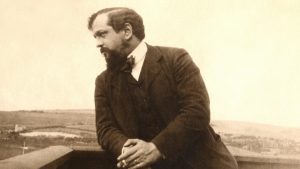
Claude Debussy (1862-1918), French composer born in Saint-Germain-en-Laye. Here spending vacation in Pourville-sur-Mer (Normandy, France). In august 1904. (Photo by adoc-photos/Corbis via Getty Images)

In 1889, Achille-Claude Debussy, then in his mid-20s, was one of 30 million people to walk through the iron arches of the newly completed Eiffel Tower. Throughout that year, the arches served as the grand entryway to the Exposition Universelle, a world’s fair celebrating the cultural, technological, and colonial prowess of France a century after the revolution. A stunning variety of sights greeted visitors: a sharpshooting Annie Oakley, some 16,000 ultramodern machines (housed in the largest indoor space ever constructed), and, of course, the Eiffel Tower itself, the world’s tallest and possibly most bizarre building at the time. But Debussy seems to have been most impressed by something he heard—the work of musicians from what was then French Indochina and is now Vietnam. More than 20 years later, he raved about the opera they performed, in which “a furious little clarinet directs the emotion, a gong organizes the terror … and that’s all! … Nothing but an instinctive need for art, needing ingenuity to satisfy; no hint of bad taste!”

As Stephen Walsh shows in Debussy: A Painter in Sound—published in 2018, 100 years after the composer’s death—Debussy craved this simplicity and directness, but he had trouble finding it in his own musical milieu. He admired older French music—its “clarity of expression, that precision and compactness of form”—but felt it had been corrupted by German influences. French color, lightness, and concision were at odds with the drama, severity, and burdensome forms of Bach, Beethoven, and, most recently, Richard Wagner.

More here.

Researchers redesign a cancer-busting protein—without the side effects

Robert F. Service in Science:

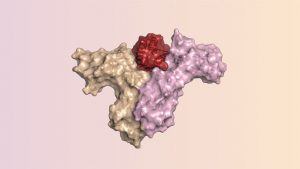
For patients with aggressive kidney and skin cancers, an immune-boosting protein called interleukin-2 (IL-2) can be a lifesaver. But the dose at which it fights cancer can also produce life-threatening side effects. Now, scientists have used computer modeling to design a new protein from scratch that mimics IL-2’s immune-enhancing abilities, while avoiding its dangerous side effects. The protein has so far been tested only in animals, but it may soon enter human trials. IL-2 plays a key role in directing the body’s immune response to outside invaders. The protein, a signaling molecule called a cytokine, ramps up the activity of white blood cells known as T lymphocytes by binding simultaneously to their IL-2β and IL-2γ receptors. In cells where a third type of receptor, IL-2α, is present, IL-2 binds collectively to all three. In other white blood cells, this dampens the body’s immune response. But it can also occur in cells in blood vessels, causing those vessels to leak, a potentially deadly condition.
“People have tried for 30 years to alter IL-2 to make it safer and more effective,” says Daniel Adriano Silva Manzano, a biochemist at the University of Washington (UW) in Seattle and first author of the new study. But IL-2 is unstable and stops working when it loses its normal 3D shape, and many mutations destabilize the structure further, Silva Manzano says.

To do better, Silva Manzano teamed up with lab director David Baker, a protein designer at UW, and colleagues in the United States, Portugal, Spain, and the United Kingdom, to remake IL-2 from scratch. They started by studying atomic maps of IL-2 interacting with the desirable β and γ receptors, as well as the undesirable α receptor. IL-2 is a single long chain of amino acids. When it folds up into its active 3D shape, it forms four segments that twist into spirals called alpha helixes that are held together by a series of loops that tie them together in a bundle. At the bottom of this bundle of helixes are two sites that bind to the β and γ receptors. Meanwhile, portions of one of the helixes and two loops at the top of the protein bind to α receptors. Baker, Silva, and their colleagues programmed protein-design software Baker had developed, called Rosetta, to maintain the needed interactions with the β and γ receptors but eliminate the portion that binds to α receptors. Rosetta produced 40 options. After analyzing them, the team synthesized and tested 22, tweaking the best to improve the designer protein’s stability and its effectiveness at binding the desired receptors. Finally, the researchers settled on a version they dubbed Neo-2/15, which shares only 14% of its amino acid sequence with IL-2. Lab studies revealed it bound tightly to β and γ receptors, but not to α receptors. In mouse models of colon cancer and melanoma, the compound reduced side effects associated with α receptors, strongly inhibited tumor growth, and even eliminated tumors in a handful of animals. Regular IL-2 given to other mice didn’t do the latter, they report today in Nature.

More here.

Wednesday, January 9, 2019

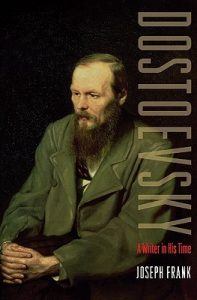
On Fidelity: A Review of “Dostoevsky: A Writer in His Time” By Joseph Frank

Claudia Verhoeven in Taxis:

The testament Dostoevsky left his children was the parable of the Prodigal Son. He asked that it be read to them the night of the day he knew would be his last, and the late, great Joseph Frank judged that Dostoevsky had probably understood the whole of his life and all of his literature as having existed under the sign of this tale of “transgression, forgiveness, and redemption.”
Anyone who loves Dostoevsky but not the effects of Dostoevshchina — the anger, annoyance, and nausea that come from overexposure to Dostoevsky’s God-peddling, Russo-mania, and digging in the dirt — that sentence will stab straight through the heart. Nine hundred pages into Frank’s Dostoevsky: A Writer in His Time (Princeton University Press, 2009), Dostoevsky suddenly stands there transformed, not absolved of his sins exactly, but somehow free from Dostoevshchina. He stands there as a man, as a father, as a false prophet but a true believer, and above all as an author — and at that moment, you may freely renew your oath of allegiance to his artistic vision of unconditional love, however short of its fulfillment he himself so often fell.

It works in just the same way, in fact, as those moments in Dostoevsky’s texts that can lift even his most hostile readers into believing things forever foresworn. Take Dmitry Pisarev. Of all the literary critics belonging to the so-called “nihilist” camp in Alexander II’s reform-era Russia, this twenty-something was the most caustic and consequential. It was primarily Pisarev’s utilitarian logic that Dostoevsky had stuffed into Raskolnikov’s monomaniacal brain in order to prove that the “rational egoism” of the young generation could only end in cold-blooded murder. And apparently, when this very Pisarev got his hands on Crime and Punishment, he cried.

More here.

The real crisis is that Trump has no idea what he’s doing

Matthew Yglesias in Vox:

Donald Trump campaigned on the absurd lie that the United States could construct a large concrete wall across the entire US-Mexico border and coerce the Mexican government into paying for its construction. The government is currently shut down because Trump refuses to admit that his absurd lie was, in fact, an absurd lie.

Since he won’t own up to it, lie has begun to pile upon lie like a sitcom farce, to the point where Trump on Tuesday night delivered an address on the subject of an entirely fake “crisis” at the southern border. The crisis, supposedly, is the reason that we not only need a wall but need it so badly that it’s worth shutting down the government to get one.

It’s an absurd situation only heightened by the larger absurdity that the fundamentals of Trump-era America are good. Unemployment is low and the economy is growing. Unauthorized immigration is low. Funds are flowing to further enhance border security, and a halfway competent president would be able to secure more without much muss or fuss. But Donald Trump doesn’t do anything without muss or fuss.

More here.

Piketty’s World Inequality Review: A Critical Analysis

James K. Galbraith at the Institute for New Economic Thinking:

Thomas Piketty and his colleagues[1] have produced a new exposition of their empirical work, entitled the World Inequality Report 2018 (hereafter: WIR). Their purpose is to showcase the exploration of income and wealth inequalities begun with the World Top Incomes Database (Atkinson and Piketty 2010) and theorized in Piketty’s epic Capital in the XXI Century (2014). In particular the WIR concentrates on the presentation of measures and evidence; the stated goal is to inform a “deliberative process” with “more rigorous and transparent information on income and wealth” than has been available to date. In a review article published on-line and open access in Development and Change on December 24, 2018, I initiate this “deliberative process” by examining the WIR data and the claims made for it.

The ground-breaking, systematic and transparent methodology on which the WIR rests is largely the use of tax records–specifically income tax records–mined to show the income shares of tranches of the income-earning population: top one percent, top ten percent, next forty percent, and bottom fifty percent are the usual divisions. These Piketty and his colleagues argue are more complete, comprehensive, and comparable across countries and through time than the generally-used alternative, which is household or person-based surveys.

More here.

What is Neoliberalism and What Comes After It?

Max Harris:

Neoliberalism is a word that can be used a little sloppily, and sometimes as a general cuss-word for policies or practices that are disliked, especially by those on the Left. But just because it is not always used rigorously does not mean it doesn’t exist.

Milton Friedman himself used the word neoliberalism, in a 1951 essay called ‘Neoliberalism and Its Prospects’. In that essay, Friedman argued that it takes twenty years for there to be “a change in the underlying current of opinion and the resultant alteration in public policy.” Friedman claimed that while elections could create a “difference of degree” and an “opportunity to begin a drift in a new direction”, “the direction this drift takes will be determined not by the day-to-day shifts in political power or the slogans of the parties or even their platforms but by the underlying current of opinion which may be already … determining a new direction for the future.” Friedman noted that he sensed the start of a move away from collectivism in 1951. “The stage is set for the growth of a new current of opinion to replace the old,” wrote Friedman, “to provide the philosophy that will guide the legislators of the next generation even though it can hardly affect those of this one.” Friedman said the problem with collectivism was its means, not its ends; in particular, its belief “in the ability of direct action by the state to remedy all evils”. He talked of the need for “a new faith”, which would put “a severe limitation on the power of the state to interfere” with individuals (while recognizing that the State can do some things well).

More here.

Lose yourself in this highly addictive “murder map” of medieval London

Jennifer Ouellette in Ars Technica:

In July of 1316, a priest with a hankering for fresh apples sneaked into a walled garden in the Cripplegate area of London to help himself to the fruits therein. The gardener caught him in the act, and the priest brutally stabbed him to death with a knife—hardly godly behavior, but this was the Middle Ages. A religious occupation was no guarantee of moral standing.

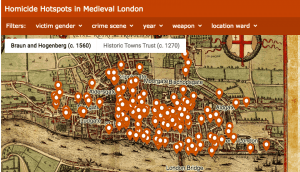
That’s just one of the true-crime gems to be found in a new interactive digital “murder map” of London compiled by University of Cambridge criminologist Manuel Eisner. Drawing on data catalogued in the city Coroners’ Rolls, the map shows the approximate location of 142 homicide cases in late medieval London. The map launched to the public in late November on the website for the university’s Violence Research Center, and be forewarned—it’s extremely addictive. You could easily lose yourself down the rabbit hole of medieval murder for hours, filtering the killings by year, choice of weapon, and location. (It works best with Google Chrome.)

“The events described in the Coroners’ Rolls show weapons were never very far away, male honor had to be protected, and conflicts easily got out of hand,” said Eisner, who embarked on the project to create an accessible resource for the public to explore the historical records. “They give us a detailed picture of how homicide was embedded in the rhythms of urban medieval life.”

More here.

Wednesday Poem

Poem That Walks From Fact to Wish

I was a skinhead

in look and seem, a balding guy trying out the future
with a shaved head while wearing blue jeans and a white T
and grinding up one of Seattle’s more Everesty hills,
when I was met by the real deal cruising the other way,

five shit-kickered dudes inked in swastikas
and Nazi daggers dripping blood, who nodded deep,
like dipping a bucket in a well, marking me as a brother
in hate, and passed before I could confess my lack of tats
and love of a Mexican Jew, I mean a kikey spic, I mean
there’s never time to get scientific and mushy
on guys trying to act the part of death,
to do what all good parents teach their tots to do
when meeting lives this unmoored, this lost at sea—
you whip out the statistical work of Joseph Chang:

“Our findings suggest a remarkable proposition:
no matter the languages we speak or the color
of our skin, we share ancestors who planted rice
on the banks of the Yangtze, who first domesticated horses
on the steppes of the Ukraine, who hunted giant sloths
in the forests of North and South America,
and who labored to build the Great Pyramid of Khufu.”

I promised myself that next time I’d be Johnny-on-the-spot
with the intellectual nunchucks, that I’d ease their longing
for a homeland by telling them we’ve all got a home
in Africa, where every soul currently huffing and puffing
got its ancient start, and that white isn’t a race,
a cutting apart, so much as an adaptation,
the process of learning to get along
with snow, I would I would I would I would I would I would

I brainchanted to myself while powering up the hill
and channeling the French, who so hiply invented éclairs,
and Paris, and l’esprit de l’escalier, or staircase wit,
when the right thing to say zooms to mind
as you’re walking away and have time to edit the past
to redress your failure to be brilliant, or in this case,
as in most cases, kind.

by Bob Hicock
from
Hold
Copper Canyon Press, 2018