
Category: Recommended Reading
The American Beef Industry and Exploitation
Alicia Kennedy at The Baffler:
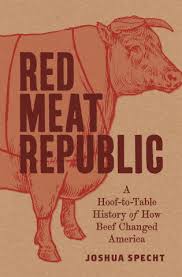 Impossible Foods seems to have created heme out of a belief that it’s the visual stimulation of blood oozing from a burger that gives it an addictive taste. What Specht’s book reveals about beef, though, is that its extraordinary success has always had little to do with its taste and everything to do with its ubiquity, increasing cheapness, and cultural status. Red Meat Republic doesn’t bring the reader up to date with innovations in plant-based beef, but it doesn’t have to. By laying down the political and economic history of beef production and culture in the United States, he demonstrates why the tech-meat industry isn’t spending time, money, or marketing dollars on chicken and goat.
Beef is more American than fried chicken, apple pie, and turkey on Thanksgiving. And it has always been political, as Specht chronicles.
more here.
A Portrait of Lebanon
Dominique Eddé at the NYRB:

Beirut—Lebanon is both the center of the world and a dead end. The broken little village of a planet that is sick. Chaotic, polluted, and corrupt beyond belief, this is a country where beauty and human warmth constantly find ways to break through. It is impossible to name that feeling of being assaulted and charmed at the same time. You are in the city center, you stroll down a sidewalk eighteen inches wide, assailed from all sides by the confusion of buildings and traffic, torn between the appeal of the sea and the stench of garbage, and suddenly your gaze is soothed by the play of light on a stone wall, by bougainvilleas cascading from an ancient balcony, by the balcony itself.
You continue on your way, head down. Refugee children’s eyes beg you for something to eat, your impatience gives way to sadness and guilt. You hurry into a shop to buy some reels of yarn, and it’s the beginning of a journey.
more here.
Alice Oswald’s Latest Collection of Poems
Leaf Arbuthnot at the TLS:
 Formally, aesthetically, “Tithonus” is a remarkable work. But it is made even more remarkable by its language. Trapped in his decaying body as day knits itself around him, Tithonus notices all. At first, the “bleak shapes of last efforts of / the night”. A little later, “bodiless black lace woods” peopled with songbirds asking one another “is it light is it light”. Later still the “whisper of a grasshopper scraping / back and forth as if working at rust”. The features of dawn concatenate and though Tithonus has seen them all before (and will see them all again), he cannot help but testify to the beauty of breaking day, with its “peach-pale air” and its rustling solitudes. At one point, a lone snail “pokes out of sleep too feelingly / as if a heart had been tinned and / opened”. It is a weird image, ghoulish and frightful, but a moving one.
The two major themes that fill the “pipe-work” – in a phrase from the first poem here – of Falling Awake are classical subjects and nature. Without the buttress of a private or grammar school education readers would not necessarily know who Tithonus is or what resonance the River Hebron has (it features in the superb “Severed Head Floating Downriver”, about Orpheus being torn to pieces by Maenads).
more here.
Analytics-enabled, individualized attention will not just treat disease, but increasingly, prevent it
Daniel Kraft in Nautilus:
 The innovations I describe here—many of which are still in early stages—are impressive in their own right. But I also appreciate them for enabling the shift away from our traditional compartmentalized health care toward a model of “connected health.” We have the opportunity now to connect the dots—to move beyond institutions delivering episodic and reactive care, primarily after disease has developed, into an era of continuous and proactive care designed to get ahead of disease. Think of it: ever present, analytics-enabled, real-time, individualized attention to our health and well-being. Not just to treat disease, but increasingly, to prevent it.
Just a decade after the first Fitbit launched the “wearables” revolution, health tracking devices are ubiquitous. Most are used to measure and document fitness activities. In the future these sensing technologies will be central to disease prevention, diagnosis, and therapy. They’ll measure health objectively, detect changes that may indicate a developing condition, and relay patients’ data to their clinicians. Flexible, electronic medical tattoos and stick-on sensors can take an electrocardiogram, measure respiratory rate, check blood sugar, and transmit results seamlessly via Bluetooth. It’s mobile vital sign tracking, but at a level once found only in an intensive care unit. Hearing aids or earbuds with embedded sensors will not only amplify sound but also track heart rate and movement. Such smart earpieces also could be integrated with a digital coach to cheer on a runner, or a guide to lend assistance to dementia patients. Smart contact lenses in the future will be packed with thousands of biosensors, and engineered to pick up early indicators of cancer and other conditions. Lenses now in development may someday measure blood sugar values in tears, to help diabetics manage diet and medications.
More here.
Wednesday, June 19, 2019
Siegfried’s Bloodline
Antonio Muñoz Molina at The Hudson Review:
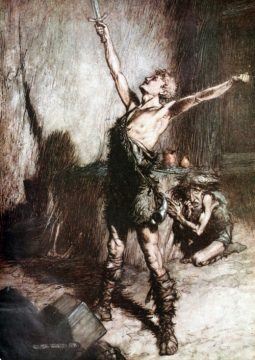 Music can have a decisive influence in a person’s life and in a nation’s history. Were it not for a brief passage in the second volume of Ian Kershaw’s biography of Hitler, I would never have learned of the direct connection between Wagner’s Siegfried and the first crucial victory of Franco’s army during the uprising that set off the Spanish Civil War. On July 25, 1936, as Kershaw recounts, Adolf Hitler attended a production of Siegfried in Bayreuth, which brought him to the state of exaltation that Wagner’s music had always caused in him from early youth. From the age of 17, to be precise, when he first heard Rienzi in Linz—as August Kubizek, friend, countryman and companion during his early years in his native city and then in Vienna, would reverently record years later. On that day in 1906, a young Hitler left the opera house in a fevered state of musical and patriotic excitement, rapt in a sense of kinship with the figure of the Roman tribune who in the fourteenth century tried to revive the glories of imperial Rome, only to meet, in Wagner’s opera, an heroic, glorious end at the hands of his betrayers. In June of 1936, exactly thirty years later, Hitler’s deranged dream was being fulfilled.
more here.
Ten contributors reflect on the continuing relevance — or irrelevance — of postmodernism to the academy and the larger culture
From the Chronicle of Higher Education:
Justin E.H. Smith: All things come to an end, not least the coming-to-an-end of things. And so it had to be with the end of modernism, and the couple of decades of reflection and debate on what was to come next. For me, postmodernism is the copy of Jean-François Lyotard’s The Postmodern Condition, which I bought in English translation in 1993. It’s sitting in a cardboard box, its pages slowly yellowing and its cover design receding into something recognizably vintage, in my old mother’s suburban California garage. I stowed it there when I moved to Paris, in 2013. And in the past six years I have seen only fossil traces of the old beast said to have roamed here in earlier times, eating up grand narratives and truth claims like they were nests full of unprotected eggs.
A few living fossils, coelacanth-like, survived from French philosophy’s âge d’or and could still fill lecture halls. But the survivors were mostly known for their non-representativity, in part because they loudly proclaimed it. Alain Badiou, for example, talked about the transcendental forms of love and beauty. Bruno Latour, not long after 2001, began regretting what his own brand of truth-wariness had done to stoke the “truther” conspiracy theories that had quickly spread to the villagers who worked his family’s vineyards, in Bourgogne.
More here.
On Yukio Mishima’s “Star”
Jan Wilm at the LARB:
 IT SEEMS BOTH the great comedy and the great tragedy of Yukio Mishima’s life that hardly any of his work’s plots live up to his death. While anything but a wallflower, Mishima didn’t have the topsy-turvy life of a Daniel Defoe or a Herman Melville — he was neither jailed and pilloried nor on the hunt for roly-poly whales. But when it comes to spectacular deaths among the writers of the world, Mishima is top tier.
The story goes that he didn’t wait for the ink to dry on his final entry in his Sea of Fertility tetralogy, The Decay of the Angel(published posthumously in 1971), until he made plans for his suicide, in public and full view of the world, when he killed himself after a failed putsch that might never have been wholly political and always a private death masquerading as a public spectacle.
more here.
Why We’re Still Looking for Lorraine Hansberry
Daniel A. Jackson at The Point:
 When Lorraine Vivian Hansberry died on January 12, 1965, her play The Sign in Sidney Brustein’s Window was at the end of a three-month run at Broadway’s Longacre Theatre. It was the second play written by a black woman to appear on Broadway. The first was her groundbreaking drama A Raisin in the Sun. Ntozake Shange’s for colored girls who have considered suicide when the rainbow is enuf, the third, opened in 1976. Remembrances of Shange published last year, after her death, called for colored girls “the second play by an African American woman” to have a Broadway run. In writing my own remembrance of Shange, I nearly made the same mistake. We are prone to myopia when we remember, and it can make inconvenient details difficult to decipher. Jewell Handy Gresham-Nemiroff, in charge of Hansberry’s estate for fourteen years, wrote that Hansberry is “not really credited, to the extent deserved, with being Mother of the modern black drama.” The scholar Margaret Wilkerson called Hansberry one of the “major literary catalysts” of the Black Arts Movement. Both are true, yet The Sign in Sidney Brustein’s Window, which Hansberry worked on feverishly during hospital stays at the end of her life, is not a black drama.
more here.
A 53-Year-Old Network Coloring Conjecture Is Disproved
Erica Klarreich in Quanta:
 A paper posted online last month has disproved a 53-year-old conjecture about the best way to assign colors to the nodes of a network. The paper shows, in a mere three pages, that there are better ways to color certain networks than many mathematicians had supposed possible.
Network coloring problems, which were inspired by the question of how to color maps so that adjoining countries are different colors, have been a focus of study among mathematicians for nearly 200 years. The goal is to figure out how to color the nodes of some network (or graph, as mathematicians call them) so that no two connected nodes share the same color. Depending on the context, such a coloring can provide an effective way to seat guests at a wedding, schedule factory tasks for different time slots, or even solve a sudoku puzzle.
Graph coloring problems tend to be simple to state, but they are often enormously hard to solve. Even the question that launched the field — Do four colors suffice to color any map? — took more than a century to answer (the answer is yes, in case you were wondering).
More here.
What Orville Wright can teach us about solving our clean energy problem
William Budinger in Democracy:
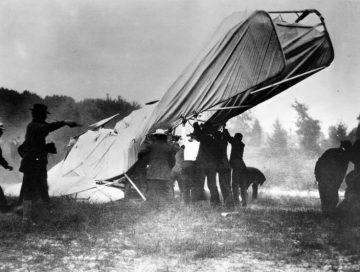 Thinking about the risk-reward of air travel can help us think about how to solve the most perplexing problem of our time—the clean energy dilemma. All the known solutions to producing clean power have risks. So how do we evaluate the risk/reward of each possibility? How do we decide which ones to pursue? Being human, our evaluation of risk is hampered by our tendency to focus on the sensational single event instead of the broader picture. When looking at accidents or “disasters,” we also tend to ignore the reward we were getting from whatever it was that failed. For example, if one were to focus only on crashes, deaths, and disasters, we would quickly conclude that air travel is deadly and must be seriously curtailed. Yet in spite of the danger, people clearly think the reward of air travel is worth taking the risk. Moreover, if one steps back, looks at the full picture, and evaluates the danger of air travel compared to other methods, it becomes clear that putting a halt to air travel would result in more, not fewer, deaths. The relative risk of air travel is lower than other travel options.
The various options available to clean up our energy emissions must be similarly evaluated. In terms of risk, any and all of the commonly available options for generating clean electricity are much less dangerous than the climate disaster we’ll face if we fail to reverse global warming. To effectively tackle climate change, all serious experts agree that we must get as close to zero carbon as possible, and do so as quickly as possible. So our selection standard should be which technologies, when considered in view of their rewards, will get us there fastest with no more risk than is manageable. The good news is that all of the available low-carbon options—all of them—have risk levels much lower than those we tolerate daily with our existing fossil plants, chemical plants, refineries, and even airplanes.
More here.
Joy Harjo Becomes The First Native American U.S. Poet Laureate
Lynn Neary and Patrick Jarenwattananon at NPR:
 Poet, writer and musician Joy Harjo — a member of the Muscogee Creek Nation — often draws on Native American stories, languages and myths. But she says that she’s not self-consciously trying to bring that material into her work. If anything, it’s the other way around.
“I think the culture is bringing me into it with poetry — that it’s part of me,” Harjo says in an interview with NPR’s Lynn Neary. “I don’t think about it … And so it doesn’t necessarily become a self-conscious thing — it’s just there … When you grow up as a person in your culture, you have your culture and you’re in it, but you’re also in this American culture, and that’s another layer.”
Harjo, 68, will represent both her Indigenous culture and those of the United States of America when she succeeds Tracy K. Smith as the country’s 23rd poet laureate consultant in poetry (that’s the official title) this fall.
More here.
Conversations with the Pioneers of Evolutionary Biology: Bobbi Low
What Makes Us Better: Two books explore whether morality is innate or learned
Sissela Bok in The American Scholar:
Conscience: The Origins of Moral Intuition by Patricia S. Churchland
The War For Kindness: Building Empathy in a Fractured World by Jamil Zaki
 These two new books give lucid, stimulating accounts of recent discoveries in neuroscience and psychology. Both authors aim to challenge antiquated views of the brain and human behavior. In so doing, they help us think through perennial debates about the sources of morality and the degree to which we inherit or can enhance traits like empathy. Both are careful to evaluate the cogency of the research they cite, noting when it remains inconclusive or unpersuasive. Jamil Zaki, a professor of psychology at Stanford, who also directs its Social Neuroscience Laboratory, usefully includes an appendix summarizing the evidence for the findings he cites and giving them a 1 to 5 rating, from weaker to stronger. Oddly, however, neither book mentions, much less rates, possible moral problems with some of the research, whether by neuroscientists injecting substances into the brains of rats or monkeys or by social scientists subjecting students to deceptive scenarios.
Early on, Churchland, professor emerita of philosophy at the University of California–San Diego, sets forth a working formulation of conscience as “an individual’s judgment about what is morally right or wrong, typically, but not always, reflecting some standard of a group to which the individual feels attached.” Later, she states that conscience “is a brain construct rooted in our neural circuitry, not a theological entity thoughtfully parked in us by a divine being.” The intervening chapters show in fascinating detail the path leading from the first to the second formulation. They explain the role of the cortex for mammals, culminating in the unusually large one of humans, and argue that an attachment to mothers—and in some cases to fathers, kin, and friends—is fundamental to social behavior and in turn to moral behavior. Human moral responses are therefore rooted in the cortex, supported by more ancient structures, such as basal ganglia and neurochemicals such as dopamine, sex hormones, and the neurohormones of oxytocin and vasopressin. Studies show how these factors combine, specifying their different roles, as for oxytocin in strengthening social bonds. When it comes to psychopaths, however—people with no moral compass who lack feelings of guilt or remorse and exhibit no empathy toward people they have injured—it has, so far, proved harder to locate specific brain abnormalities. The same is true of persons exhibiting self-destructive moral behavior, known as scrupulosity.
More here.
Why Humans Are The Most Irrational Animals
Bence Nanay in iai:
 It is easy to make fun of the Aristotelian idea that humans are rational animals. In fact, a bit too easy. Just look at the politicians we elect. Not so rational. Or look at all the well-demonstrated biases of decision-making, from confirmation bias to availability bias. Thinking of humans as deeply irrational has an illustrious history, from Francis Bacon through Nietzsche to Oscar Wilde, who, as so often, came up with the bon mot that sums it all up: “Man is a rational animal who always loses his temper when he is called upon to act in accordance with the dictates of reason.”
My aim is to argue that humans are, in fact, not more rational, but less rational than other animals. Aristotle talked about rationality as the distinguishing feature of humans compared to other animals. I think we can use irrationality as a distinguishing feature. It’s not just that humans are irrational animals; humans are more irrational than any other animals. This is not a completely new line either, although the point has often been made merely as a provocative overstatement. In fact, according to the standard account of biases, irrationality (in the guise of biases) is explained by simpler cognitive mechanisms taking over. And these simpler mechanisms are exactly the ones we share with animals. So if human irrationality is explained by animal cognitive mechanisms, then humans will not come out as less rational than animals.
I have a different argument, one that focuses on the importance of imagination in our mental life. I argued here and here that imagination plays a crucial role in making most of our important decisions. Think back to some of the big decisions you have made over the years. Break up with your partner or not? Which college to choose? Go to grad school or not? Which job offer to take? Which house to bid on? And so on. My guess is that you made all of these decisions by imagining yourself in one of the two situations and then imagining yourself in the other and then comparing the two.
More here.
Wednesday Poem
Muir Song
—from the writings of John Muir
The sun shines not on us but in us. The rivers flow not past, but through us, thrilling, tingling, vibrating every fiber and cell of the substance of our bodies, making them glide and sing. The trees wave and the flowers bloom in our bodies as well as our souls…
We are now in the mountains and they are in us, kindling enthusiasm, making every nerve quiver, filling every pore and cell of us. …thrilling with the air and trees, streams and rocks, in the waves of the sun,—a part of all nature, neither old nor young, sick nor well, but immortal.
…and every bird song, wind song, and tremendous storm song of the rocks in the heart of the mountains is our song, our very own, and sings our love
Muir Song from Janssen Powers on Vimeo.
Tuesday, June 18, 2019
A Republic of Discussion: Habermas at ninety
Raymond Geuss in The Point:
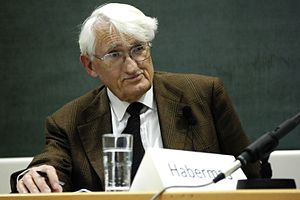 Is “discussion” really so wonderful? Does “communication” actually exist? What if I were to deny that it does?
The public discussion of exit from the European Union has already caused incalculable, probably irreversible and completely superfluous damage to Britain. Obviously, the “conditions of discussion” before the vote were not in any way “ideal.” There is no need to belabor that, but one should also recall that ten years ago no one, except a handful of fanatics, had any real interest in discussing relations with the EU; they were not on the table, and nothing was any the worse for that. It is only the discussion of the last four years, stoked by a few newspaper owners (many of them not domiciled in the U.K. at all), a small group of wealthy leftover Thatcherites and some opportunistic political chancers, that generated any interest in the subject at all. Dyed-in-the-wool Europhobes didn’t constitute more than 10 percent of the population. It was only the process of public discussion that permitted that hard-core to create conditions in which another 10 percent of the population articulated what was previously a merely latent mild discontent of the kind any population will be likely to have with any political regime, and express it as skepticism toward the Union. A number of further, highly contingent historical factors caused another 17 percent of the population to join the vote for Brexit. The most important of these factors was the ability of the Brexiteers to convince people (falsely) that harms they had in fact suffered at the hands of politicians in Westminster were actually the direct result of action by bureaucrats in Brussels. Structural features of the archaic and rather ridiculous first-past-the-post electoral system transformed the vote of 37 percent of the electorate into a politically effective, and constantly cited, 52 percent of votes cast (in one single election), and that has now been treated as the Irresistible Voice of the People for three years.
More here.
Sean Carroll’s Mindscape Podcast: Anthony Aguirre on Cosmology, Zen, Entropy, and Information
Sean Carroll in Preposterous Universe:
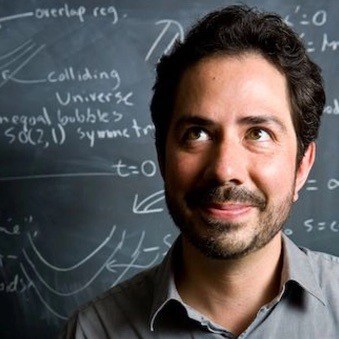 Cosmologists have a standard set of puzzles they think about: the nature of dark matter and dark energy, whether there was a period of inflation, the evolution of structure, and so on. But there are also even deeper questions, having to do with why there is a universe at all, and why the early universe had low entropy, that most working cosmologists don’t address. Today’s guest, Anthony Aguirre, is an exception. We talk about these deep issues, and how tackling them might lead to a very different way of thinking about our universe. At the end there’s an entertaining detour into AI and existential risk.
More here.
Putting the Political Back in Politically Correct
Jonny Thakkar in the Chronicle of Higher Education:
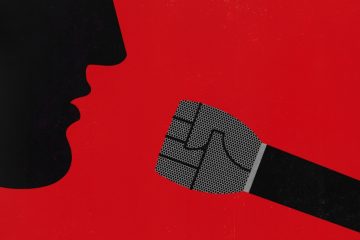 Debates about political correctness on college campuses can be extremely frustrating. On one side you have those, like New York magazine’s Jonathan Chait, who claim to detect “a system of left-wing ideological repression” that operates both within the academy and beyond. On the other you have those, like Moira Weigel, in The Guardian, for whom “PC was a useful invention for the Republican right,” “a phantom enemy” that allowed it to scare voters, rebrand racism, and defund universities. The gap between those views is so large that each side seems bound to accuse the other of bad faith — not least since the one thing they agree on is that the future of higher education is at stake. In the face of such disagreement, the way forward is to take a step back. We must think philosophically — by defining terms, breaking down arguments, and interpreting others charitably while questioning ourselves.
A lot depends on what we mean by political correctness. Chait thinks of it as a whole “style of politics” that is intolerant of dissent and obsessed with identity. That analysis packs in too much, threatening to turn political correctness into a floating signifier whose real referent is “stuff that annoys me.”
More here.
“Irrationality: A History of the Dark Side of Reason” with Justin Smith
Wasim Akhtar at Bridging the Gaps:
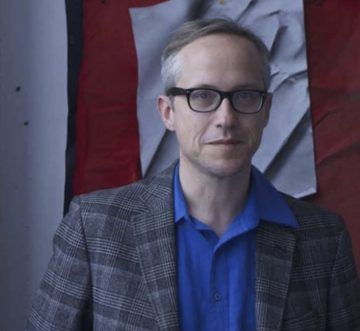 In his new book, “Irrationality: A History of the Dark Side of Reason” philosopher Justin Smith presents a fascinating narrative that reveals the ways in which the pursuit of rationality often leads to an explosion of irrationality. Smith, a professor of the history and philosophy of science at the University of Paris, acknowledges that we are living in an era when nothing seems to make sense. Populism is on the rise, pseudoscience is still around and there is no shortage of of conspiracy theories. Smith discusses the core of the problem that the rational gives birth to the irrational and vice versa in an endless cycle, and any effort to permanently set things in order sooner or later ends in an explosion of unreason.
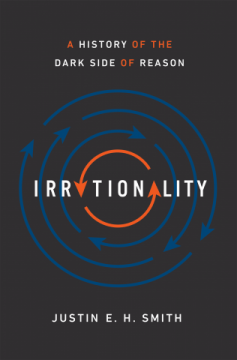 He notes that despite the fact logic and reason are well understood, methods and practises that were supposed to have been setup to counter irrationality, ended up mired in the very problem that they were meant to solve, and that is irrationality.
“Irrationality: A History of the Dark Side of Reason” is rich and ambitious and ranges across philosophy, politics and current events. It challenges conventional thinking about logic, natural reason, dreams, art and science, pseudoscience, the Enlightenment, the internet, jokes and lies and death and shows how history reveals that any triumph of reason is temporary and reversible, and that rational schemes often result in their polar opposite. Smith argues that it is irrational to try to eliminate irrationality and describes irrationality an ineradicable feature of life. It has been an absolute pleasure speaking with Professor Justin Smith in this episode of Bridging the Gaps. This has been a fascinating conversation.
More here.