
Marcel Theroux in The Guardian:
 By a strange twist of fate, I read this book while on a visit to the Falkland Islands, where the British victory over Argentina in the 1982 war feels as though it might have happened last week. Outside Port Stanley, on treeless uplands whose names ring distant bells – Goose Green, Mount Harriet, Tumbledown – the conflict is still unofficially memorialised by chunks of crashed war planes and the wires of field telephones from a pre-digital age. Machines Like Me, Ian McEwan’s new novel, also turns in part on the Falklands conflict, eternalising a version of that year’s events, though in the book’s fictional world things have turned out rather differently.
In the 1982 of the novel, the British navy sails from Portsmouth with calamitous results. A devastating Argentinian attack ends the war abruptly and the Falklands become Las Malvinas. The humiliation of defeat forces Margaret Thatcher from office, brings a very different politician to power, and triggers the country’s unexpected departure from Europe. This political and social upheaval feels like both reminiscence and prophecy. The counterfactual 1982 of the novel plays variations on our historical record and contains clear allusions to the present. “Only the Third Reich and other tyrannies decided policies by plebiscites and generally no good came from them,” the narrator reminds the inhabitants of post-referendum Britain.
…Machines Like Me belongs to the genre of speculative fiction, but in its narrow focus on morally ambiguous characters in a bleak cityscape it also owes a debt to film noir, sharing noir’s conviction that nothing is more human than moral inconsistency.
More here.
 The
The  Thomas J. Sugrue (TJS): I began as an economic determinist. That is, I wanted to write about work and housing, but I hypothesized that work, labor, and industry were the driving factors in the transformation of Detroit and other cities like it. Housing and the city’s neighborhood racial politics would follow. When I began doing my research, it very quickly became clear to me that drawing an artificial line between race and class or between work and neighborhood made no sense. The two needed to be understood as mutually constitutive. To pull them apart would do injustice to the way the political economy worked in post–World War II America.
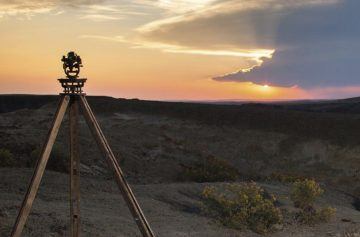 If, on a certain evening about sixty-six million years ago, you had stood somewhere in North America and looked up at the sky, you would have soon made out what appeared to be a star. If you watched for an hour or two, the star would have seemed to grow in brightness, although it barely moved. That’s because it was not a star but an asteroid, and it was headed directly for Earth at about forty-five thousand miles an hour. Sixty hours later, the asteroid hit. The air in front was compressed and violently heated, and it blasted a hole through the atmosphere, generating a supersonic shock wave. The asteroid struck a shallow sea where the Yucatán peninsula is today. In that moment, the Cretaceous period ended and the Paleogene period began.
 Astronomers announced on Wednesday that at last they had seen the unseeable: a black hole, a cosmic abyss so deep and dense that not even light can escape it.
 When things fall apart, it is not surprising that people cling to forces they associate with an earlier age of stability. The voters of Kiskunhalas sent a socialist to the Budapest parliament in 1994 and elected the same individual to be their mayor from 2002 to 2010. He was formerly a communist and a director at the State Farm, yet some claim that he did more to help small businessmen than his Free Democrat predecessor. According to Ferenc he did not do enough, for example in the way of reducing the local tax burden. No post-Socialist mayor has so far been able to attract any large-scale external investment to the town. Disaster struck in 2008 when Lévi-Strauss decided to close its factory and relocate to Romania, where costs were apparently significantly lower. Almost 500 jobs were lost at short notice.
 Peak Car offers a compelling story of vast riches and better living. Yet the evidence is thin. The rate at which young people get their licenses has indeed been falling, but the trend began in 1983, when the internet was still a science experiment. Today, the three best-selling vehicles in the US by far are pickup trucks. Most of those trucks are used as personal vehicles, as their pristine empty beds make clear. Whatever madness causes Americans to drive empty-bedded trucks around is not something Uber or Lyft can cure. And for those of us in the suburbs, minivans and three-row SUVs are more than transportation. They are waiting rooms, warm cabins on a cold day, and a place to leave the squash racket so we don’t forget it every week. It may be possible to find a Lyft big enough to carry the soccer team, but piling in with muddy cleats and leaving behind lost balls will earn you the dreaded one-star rating. Do it regularly and you’ll get you banned from the app.
 ‘A
‘A Lynn Lear finished her final round of chemotherapy for breast cancer in December. To help keep the cancer from coming back, Lear’s doctor told her about a new medication she could take called Nerlynx. Lear, who is 46, wanted to do everything she could to remain healthy, so she asked her doctor to order the drug for her. Unlike, say, an antibiotic or an antidepressant, a Nerlynx prescription can’t be filled at a neighborhood CVS or Walgreens. Instead, Nerlynx is dispensed either through certain doctors’ offices or through
  How much do Americans know about science? There’s a new science quiz from Pew Research Center. You can test yourself
 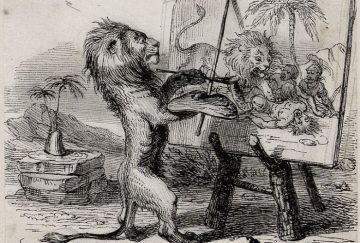 Humans always defeat lions in paintings because there are no lion painters. With this lesson, the griot gets up to leave, as Dani Kouyaté’s Keïta! (1995) comes to an end. The film is set in late twentieth-century Burkina Faso. The aphorism culminates a series of lessons that a folk storyteller imparts to an urban youth, all cautioning that traditional knowledge must be preserved in order to survive the country’s rapid modernization. City dwellers should learn French, but also Mandinka; they should know the oral epic Sundjata as well as they know capitalism.
 What led you to write a book about irrationality?
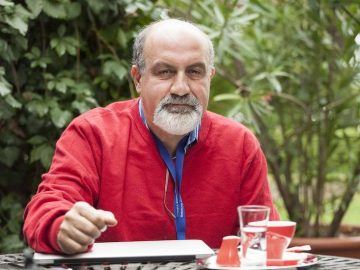 Since the midterm elections, a feud has been raging on Twitter between Nate Silver, founder of FiveThirtyEight, and Nassim Nicholas Taleb, hedge-fund-manager-turned-mathematical-philosopher and author of The Black Swan. It began, late last year, with Silver boasting about the success of his election models and Taleb shooting back that Silver doesn’t “
 One can fly
  I
I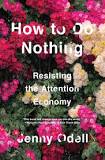 In her first chapter, “The Case for Nothing,” Odell recounts the near-daily visits she began making in 2016 to the Morcom Amphitheatre of Roses (a.k.a. the Rose Garden) in Oakland, California. Seeking post-election consolation, she sat in the public park, whose fragrant bushes are meticulously tended by volunteers, whose branching paths invite meandering, and whose architecture “holds open a contemplative space against the pressures of habit, familiarity, and distraction that constantly threaten to close it.” The difficulty of holding open space in the mind is mirrored by the difficulty of holding open space in public. Built by the Works Progress Administration, the Rose Garden was almost turned into condos in the 1970s. Local residents had to work together to block construction. The parallel Odell draws between the two struggles—for private, mental space and public, communal space—is characteristic of her method. She routinely finds formal similarities among seemingly disparate phenomena, thereby bringing them onto the same plane. In this case, the individual’s time to think and the public good become two bright points in the same constellation. “’Doing nothing’—in the sense of refusing productivity” entails both enjoyment of roses and birds, and “an active process of listening that seeks out the effects of racial, environmental, and economic injustice and brings about real change.”