
Elizabeth Svoboda and Undark in The Atlantic:
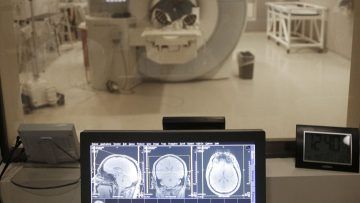
As he neared his 50s, Anthony Andrews realized that living inside his own head felt different than it used to. The signs were subtle at first. “My wife started noticing that I wasn’t getting through things,” Andrews says. Every so often, he’d experience what he calls “cognitive voids,” where he’d get dizzy and blank out for a few seconds. Over time, Andrews’s issues became more pronounced. It wasn’t just that he would lose track of things, as if a thought bubble over his head had popped. A dense calm had descended on him like a weighted blanket. “I felt like I was walking through the swamp,” says Andrews, now 54. He had to play internet chess each morning to penetrate the mental murk.
With his wife, Mona, by his side, Andrews went to doctor after doctor, racking up psychiatric diagnoses. One told him he had ADHD. Another thought he was depressed, and another said he had bipolar disorder. But the drugs and therapies they prescribed didn’t seem to help. “After a month,” Andrews recalls of these treatments, “I knew it’s not for me.” After a few rounds of diagnostic hopscotch, Mona found David Merrill, a psychiatrist and brain researcher at the University of California at Los Angeles. Other doctors had diagnosed Andrews based mostly on his symptoms, but Merrill proposed a new approach: using computer software called Neuroreader to measure the volume of Andrews’s brain. The results were a shock: Based on small volume changes, along with Andrews’s history and cognitive tests, Merrill told Andrews that he likely had chronic traumatic encephalopathy (CTE), a neurodegenerative disorder caused by repeated head impacts. Andrews was stunned. CTE? Like Dave Duerson, Junior Seau, and all those other NFL guys? Sure, he’d played football as a kid, but he’d mostly stopped after high school.
 Burnout — work-related stress resulting in emotional and physical exhaustion — remains an expected rite of passage for many professions. However, the medical community has begun to place more emphasis on reducing burnout — and science academia would do well to learn from it. Despite the differences between medical and scientific training, stress is a common denominator for students in both fields. For example,
  Maybe podcasting would be more interesting if it were an instrument of fascism, or terrorism. ISIS knows better: they don’t make podcasts, they make YouTube videos. Talk radio can still control the listener’s emotional response, but no one feels threatened by the infinitely banal podcast. Instead of emotion or camaraderie, what podcasts produce is chumminess
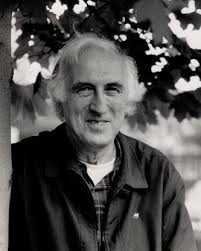 He studied theology and philosophy, completing his doctoral studies on happiness in the ethics of Aristotle. He became a teaching professor at St Michael’s College in Toronto.
 The governing elites of ancient and medieval Europe were not greatly hospitable to humor. From the earliest times, laughter seems to have been a class affair, with a firm distinction enforced between civilized amusement and vulgar cackling. Aristotle insists on the difference between the humor of well-bred and low-bred types in the
 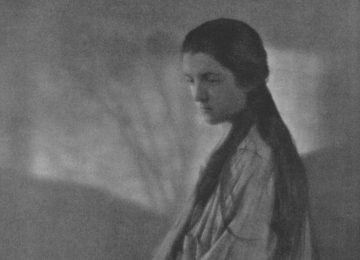 Vladimir Nabokov, whose 120th anniversary we mark this Spring, remains one of the 20th Century’s most acclaimed and enduring writers. He keeps turning up on
 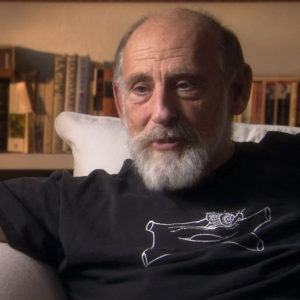 For decades now physicists have been struggling to reconcile two great ideas from a century ago: general relativity and quantum mechanics. We don’t yet know the final answer, but the journey has taken us to some amazing places. A leader in this quest has been Leonard Susskind, who has helped illuminate some of the most mind-blowing ideas in quantum gravity: the holographic principle, the string theory landscape, black-hole complementarity, and others. He has also become celebrated as a writer, speaker, and expositor of mind-blowing ideas. We talk about black holes, quantum mechanics, and the most exciting new directions in quantum gravity.
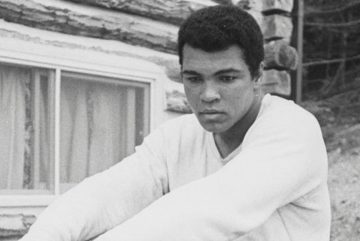 The opening frame of “What’s My Name” shows Ali explaining that should his story ever be told, he wants it done in full. So, there are no talking heads or narration, because who better to tell such a remarkable, revolutionary story than Muhammad Ali himself? His interviews and words guide us through his life, from early childhood until his final days, as he endures the bodily constraints of Parkinson’s disease. Ali’s famous, rhythmic one-liners, like “float like a butterfly, sting like a bee,” are accompanied by his critical analysis about race, white supremacy and his politics, which are global.
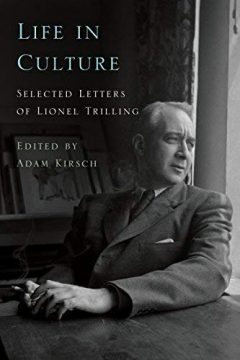 Trilling rather disliked the label “literary critic” and was pleased when Étienne Gilson suggested, in 1955, that he was not one. (Just what Gilson proposed him to be is not made clear.) All the same, twenty years after the Gilson exchange, Trilling would write to someone, who had sent him some offprints, to aver that he should “best refer to me as a critic of literature.” He did not much care for the New Criticism of Allen Tate, William Empson, and Cleanth Brooks, calling it snide and restrictive. Leon Edel, more a literary historian than a critic to be sure, he thought dull-witted (“a very stupid man”). One would not expect the life of a literary critic to be full of high adventure and derring-do, and the composite portrait of a critic’s life as painted in Trilling’s letters appears a largely unruffled if not a completely serene one. He married young and stay married to the same woman for his entire life. If there were any occasions of extramarital desire, much less action, they are not even intimated here. There is only a single rather explicit letter, to his wife, Diana, in which he talks about sex, and he never once swears and rarely uses slang. (When he writes in a letter to Norman Mailer that sex should be a subject for novelists for “ten, maybe twelve years; then everybody shut up,” it is a bit of a shock.)
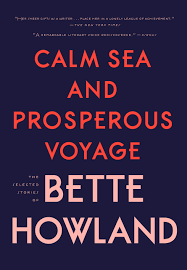 There is a way in which all of Bette Howland’s characters seem like visitors from a parallel universe, where they are free rather than confined. This is the eponymous visitor in the opening story of this collection: “I was catching on at last. The bad roads, the crash, the minor injury. This petty bureaucrat. This place. Sir? I’m dead? Is that it? I’m dead? … That’s what they all want to know! he said. But that’s the whole show! I can’t give that away, can I?” An uncle’s young wife is “a big handsome Southern girl, rawboned, rock jawed, her pale head dropped over her knitting. Peculiarly pale; translucent, like rock candy, and almost as brittle.” It is as if they step into a room accompanied by their own lighting. “ ‘When are you going to get married?’ Uncle Rudy asked, towering over me.” Imagination is what she calls what she does with them, imaginative selection from the panoply of life. “He’s a scofflaw. He’ll go out of his way to park illegally. He’ll drive around the block looking for a No Parking sign or a nice little fire hydrant.” Reading the prose brings a Bette I’d forgotten—a glass of Scotch, how she threw back her head and uproariously laughed. Ah, yes; here’s the one with verve, the woman in the fedora photo.
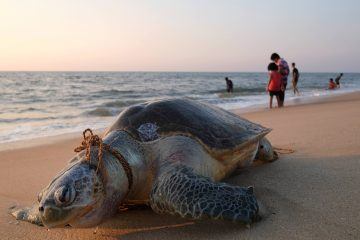 WASHINGTON — Humans are transforming Earth’s natural landscapes so dramatically that as many as one million plant and animal species are now at risk of extinction, posing a dire threat to ecosystems that people all over the world depend on for their survival, a sweeping new United Nations assessment has concluded. The 1,500-page report, compiled by hundreds of international experts and based on thousands of scientific studies, is the most exhaustive look yet at the decline in biodiversity across the globe and the dangers that creates for human civilization. A
  When I was laid off in 2015, I told people about it the way any good millennial would: By tweeting it. My hope was that someone on the fringes of my social sphere would point me to potential opportunities. To my surprise, the gambit worked. Shortly after my public plea for employment, a friend of a friend sent me a Facebook message alerting me to an opening in her department. Three rounds of interviews later, this acquaintance was my boss. (She’s now one of my closest friends).
 In the opening of The Other Americans, Laila Lalami’s fourth novel, a man is killed in a hit-and-run collision. The victim is Driss Guerraoui, an immigrant and small business owner who, after fleeing political unrest in Casablanca, eventually settles in a small town in California’s Mojave Desert to open a business and raise his family. His immigrant story is one his younger daughter Nora, a jazz composer, considers with mixed feelings. “I think he liked that story because it had the easily discernible arc of the American Dream: Immigrant Crosses Ocean, Starts a Business, Becomes a Success.” And it’s this clichéd American-immigrant narrative that Lalami sets out to deconstruct in her book.
 This week, amid devastating
 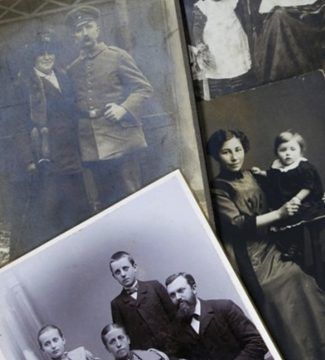 If someone says, “I guess it’s in my DNA,” you never hear people say, “DN—what?” We all know what DNA is, or at least think we do.
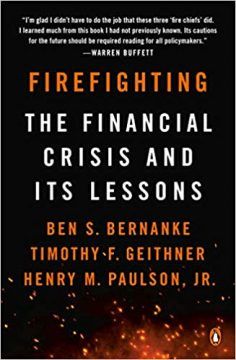 For a few months in 2008 and 2009 many people feared that the world economy was on the verge of collapse…