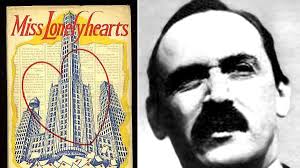
It was at this point I discovered Nathanael West. Although all his books had been published in the 1930s, they seemed to anticipate the America that was throbbing all around me, with its violence and disappointments, its spiritual emptiness, its foolishness and its freaks.
I had come across Miss Lonelyhearts as a paperback, and then found the New Directions edition of Miss Lonelyhearts and The Day of the Locust, and then, around 1960, an omnibus edition of his novels, which also included The Dream Life of Balso Snell and A Cool Million. The introduction to this edition was by the English writer and publisher Alan Ross. His note of special pleading (‘West’s slightness of reputation is not easy to understand’) resonated with my feeling of being marginal, like West, if not entirely overlooked.
Tanka: a Japanese poem consisting of five lines, the first and third of which have five syllables and the other seven, making 31 syllables in all and giving a complete picture of an event or mood.
What are a writer’s letters worth? The question, posed bluntly in dollars, plays out in one of the tangled subplots of The Dolphin Letters.
In 1970 Robert Lowell was a visiting fellow at All Souls College, Oxford, and Elizabeth Hardwick was at home in New York with their thirteen-year-old daughter, Harriet. Hardwick felt overwhelmed trying to manage the family’s affairs. “Cal,” she wrote to Lowell, “I can’t cope. I have gotten so that I simply cannot bear it. Each day’s mail and effort grows greater and greater.” Seeing the chance to simplify “a life that has become too weighty, detailed, heavy—for me,” Hardwick undertook to sell Lowell’s papers. SUNY Stony Brook was “wildly interested,” but she favored Harvard because of Lowell’s ties there. He agreed that Stony Brook was second choice, but they were offering more money, and he needed money. Hardwick told Harvard about the Stony Brook offer, the university raised its bid, and after much back and forth, in 1973, Harvard purchased Lowell’s papers dating from his childhood to 1970.
Too much had happened in the meantime for Hardwick to celebrate. When she had first looked into Lowell’s crammed file cabinets, she expected him to come home soon. But he didn’t. He fell in love with the Anglo-Irish writer Caroline Blackwood and remained in England with her, even after he was hospitalized following a manic breakdown in July 1970, and Hardwick came to him while Blackwood fled to Ireland. In 1971 Blackwood and Lowell’s son, Sheridan, was born. A year later, Lowell divorced Hardwick and married Blackwood. Throughout this time, he was writing about being torn between Blackwood and Hardwick in poems that would be published in 1973 as a sonnet sequence called The Dolphin.
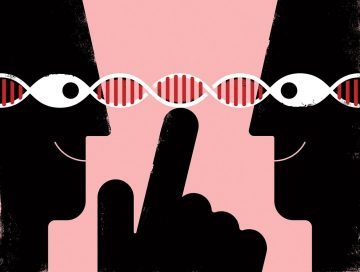
When Adam Siepel was building algorithms for evolutionary genomics as part of his PhD, he wasn’t thinking about visualization. But, as a graduate student in the laboratory of computational biologist David Haussler, at the University of California, Santa Cruz (UCSC), he happened to sit next to the software engineers who were building and maintaining a tool called the UCSC Genome Browser. These engineers helped Siepel to make his algorithms publicly available as a track, or data overlay, that anyone could explore. Genome browsers are graphical tools that display the genome sequence, usually as a horizontal line. Other sequence-associated data are aligned and stacked above and below that line in ‘tracks’, for instance to illustrate the relationship between gene expression, DNA modification and protein-binding sites.
Siepel’s track identifies sequences that have been retained over evolutionary time; when a user applies it while viewing the alignment of genomic data from two or more species, the track highlights regions that are evolutionarily conserved. Allowing others to use the algorithm to highlight regions of interest in their own data was “probably the single most important thing I did during my PhD”, says Siepel, who is now a computational biologist at Cold Spring Harbor Laboratory in New York. Other researchers have used it, for instance, to find mutations associated with diseases and to pinpoint functionally important regions of noncoding RNA molecules.
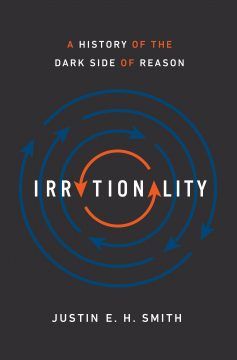
Justin Smith’s Irrationality is one of many books provoked by the political eruptions of 2016. Trump is a recurring preoccupation, but so is the internet and the carnival of quickfire nonsense it hosts. Taking these two themes together – the absurd liar in the White House, and the sarcastic meme culture that helped put him there – suggests that something distinctly new and dangerous has arisen. Trump, it seems, outstrips any previous conspiracy theorist or demagogue. His election means ‘the near-total disappearance of a shared space of common presuppositions from which we might argue through our differences’. In 2016, we saw ‘the definitive transformation of the internet, from vehicle of light to vehicle of darkness’. Trump’s pre-eminence forces us to defend principles and institutions we shouldn’t have to defend. We find ourselves having to assert that good reasons are better than bad reasons, that rational government policies are better than irrational ones. Distinctions between scientific fact and conspiracy theory now have to be explained and justified. These are tasks that many rationalists, in the ‘new atheist’ tradition of Steven Pinker and Richard Dawkins, have been happy to pursue. Arguing as much with (what they perceive as) the relativism of the left as with the dogmatism of the right, these bombastic defenders of Western reason exhibit a spirit of hostility towards anyone daring to question the benefits and rectitude of the natural sciences. Dawkins in particular has converted a defence of scientific method into a defence of cultural hierarchy, with ‘the West’ at the top. Pinker clings to a form of Benthamism, in which statistical data prove that modernity is still on the right track, regardless of what political or cultural anguish might be at large.
Faced with a choice between a world governed by brute Pinker-esque reason and the Dadaist nightmare of fantasy and propaganda emanating from the White House, Smith seems in no doubt where he stands. Yet Irrationality is unique among recent paeans to Enlightenment and liberalism in marrying a resolute defence of reason with a recognition of how futile such defences tend to be. What troubles Smith is that ‘rationality’ means nothing without some ‘irrationality’ from which to distinguish itself, yet the precise nature of this distinction is impossible to establish.
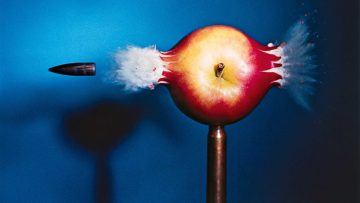
On the evening of Jan. 10, 1957, Harold Edgerton set a 4,000-volt electronic flash of his own design to the right of a small, shallow pool of milk in his “Strobe Lab” at the Massachusetts Institute of Technology (MIT). Edgerton, an electrical engineering professor, then released a drop of milk from a funnel 8 inches above the pool, reflecting a bright red background. A motion trigger was delayed a fraction of a second in order for the powerful flash to record the thumbnail-sized crown of the drop’s splash a few milliseconds after it hit the pool’s surface.
Like any good scientist, Edgerton recorded his data in his notebook. He had first done a successful milk drop photo two decades before in black and white, but kept trying to perfect the shot. His goal was to record equally spaced droplets around the ring. Working with color film that was less sensitive to light made matters more difficult, and when he first saw the color film version of the milk crown, he said it was merely “acceptable” because the droplets were not perfectly spaced. However, to viewers around the world the photo was stunning. In 2016, Time magazine selected “Milk Drop Coronet, 1957” as one of the 100 most influential images of all time, claiming that “the picture proved that photography could advance human understanding of the physical world, and the technology Edgerton used to take it laid the foundation for the modern electronic flash.”
It has been nearly three decades since the death of Edgerton, often called the father of high-speed flash photography. A fresh look at his pioneering work, “Harold Edgerton: Seeing the Unseen,” includes more than 100 photographs and newly released selections from his notebooks, accompanied by essays by former colleagues and curators of the Edgerton photo and strobe archive at the MIT Museum.
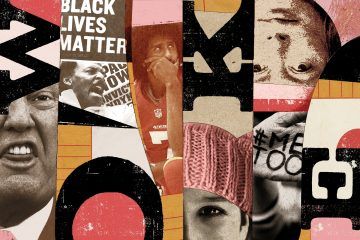
There is a certain kind of liberally inclined writer who sees Donald Trump’s America as a nation in crisis. At every turn, in every tweet, she is confronted by the signs of an ongoing catastrophe, from which it may be too late to escape. An ugly, vicious intolerance spread on social media; the collapse of norms once considered sacred; a crass narrow-mindedness surreally celebrated by some of this country’s most powerful institutions—these are all elements in the gathering storm of a new, distinctly American fascism. The twist is that this crisis has its source, she contends, not in the person of Trump, but in his frothing-mouthed opposition: the left.
That, roughly speaking, is the thesis of a group of writers who, since Trump’s election in 2016, have chastised the left for its supposedly histrionic excesses. Their enemies extend well beyond the hashtag resistance, and their fire is aimed, like a Catherine wheel, in all directions, hitting social justice warriors, elite universities, millennials, #MeToo, pussy hat–wearing women, and columnists at Teen Vogue. Everyone from Ta-Nehisi Coates down to random Facebook commenters is taken to task, which makes for a sprawling, hard-to-define target. These writers might call their bugbear “woke culture”: a kind of vigilance against misogyny, racism, and other forms of inequality expressed in art, entertainment, and everyday life.
In the appendix to an article recently published on The Philosophical Salon website, Slavoj Žižek offers a response to the accusations of racism, repetition, reactionaryism and charlatanism that I made against him in an article published last month in the journal Current Affairs.
Arguably, what is most noteworthy about Žižek’s response is not what it says, but what it omits. In particular, Žižek offers no defense of – or apology for – his racist suggestion that pedophilia is “a key constituent of the very identity” of “Pakistani Muslim youth”; he offers no defense of his preposterous preference for “the worst of Stalinism [over] the best of the liberal-capitalist welfare state”; he provides no rationalization of his ridiculous claim that all forms of political Islam ultimately reduce to fascism or Wahhabi-Salafism; he offers no justification for his outrageous suggestion of the acceptability of Western state terrorism and the permissibility of “violat[ing] elementary moral norms”; he supplies no further buttressing of his flimsily-defended assertion of why he believes “right-wing chaos” is a necessary precursor to progressive political change; he offers no attempt to render consistent his belief that US President Donald Trump will provide such “right-wing chaos” with his view that Trump is also a “pretty ordinary centrist liberal”[i]; he provides no explanation for why he advocated abstention in the Macron vs Le Pen 2017 French Presidential election, given his (Žižek’s) professed belief that Le Pen is an “anti-immigrant populist” who represents “the principal threat to Europe”; he makes no admission of, or apology for, the fact that his 2018 book Like a Thief in Broad Daylight was deceptively marketed as a book about technology’s impact on human affairs, when in fact the book was largely about sex; he makes no attempt to clarify what he means by “dialectical materialism”, or to render the dozen or so (often amusingly) distinct definitions he has previously offered of the term consistent; he offers no defense or retraction of his ridiculous assertion that the world (according to quantum mechanics) is a “positively charged void, and that particular things appear when the balance of the void is disturbed”; and, finally – and perhaps somewhat forgivably – he offers no attempt to explain what on earth (e.g.) animal sex has to do with Hegelian interpretations of quantum mechanics.
It’s the year of John Ruskin. 2019 is the bicentennial of his birth and there continues to be events to mark it. Perhaps the celebrations will prove to be a turning point for him. For though during his lifetime, and for a generation or so afterwards, Ruskin was hugely influential, his achievements have now been neglected for decades. His collected works run to 39 volumes; he wrote around 250 books during his long life. As an author he commanded international respect, attracting praise from figures as varied as Tolstoy, George Eliot, Proust and Ghandi. He was cited as an influence by Clement Atlee and the founders of the National Trust. His ideas helped found the Labour Party and the welfare state. Gladstone wanted to make him poet laureate. Yet most of his books are now out of print. While you might see books about him, you would be lucky to find his work even in secondhand bookshops. Few artists have experienced such a decline in reputation. There are many factors in this steep descent, both personal and professional, and they began mid-way through Ruskin’s career. Chief among the personal is Ruskin’s failed marriage to Effie Gray, which was annulled on the grounds of impotency. Effie subsequently married Ruskin’s friend, the Pre-Raphaelite artist John Everett Millais, and the scandal at the time was injurious to both parties. The affair is dramatised in Emma Thompson’s 2014 film Effie Gray.
Four years after the annulment, at the age of 39, Ruskin became infatuated with one of his drawing pupils, 10-year-old Rose La Touche. When she was 18 and he 47, he proposed marriage and Rose refused. The situation was complicated because Rose’s mother had designs on Ruskin. Three years later, Rose died – possibly of anorexia – which broke Ruskin’s own vulnerable mental health. There was no suggestion of any impropriety and this second romantic disaster was not as public at the time as his annulled marriage, but both episodes have subsequently got in the way of his work to the degree that he is too neglected by some and completely dismissed by others. His work fell foul of censorious opprobrium 150 years ago, and is doing so again in an age when artists are rarely judged for their work alone.
I have a clear memory of presenting my initial results about a “failed” protein at a lab meeting with my postdoctoral advisor Angus Lamond at the University of Dundee in Scotland and the rest of his group. It was the summer of 2000, and for the first few months of my postdoc I had been fusing green fluorescent protein with novel proteins that had recently been identified by mass spectrometry as residing in the nucleolus. I engineered HeLa cells to produce copious amounts of these fusion proteins, and watched where they went. Most migrated to the nucleolus, as expected, but one protein steadfastly refused. Instead, it formed nuclear dots that were much smaller than the large and obvious nucleoli. I was really worried about the messiness of this result, but also intrigued. To my relief, instead of being disappointed that the protein was not doing what we had expected, Angus and my lab mates encouraged me to explore it further. The group had access to antibodies against many cellular structures, so I quickly established that these nuclear dots were different from any known nuclear bodies. But having generated much of my data with overexpressed protein, it was critical to make sure that the endogenous form of the protein also localized to the same nuclear dots, and that what I had seen were not simply artifacts of my approach.
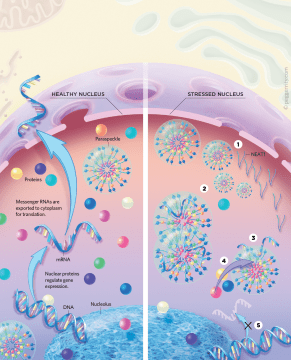
We created an antibody against the protein and incubated it with HeLa cells. It was an incredibly nerve-wracking moment looking down the microscope to see what the antibody had stained. Thankfully, it worked. I was ecstatic when I saw that it had picked out the same small nuclear dots that I had identified with GFP. In 2002, I published a manuscript introducing the scientific community to paraspeckles— orbs of protein and nucleic acid 360 nanometers in diameter, squeezed next to the more famous and larger structures called nuclear speckles. Since then, paraspeckles have become an established part of cell biology; there are more than 250 articles on them, and they have already found their way into some textbooks. We now know they are membraneless organelles seeded by a long noncoding RNA (lncRNA), formed through a well-characterized physical phenomenon known as liquid-liquid phase separation, and composed of numerous proteins and RNA molecules. We also know that they can alter gene regulation when cells get stressed, an important mechanism for maintaining cell homeostasis and one that appears to be disrupted in many diseases.
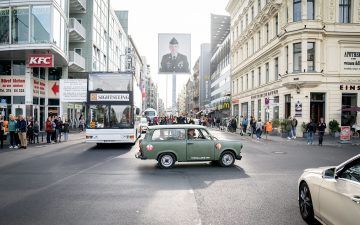
In August 1989, just a few weeks before the Berlin Wall came down, the East German writer Christa Wolf offered her view on the possibility of German reunification. Wolf had remained a communist party member until June that year, and even thereafter she espoused her Leftist convictions to the shrinking number of people who openly shared them. She firmly stated her opposition to the merger of the two Germanys. ‘[R]eunification – as the annexation of the smaller, poorer part of Germany to the larger, wealthier one – would render the self-critical treatment of our past much more difficult,’ she argued. The people of the German Democratic Republic (GDR) should instead try on their own terms to realise the dream of a truly ‘democratic socialism’ in a state where ‘contradiction’ can be not only ‘tolerated’ but even ‘made productive’. If the GDR were to simply disappear, the necessary opposite – Germany’s own ‘double meaning’ (a recurring theme in her literary work) – would disappear along with it, to catastrophic effect. Collapsing the two Germanys into one, in other words, would destroy it.
Just as Wolf decried the merger of the two Germanys, several decades earlier Herbert Marcuse mourned the merger of two dimensions in his book One-Dimensional Man (1964). Marcuse, a German philosopher of the Frankfurt School whose members devised a form of Western Marxist philosophy known as critical theory, offered an analysis of the homogenising effects of consumerism.
People who embrace anti-racist politics now regularly denounce the New Deal as a model for universalist social and economic reform on the grounds that many of its signature programs discriminated against African Americans. Some of these detractors simply dismiss the New Deal as racist and have gone further to argue that all universal programs—i.e., initiatives that are officially designed to benefit everyone—are racist and will not help black Americans. They argue instead that only government and market interventions targeted solely to African Americans should count as benefits for black people.
It is certainly true that black Americans received less than whiteson the average from many New Deal programs, but it’s not true that they didn’t receive benefits. Often, critics who dismiss the New Deal as racist focus on racial disparity—the fact that in many programs, smaller overall percentages of African Americans benefited than the percentages of whites, or that African Americans received lower benefits on average—and ignore the degree to which African Americans actually did benefit.
The most telling chant of the 2019 Hong Kong protests is “Liberate Hong Kong, the revolution of our times” (光復香港 時代革命), not because it offers a vision for “revolution,” but because it reveals the protesters’ accurate assessment of “our times.”
Very few protesters expect that Hong Kong will be “liberated” from its status as a special administrative region of the People’s Republic of China. Although the protest movement borrows the language of Cold War decolonization movements, the demand for Hong Kong’s “liberation” is not quite a demand for national sovereignty. It is, more accurately, a plea to let Hong Kong remain liberal: to let Hong Kong remain the island of unregulated global capitalism that it has been since the 19th century. This is why “revolution” seems, at first glance, an ill-fitting term: this is not a revolutionary politics in the traditionally optimistic or utopian sense.
But that is not to say that the protesters are conservative, naive, or uninformed. Indeed, to claim that the pro–Hong Kong protesters have no overarching political vision or historical perspective is to grossly underestimate their intelligence. The protesters offer a clear-eyed assessment of the global present—“our times”—and their demands are designed for the compromised world that we have made. Liberation and revolution can no longer promise us that we “have nothing to lose” or a “world to win,” in Marx and Engels’s formulation. “Our times” require a revised revolutionary vision that is merely necessary, dismally insufficient, and ultimately impossible: liberation for a future in which there’s nothing left to win or lose, for anyone.
Anna Deavere Smith in the New York Review of Books:
Elwood Curtis is a junior at Lincoln High School in Tallahassee, Florida, when we meet him in Colson Whitehead’s latest novel, The Nickel Boys. It’s 1962, and Elwood’s prized possession is a Martin Luther King at Zion Hill record that his grandmother, Harriet, bought him for a dime outside the Richmond Hotel, the fancy establishment where she works. He listens to King’s speeches and thinks about them often: “Throw us in jail and we will still love you,” King says, his voice reverberating in Elwood’s head:
But be assured that we will wear you down by our capacity to suffer, and one day we will win our freedom. We will not only win freedom for ourselves, we will so appeal to your heart and your conscience that we will win you in the process and our victory will be a double victory.
Elwood lives with his grandmother in the predominantly black neighborhood of Frenchtown. His parents left him with her when he was six and moved to California without saying goodbye; he hasn’t heard from them since. Now a teenager, he likes to hang out at Marconi’s tobacco store. He has “a curious habit where he read every comic front to back before he bought it, and he bought every one he touched.” When Mr. Marconi asks why he goes through all that if he’s going to buy them whether they are good or not, Elwood says, “Just making sure.” But a more telling sign of his personality is that he buys what he touches because that’s the right thing to do.
“Am I a real addict now? I ask. Yes, he says, with his shy, tentative smile, now you are a real addict.” The Copenhagen trilogy, Tove Ditlevsen’s majestic memoir of art and addiction, was originally published in Danish in the late 1960s and early 70s, and now appears in English for the first time, translated by Tiina Nunnally and Michael Favela Goldman. The three novella-length books are called Childhood, Youth and Dependency and trace the arc of Ditlevsen’s story from birth to literary stardom to the seamy, grasping years of addiction that ended with her suicide in 1976. The trilogy is stridently honest, entirely revealing – she makes no effort to hide the many shameful episodes of a shambolic, drug-addled existence – and, in the end, devastating.
Ditlevsen was born in Vesterbro, Copenhagen, in 1917, the daughter of a fretful, socially ambitious mother and a socialist father who was fired from one job after another for his politics. Their down-at-heel neighbourhood is full of drunks, and the future for Ditlevsen is – at best – one of marriage to a “stable skilled worker”.
You can take the writer out of California but you can’t take California out of the writer — or at least so I prefer to imagine, in my romantic fashion, during these dark days in which everything beautiful about the Golden State seems to be burning.
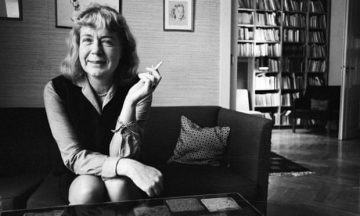
Jean Stafford was born and raised in California (on a West Covina walnut farm). While she spent her life continually moving east (to Colorado, Missouri, New York), Stafford often looked back fondly at the West’s wide amenable spaces.
In many further ways, she swung restlessly across extremes. She studied, worked and partied with both members of the Southern-based “Fugitives” (poets and critics like Allen Tate and Robert Penn Warren), who argued that artful writing was more about form than experience, as well as the more East Coast-leaning Partisan Review crowd (Edmund Wilson and Mary McCarthy), who argued, well, the opposite.
“A sense of humor is just common sense, dancing,” he wrote. “Those who lack humor are without judgment and should be trusted with nothing.”
He said of George W. Bush that he “should not be delivering a State of the Union address. He should be delivering pizza.” He compared Arnold Schwarzenegger’s torso to a “condom full of walnuts.” He made fun of his own looks, comparing himself to a bank robber who forgot to take the stocking off his head.
He told an editor, “Listen, if I wrote like that, I’d be you.” Reviewing a memoir by Leonid Brezhnev, he declared: “Here is a book so dull that a whirling dervish could read himself to sleep with it. If you were to recite even a single page in the open air, birds would fall out of the sky and dogs drop dead.”

 It was at this point I discovered Nathanael West. Although all his books had been published in the 1930s, they seemed to anticipate the America that was throbbing all around me, with its violence and disappointments, its spiritual emptiness, its foolishness and its freaks.
 When Adam Siepel was building algorithms for evolutionary genomics as part of his PhD, he wasn’t thinking about visualization. But, as a graduate student in the laboratory of computational biologist David Haussler, at the University of California, Santa Cruz (UCSC), he happened to sit next to the software engineers who were building and maintaining a tool called the UCSC Genome Browser. These engineers helped Siepel to make his algorithms publicly available as a track, or data overlay, that anyone could explore. Genome browsers are graphical tools that display the genome sequence, usually as a horizontal line. Other sequence-associated data are aligned and stacked above and below that line in ‘tracks’, for instance to illustrate the relationship between gene expression, DNA modification and protein-binding sites.
 Justin Smith’s Irrationality is one of many books provoked by the political eruptions of 2016. Trump is a recurring preoccupation, but so is the internet and the carnival of quickfire nonsense it hosts. Taking these two themes together – the absurd liar in the White House, and the sarcastic meme culture that helped put him there – suggests that something distinctly new and dangerous has arisen. Trump, it seems, outstrips any previous conspiracy theorist or demagogue. His election means ‘the near-total disappearance of a shared space of common presuppositions from which we might argue through our differences’. In 2016, we saw ‘the definitive transformation of the internet, from vehicle of light to vehicle of darkness’. Trump’s pre-eminence forces us to defend principles and institutions we shouldn’t have to defend. We find ourselves having to assert that good reasons are better than bad reasons, that rational government policies are better than irrational ones. Distinctions between scientific fact and conspiracy theory now have to be explained and justified. These are tasks that many rationalists, in the ‘new atheist’ tradition of Steven Pinker and Richard Dawkins, have been happy to pursue. Arguing as much with (what they perceive as) the relativism of the left as with the dogmatism of the right, these bombastic defenders of Western reason exhibit a spirit of hostility towards anyone daring to question the benefits and rectitude of the natural sciences. Dawkins in particular has converted a defence of scientific method into a defence of cultural hierarchy, with ‘the West’ at the top. Pinker clings to a form of Benthamism, in which statistical data prove that modernity is still on the right track, regardless of what political or cultural anguish might be at large.
 On the evening
 There is a certain kind of liberally inclined writer who sees Donald Trump’s America as a nation in crisis. At every turn, in every tweet, she is confronted by the signs of an ongoing catastrophe, from which it may be too late to escape. An ugly, vicious intolerance spread on social media; the collapse of norms once considered sacred; a crass narrow-mindedness surreally celebrated by some of this country’s most powerful institutions—these are all elements in the gathering storm of a new, distinctly American fascism. The twist is that this crisis has its source, she contends, not in the person of Trump, but in his frothing-mouthed opposition: the left.
 It’s the year of John Ruskin. 2019 is the bicentennial of his birth and there continues to be events to mark it. Perhaps the celebrations will prove to be a turning point for him. For though during his lifetime, and for a generation or so afterwards, Ruskin was hugely influential, his achievements have now been neglected for decades. His collected works run to 39 volumes; he wrote around 250
  I have a clear memory of presenting my initial results about a “failed” protein at a lab meeting with my postdoctoral advisor
  Holly Case in Aeon:
 Adolph Reed Jr. in The New Republic:
 J. Daniel Elam in Public Books: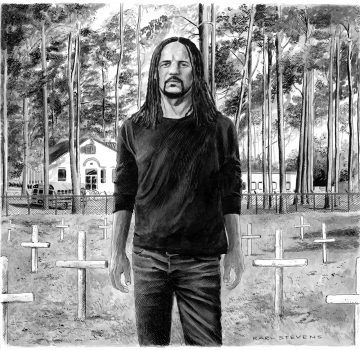
 “A
“A You can take the writer out of California but you can’t take California out of the writer — or at least so I prefer to imagine, in my romantic fashion, during these dark days in which everything beautiful about the Golden State seems to be burning.
 “A sense of humor is just common sense, dancing,” he wrote. “Those who lack humor are without judgment and should be trusted with nothing.”