How scientific conferences will survive the coronavirus shock

Giuliana Viglioni in Nature:
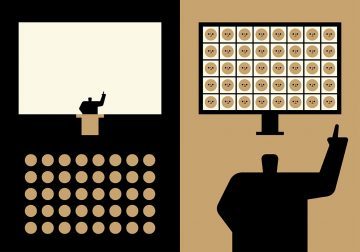
Before the COVID-19 pandemic, Adam Fortais had never attended a virtual conference. Now he’s sold on them — and doesn’t want to go back to conventional, in-person gatherings. That’s because of his experience of helping to instigate some virtual sessions for the March meeting of the American Physical Society (APS), after the organization cancelled the regular conference at short notice. “If given the option, I think I would almost always choose to do the virtual one,” says Fortais, a physicist at McMaster University in Hamilton, Ontario. “It just seems better to me in almost all ways.”

Fortais could get his wish. Since the coronavirus spread worldwide in early March, many scientific conferences scheduled for the first half of the year have migrated online, and organizers of meetings due to take place in the second half of 2020 are deciding whether they will go fully or partially virtual. Some researchers hope that the pandemic will finally push scientific societies to embrace a shift towards online conferences — a move that many scientists have long desired for environmental reasons and to allow broader participation. Scientists with disabilities and parents of young children are just two examples of the researchers who are benefiting from online meetings, says Kim Cobb, a climate scientist at the Georgia Institute of Technology in Atlanta. Cobb has been cutting back her own air travel since 2017, both to reduce her personal carbon footprint and to blaze a trail towards structural change in her discipline. She hopes the changes as a result of the pandemic will last long after it has ended. “In five years, we’ll be in a remarkably different place.”

More here.
Wednesday Poem

Dylan could have written this yesterday and the sense of being bound up in a bad dream would feel, verse by verse, as palpably true.

Stuck Inside of Mobile With the Memphis Blues Again

Oh, the ragman draws circles
Up and down the block
I’d ask him what the matter was
But I know that he don’t talk
And the ladies treat me kindly
And furnish me with tape
But deep inside my heart
I know I can’t escape
Oh, Mama, can this really be the end
To be stuck inside of Mobile
With the Memphis blues again

Well, Shakespeare, he’s in the alley
With his pointed shoes and his bells
Speaking to some French girl
Who says she knows me well
And I would send a message
To find out if she’s talked
But the post office has been stolen
And the mailbox is locked
Oh, Mama, can this really be the end
To be stuck inside of Mobile
With the Memphis blues again

Mona tried to tell me
To stay away from the train line
She said that all the railroad men
Just drink up your blood like wine
An’ I said, “Oh, I didn’t know that
But then again, there’s only one I’ve met
An’ he just smoked my eyelids
An’ punched my cigarette”
Oh, Mama, can this really be the end
To be stuck inside of Mobile
With the Memphis blues again

Grandpa died last week
And now he’s buried in the rocks
But everybody still talks about
How badly they were shocked
But me, I expected it to happen
I knew he’d lost control
When he built a fire on Main Street
And shot it full of holes
Oh, Mama, can this really be the end
To be stuck inside of Mobile
With the Memphis blues again

Read more »

Tuesday, June 2, 2020

One Small Magazine’s Fight for the Indian Mind

Maddie Crowell in the Virginia Quarterly Review:

The offices of Caravan, a small but influential Indian monthly magazine, are housed on the third floor of a Soviet-style building in New Delhi. For a long time, Vinod Jose, the magazine’s executive editor, didn’t give much thought to the view outside his window: a budding thicket of gulmohar trees where, down below, smokers convened in small circles on their lunch break. But then, a few years ago, the view began to change. The netted steel cage of a new building began to rise out of the foliage, piquing Jose’s interest: It would be, he soon found out, the New Delhi headquarters for the Rashtriya Swayamsevak Sangh (RSS), India’s most powerful right-wing Hindu-nationalist organization, and a longtime fixation of Jose’s journalistic career.

“A colleague once told me that if he were writing a profile of me, that this would be the opening scene,” Jose said, gesturing to his view of the RSS headquarters, when we met in April 2019. Jose, who is forty and speaks in tranquil bursts, carries himself with a calm authority that can often feel out of place in Delhi’s cacophony.

More here.

Sean Carroll’s Mindscape Podcast: Scott Aaronson on Complexity, Computation, and Quantum Gravity

Sean Carroll in Preposterous Universe:

There are some problems for which it’s very hard to find the answer, but very easy to check the answer if someone gives it to you. At least, we think there are such problems; whether or not they really exist is the famous P vs NP problem, and actually proving it will win you a million dollars. This kind of question falls under the rubric of “computational complexity theory,” which formalizes how hard it is to computationally attack a well-posed problem. Scott Aaronson is one of the world’s leading thinkers in computational complexity, especially the wrinkles that enter once we consider quantum computers as well as classical ones. We talk about how we quantify complexity, and how that relates to ideas as disparate as creativity, knowledge vs. proof, and what all this has to do with black holes and quantum gravity.
More here.

Understanding epidemiology models

John Timmer in Ars Technica:

One of the least expected aspects of 2020 has been the fact that epidemiological models have become both front-page news and a political football. Public health officials have consulted with epidemiological modelers for decades as they’ve attempted to handle diseases ranging from HIV to the seasonal flu. Before 2020, it had been rare for the role these models play to be recognized outside of this small circle of health policymakers.

Some of that tradition hasn’t changed with the SARS-CoV-2 pandemic. International bodies, individual countries, most states, and even some cities have worked with modelers to try to shape policy responses to the threat of COVID-19. But some other aspects of epidemiological modeling life clearly have changed. The models, some of which produce eye-catching estimates of fatalities, have driven headlines in addition to policy responses. And those policy responses have ended up being far more controversial than anyone might have expected heading into the pandemic.

With the severity of COVID-19, it’s no surprise that there has been increased scrutiny of epidemiological models. Models have become yet another aspect of life embroiled in political controversy. And it’s fair for the public to ask why different models—or even the same model run a few days apart—can produce dramatically different estimates of future fatalities.

More here.

George Herbert: “Love (III)”

Hannah Brooks-Motl at Poetry Magazine:

Published shortly after his death in 1633, George Herbert’s The Temple is an example of a kind of poetry-project, the exact meaning of which has been debated almost since its first appearance. Because it is composed of poems with titles like “The Altar” and “The Windows,” some critics have believed Herbert was attempting to recreate the elements of a church in the structure of his book; others thought he was mapping the liturgical year through poems such as “Whitsunday,” “Lent,” and “Christmas.” Some, such as Helen Vendler, note that the book models new kinds of friendship and lyric address, even anticipating, in Herbert’s painstaking dissections of his own weakness and his many dialogues with God, “the modern notion of the ideal therapist.” Still others, notably Stanley Fish, think about The Temple’s project in the terms Herbert himself set out, in a chapter on catechizing in his prose work The Life of a Country Parson: “at Sermons, and Prayers, men may sleep or wander;” Herbert wrote, “but when one is asked a question, he must discover what he is.” Herbert’s project, in this reading, is a kind of “catechism” intent on leading the reader to discover “what he is” for himself. “What is crucial,” Fish notes, “is not the dialogue in the poem, but the dialogue the poem is in.” Herbert wasn’t just writing about his own relationship with God, he was writing to alter his readers’ sense of their own. But despite, or because of, such varying interpretations, what has never been disputed is the “project-ness” of The Temple: “We cannot judge Herbert, or savour fully his genius and his art, by any selection to be found in an anthology,” T.S. Eliot wrote in his seminal study of the poet. “We must study The Temple as a whole.”
more here.

Martin Buber’s Path to a Believing Humanism

Patrick Jordan at Commonweal:

“I am unfortunately a complicated and difficult subject.” With these words of Martin Buber, Paul Mendes-Flohr lays down the challenge for his meticulous biography of the distinguished Jewish scholar, humanist, and author of I and Thou. “Complicated,” to be sure, and “difficult,” certainly; that goes with the territory of Buber’s at times maze-like philosophical explorations and heavily Germanic articulation. And one may add to these challenges the fact that—to quote this biographer—Buber was a “contested figure who evoked passionate, conflicting opinions about his person and his thought.” Yet these obstacles are by no means insurmountable, thanks to Mendes-Flohr’s philosophical acumen and gift for succinct expression. Indeed, in his capable hands Buber’s life makes for an engrossing, instructive tale, and an exemplary contribution to Yale’s “Jewish Lives Series.”
more here.

Tuesday Poem

Song of the Taste

Eating the living germs of grasses
Eating the ova of large birds

the fleshy sweetness packed
around the sperm of swaying trees

The muscles of the flanks and thighs of
soft-voiced cows
the bounce in the lamb’s leap
the swish in the ox’s tail

Eating roots grown swoll
inside the soil

Drawing on life of living
clustered points of light spun
out of space
hidden in the grape.

Eating each other’s seed
eating
ah, each other.

Kissing the lover in the mouth of bread:
lip to lip.

by Gary Snyder
from Regarding Wave
New Directions, 1970

Universities will never be the same after the coronavirus crisis

Alexandra Witze in Nature:

As universities face major changes, their financial outlook is becoming dire. Revenues are plummeting as students (particularly international ones) remain home or rethink future plans, and endowment funds implode as stock markets drop.
The universities that are likely to fare best are those that are rich and powerful. But even those face challenges. The Massachusetts Institute of Technology in Cambridge has been putting courses online for free since 2002, but most academics who were teaching in the current semester still had to scramble to work out how to move their materials online when the pandemic hit, says Sanjay Sarma, the university’s vice-president for open learning. More broadly, many institutions are learning the hard way that simply delivering course materials through digital platforms is not the best way to teach students. “Zoom university isn’t proper online learning,” he says.

Sarma hopes that when universities resume in-person classes, the experience will be radically different — with instructors distributing video lectures early, and focusing in-person time on interacting with students to ensure that they understand the concepts being taught. “We don’t want to waste our proximity on one-way stuff,” he says. “It has to be two-way learning.” Some educators expect the pandemic will lead to more and better online teaching than before — in both wealthy countries and those with lower incomes. When universities in Pakistan closed in March, many instructors didn’t have the tools to teach online and many students lacked reliable Internet access at home, says Tariq Banuri, chairman of Pakistan’s Higher Education Commission in Islamabad. But the commission has been working to standardize online teaching and to get telecommunication companies to offer students cheaper mobile-broadband packages.

More here.

With Trump we’ve reached the ‘mad emperor’ stage

Richard Wolffe in The Guardian:

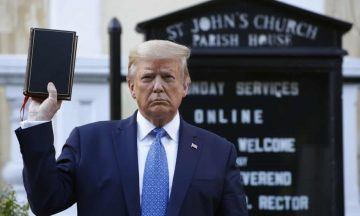
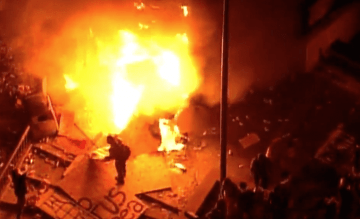
Writing from a Birmingham jail, Martin Luther King Jr famously told his anxious fellow clergymen that his non-violent protests would force those in power to negotiate for racial justice. “The time is always ripe to do right,” he wrote. On an early summer evening, two generations later, Donald Trump walked out of the White House, where he’d been hiding in a bunker. Military police had just fired teargas and flash grenades at peaceful protesters to clear his path, so that he could wave a bible in front of a boarded church. For Trump, the time is always ripe to throw kerosene on his own dumpster fire. In the week since George Floyd was killed by Minneapolis police officers, Trump has watched and tweeted helplessly as the nation he pretends to lead has reached its breaking point. After decades of supposedly legal police beatings and murders, the protests have swept America’s cities more quickly than even coronavirus. This is no coincidence of timing. In other crises, in other eras, there have been presidents who understood their most basic duty: to calm the violence and protect the people. In this crisis, however, we have a president who built his entire political career as a gold-painted tower to incite violence.
We were told, by Trump’s supporters four years ago, that we should have taken him seriously but not literally. As it happened, it was entirely appropriate to take him literally, as a serious threat to the rule of law. During his 2016 campaign, he encouraged his supporters to assault protesters. “Knock the crap out of them, would you? Seriously, OK,” he said on the day of the Iowa caucuses. “I promise you I will pay for the legal fees.” Later in Las Vegas, he said the security guards were too gentle with another protester. “I’d like to punch him in the face,” he said. Sure enough, a protester was sucker-punched on his way out of a rally the following month. No wonder Trump was sued for incitement to riot by three protesters who were assaulted as they left one of his rallies in Kentucky. The case ultimately failed, but only after a judge ruled that Trump recklessly incited violence against an African-American woman by a crowd that included known members of hate groups.

So when he stood, as president, and told a crowd of police officers to be violent with arrested citizens, it wasn’t some weird joke or misstatement, no matter what his aides claimed afterwards. “When you see these thugs being thrown into the back of a paddy wagon, you just see ’em thrown in, rough, I said, ‘Please don’t be too nice.’

More here.

Sunday, May 31, 2020

Could nearly half of those with Covid-19 have no idea they are infected?

David Cox in The Guardian:

Epidemiological studies are now revealing that the number of individuals who carry and can pass on the infection, yet remain completely asymptomatic, is larger than originally thought. Scientists believe these people have contributed to the spread of the virus in care homes, and they are central in the debate regarding face mask policies, as health officials attempt to avoid new waves of infections while societies reopen.

But the realisation that asymptomatic people can spread an infection is not completely surprising. For starters, there is the famous early 20th century case of “Typhoid Mary”, a cook who infected 53 people in various households in the US with typhoid fever despite displaying no symptoms herself. In fact, all bacterial, viral and parasitic infections – ranging from malaria to HIV – have a certain proportion of asymptomatic carriers. Research has even shown that at any one time, all of us are infected with between eight and 12 viruses, without showing any symptoms.

More here.

How Double-Entry Bookkeeping Changed The World

Keith Devlin at the website of the Mathematical Association of America:

What’s your reaction when you see the term “double-entry book-keeping”? Do you associate it with cool, societal-changing innovations like the Internet, Google, social media, laptops, and smartphones? Probably not. Neither did I—until I was asked to write a brief article about the fifteenth century Italian mathematician Luca Pacioli, to go into the sale catalog for the upcoming (June) Christie’s auction of an original first edition of his famous book Summa de arithmetica, geometria, proportioni et proportionalita (“Summary of arithmetic, geometry, proportions and proportionality”), published in 1494, which I referred to in last month’s column. (I also gave a talk at a public showing Christie’s organized in San Francisco on April 24, which gave me an opportunity to examine the book myself.)

More here.

Sean Carroll’s Mindscape Podcast: Olga Khazan on Living and Flourishing While Being Weird

Sean Carroll in Preposterous Universe:

Each of us is different, in some way or another, from every other person. But some are more different than others — and the rest of the world never stops letting them know. Societies set up “norms” that define what constitute acceptable standards of behavior, appearance, and even belief. But there will always be those who find themselves, intentionally or not, in violation of those norms — people who we might label “weird.” Olga Khazan was weird in one particular way, growing up in a Russian immigrant family in the middle of Texas. Now as an established writer, she has been exploring what it means to be weird, and the senses in which that quality can both harm you and provide you with hidden advantages.
More here.

The last of his kind: ‘Jewish Arab’ Albert Memmi leaves a vital message about Zionism

Joel Swanson in Forward:

Albert Memmi, the great Tunisian-born French Jewish intellectual, passed away in Paris last Friday at the age of 99. He was arguably the last surviving member of a generation of great mid-20th-century Francophone intellectuals.
Sadly, few in the English-speaking world seemed to notice. While major FrenchGerman and Hebrew news sources reported on his passing, for the most part, English language news sources have not. Memmi has not received an obituary in The New York Times or the Washington Post or the Wall Street Journal. A man once considered so important to midcentury French intellectual life that no less than Camus and Sartre wrote introductions to his earliest works is gone, and the English-speaking world has barely taken notice.

How did this happen? How did a man who was once the darling of the French existentialist left, and who was once considered as foundational for early post-colonial theory as Frantz Fanon and Edward Said are today, come to be so thoroughly forgotten in the United States?

More here.

Protest, Uprisings, and Race War

Tim Wise in Counterpunch:

The moralizing has begun.

Those who have rarely been the target of organized police gangsterism are once again lecturing those who have about how best to respond to it. Be peaceful, they implore, as protesters rise up in Minneapolis and across the country in response to the killing of George Floyd. This, coming from the same people who melted down when Colin Kaepernick took a knee — a decidedly peaceful type of protest. Because apparently, when white folks say, “protest peacefully,” we mean “stop protesting.”

Everything is fine, nothing to see here.

It is telling that much of white America sees fit to lecture black people about the evils of violence, even as we enjoy the national bounty over which we claim possession solely as a result of the same. I beg to remind you, George Washington was not a practitioner of passive resistance. Neither the early colonists nor the nation’s founders fit within the Gandhian tradition. There were no sit-ins at King George’s palace, no horseback freedom rides to affect change. There were just guns, lots and lots of guns. We are here because of blood, and mostly that of others. We are here because of our insatiable desire to take by force the land and labor of others. We are the last people on Earth with a right to ruminate upon the superior morality of peaceful protest. We have never believed in it and rarely practiced it. Instead, we have always taken what we desire, and when denied it, we have turned to means utterly genocidal to make it so.

…In short, most white Americans are like that friend you have, who never went to medical school, but went to Google this morning and now feels confident he or she is qualified to diagnose your every pain. As with your friend and the med school to which they never gained entry, most white folks never took classes on the history of racial domination and subordination, but are sure we know more about it than those who did. Indeed, we suspect we know more about the subject than those who, more than merely taking the class, actually lived the subject matter.

When white folks ask, “Why are they so angry, and why do some among them loot?” we betray no real interest in knowing the answers to those questions.

More here.