Sean Carroll’s Mindscape Podcast: Angela Chen on Asexuality in a Sex-Preoccupied World

Sean Carroll in Preposterous Universe:

Sexuality is, and always has been, a topic that is endlessly fascinating but also contentious. You might think that asexuality would be more straightforward, but you’d be wrong. Asexual people, or “aces,” haven’t been front and center in the public discussion of gender and sexuality, and as a result there is confusion about such basic issues as what “asexuality” even means. Angela Chen is a science journalist and an ace herself, and she’s written a new book about asexuality and how it fits into the wider discussion of sex and gender. Precisely because sexuality is so taken for granted by many people, thinking about asexuality not only helps us understand the issues confronting aces, but the meaning of sexuality more broadly.

More here.

How cigarette butts can be recycled into bricks: A step-by-step plan

From Phys.Org:

Researchers have shown how industries could work together to recycle cigarette butts into bricks, in a step-by-step implementation plan for saving energy and solving a global littering problem. Over 6 trillion cigarettes are produced each year globally, resulting in 1.2 million tons of toxic waste dumped into the environment. RMIT University researchers have previously shown fired-clay bricks with 1% recycled cigarette butt content are as strong as normal bricks and use less energy to produce. Their analysis showed if just 2.5% of global annual brick production incorporated 1% cigarette butts, this would offset total cigarette production each year. The research team has now developed a detailed plan for bringing the brickmaking and waste management industries together, to implement cigarette butt recycling into bricks at mass scale. Lead researcher Associate Professor Abbas Mohajerani said cigarette butts were saturated with toxic chemicals, including over 60 known to cause cancer.

“Firing butts into bricks is a reliable and practical way to deal with this terrible environmental problem, while at the same time cutting brickmaking production costs,” Mohajerani said. “We need to do far more to stop cigarette butts from polluting our streets, rivers and oceans, and prevent them leaching harmful toxins into our environment. “Our ultimate goal is a world free of cigarette butt pollution: our industry implementation plan outlines the practical steps needed to bring this vision to reality.” The plan, published in a special issue of the journal Materials, shows how cigarette butts can be collected and recycled on an industrial scale.

More here.

Scientific American has never backed a presidential candidate in its 175-year history—until now

The editors of Scientific American:

Scientific American has never endorsed a presidential candidate in its 175-year history. This year we are compelled to do so. We do not do this lightly.

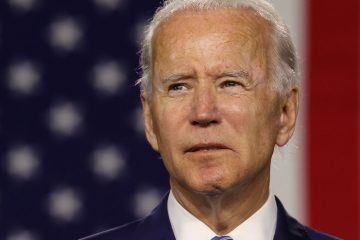
The evidence and the science show that Donald Trump has badly damaged the U.S. and its people—because he rejects evidence and science. The most devastating example is his dishonest and inept response to the COVID-19 pandemic, which cost more than 190,000 Americans their lives by the middle of September. He has also attacked environmental protections, medical care, and the researchers and public science agencies that help this country prepare for its greatest challenges. That is why we urge you to vote for Joe Biden, who is offering fact-based plans to protect our health, our economy and the environment. These and other proposals he has put forth can set the country back on course for a safer, more prosperous and more equitable future.

The pandemic would strain any nation and system, but Trump’s rejection of evidence and public health measures have been catastrophic in the U.S.

More here.

Witness California’s record blazes through the eyes of frontline firefighters

David Helvarg in National Geographic:

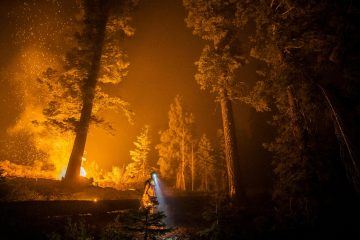
It was a comfortable looking home in a high-risk location, on Stringtown Road in the wooded hills south of Lake Oroville—a brown wood house with a stone chimney and big picture windows facing the forest. The pleasantly cluttered garden had tomato plants, a glass flamingo, and an abalone shell. It was here that a CAL FIRE task force, including a couple of engines and a dozen firefighters, decided to take a stand. They’d been pushed around by the Bear Fire for 24 hours. They would try to save at least one house.

Before passing through a police roadblock to meet the firefighters, I’d been to the rapidly growing CAL FIRE base camp at the fairgrounds in Chico. Like all CAL FIRE camps, it now requires passing through a “Mass Fever Screening” tent for COVID-19. Wearing a mask in California today, during a pandemic and a record-shattering fire season, serves a dual purpose. For days parts of this state have been competing with smoke-choked places in Oregon and Washington for the worst air quality in the world.

When I reached Oroville on September 9, the Bear Fire, the deadliest so far in 2020, had exploded in the hills north of the lake. Part of the North Complex fire, it had grown to 1,000 acres in its first half hour and advanced 30 miles in 18 hours. A wall of flame had destroyed the town of Berry Creek, including its fire station and fire truck—a grim reminder of the catastrophe that struck Paradise, California, just 14 miles to the northwest, in 2018.

More here.

The Paintings of Michael Armitage

Michael Armitage with Toby Kamps at The Brooklyn Rail:

Rail: Were you always a figurative painter?

Armitage: I certainly was when I started, seeing as I was six. Throughout art school, throughout my BA foundation course, I was basically making figurative paintings. Then I got to a point at the beginning of my postgraduate where I was questioning the use of the figure in painting. I was questioning all of the elements that make up a painting, down to image, support, color, material, ideas. At that point, I took the figure out of my paintings, and I began making abstract compositions that sometimes related to figures but were much more loose explorations of ideas. Ideas that I’m still thinking about and working on today.

But then, after working mainly as an abstract painter for the best part of three years, I began thinking about the relevance of art in Kenya and in East Africa. One of the things that was clear to me was that there isn’t a huge audience there, certainly not a kind of gallery-going audience. So if I wanted to make my paintings have a kind of immediacy and relevance to someone there that walked in off the street, one way of doing that would be to have a reflection of the people that I was interested in talking to. So that made me consider putting the figure back into my work.

more here.

On Quitting Academia

Malcolm Gaskill at the LRB:

Widening opportunity in education is the noblest of social and political projects. But the cost is now clear. In the ‘bad old days’ students were, as they are today, taught with commitment and passion, but sometimes eccentricity added a spark. Provided he – and it was usually a he – turned up fully dressed and sober and didn’t lay hands on anyone, the crazy lecturer could be an inspiration. Expectations were less explicit, the rhetoric and metrics of achievement were absent, which made everyone feel freer. Even applying to a university seemed less pressured, because it was so unclear what it would be like when you got there. You absorbed teachers’ anecdotal experiences and sent off for prospectuses, including the student-produced ‘alternative’ versions mentioning safe sex and cheap beer. Even after matriculation I had only a vague sense of the structure of my course. The lecture list was to be found in an austere periodical of record available in newsagents. Mysteries that today would be cleared up with two clicks on a smartphone had to be resolved by listening to rumours. This news blackout has been replaced by abundant online information, the publication of lucid curricular pathways, the friendly outreach of student services and the micromanagement of an undergraduate’s development. Leaps of progress all, if it weren’t for the suspicion that students might develop better if they had to find out more things for themselves. We learned to be self-reliant and so were better prepared for an indifferent world; we didn’t for a moment see the university as acting in loco parentis. Excessive care for students is as reassuring as a comfort blanket and can be just as infantilising.

more here.

On Albert Memmi

Adam Shatz in the LRB:

In​ 1957, Albert Memmi published a slender but explosive book, Portrait du colonisé précédé de Portrait du colonisateur, later translated as The Coloniser and the Colonised. Memmi was a Jew from Tunisia; he was in his late thirties and firmly on the left. At the time of publication, France had entered the fourth year of an undeclared war against nationalist insurgents in Algeria; it had lost its imperial foothold in Indochina in 1954 and was now determined to hang on to its possessions in Africa. Most French critics of colonial rule focused on land expropriation, the exploitation of indigenous labour and violent repression. To Memmi, however, these were symptoms of a broader, structural malaise. He depicted colonialism in North Africa – and elsewhere – as ‘a pyramid of privilege’ in which European settlers stood at the top, and the Arab Muslim majority at the absolute bottom. Even the poorest of Europeans – the so-called petits blancs or little whites – had an advantage over the wealthiest of Arabs, as members of the colonising population. As for Jews like himself, they too were colonised, yet they were a notch above the Arabs, and looked to France and the French language as potential sources of emancipation.

As a young man, he had defied his own community by allying himself with Arab nationalists fighting against French rule, but once Tunisia was liberated in 1956, he settled in France. While he believed that Tunisian Muslims had every right to expel the French who’d ruled their country as a protectorate since 1881, he had no wish to live under a government that he expected to be strongly influenced by Islam. Memmi, who died in late May, spent the rest of his life in Paris, in an apartment in the Marais, but he remained preoccupied with the question of the ‘lived experience’ of colonial domination, racism and other forms of oppression.

More here.

Wednesday Poem

Naming the Animals

Having commanded Adam to bestow
Names upon all the creatures, God withdrew
To empyrean palaces of blue
That warm and windless morning long ago,
And seemed to take no notice of the vexed
Look on the young man’s face as he took thought
Of all the miracles the Lord had wrought,
Now to be labelled, dubbed, yclept, indexed.

Before an addled mind and puddled brow,
The feathered nation and the finny prey
Passed by; there went biped and quadruped.
Adam looked forth with bottomless dismay
Into the tragic eyes of his first cow,
And shyly ventured, “Thou shalt be called ‘Fred.’ ”

by Anthony Hecht
from Collected Later Poems
Publisher Alfred A. Knopf 


Tuesday, September 15, 2020

From plague times to the coronavirus, the history of our flawed ability to process mass casualty events

Rebecca Onion in Slate:
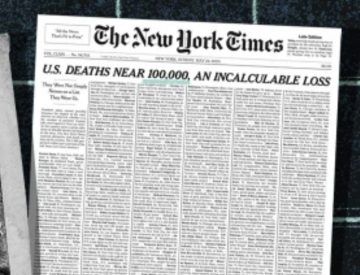
At first, some believed the numbers of Americans dead of the coronavirus might stay in the five figures. Then, as the toll climbed into six, some grieved, some grew numb, some made comparisons to the numbers lost in wars, some threw up every possible defense to deny that these numbers mattered. How is it that so many deaths—194,000 in the U.S. as of this weekend’s official count—can feel so intangible, so hard for so many people to fathom?

Jacqueline Wernimont, a historian who writes about quantification and commemoration, has been watching this unfold and feeling no small sense of déjà vu. Wernimont’s book, Numbered Lives: Life and Death in Quantum Media, is a history of the way we came to quantify mass death—and how those numbers have, too often, blunted the pain of those deaths. We spoke recently about the blurry historical line between “bills of mortality” in plague times and COVID dashboards, and why numbers can make some people feel, and others stop feeling. Our conversation has been condensed and edited for clarity.

Rebecca Onion: In your book, you point to the bills of mortality, which publicized the numbers of dead during 17th century plague epidemics in London, as a first instance of media that people in the middle of an outbreak could use to keep up with death counts. What were the bills of mortality, for the unfamiliar? 

Jacqueline Wernimont: The bills were publications, but also internal government documents. They were often published as broadsides—longer pieces of paper that could be nailed to poles or put in taverns or, say, at the entrance of London Bridge. They were sold as a single sheet for about 2 pence in the market and were compiled by what was known as the “Worshipful Company of Parish Clerks,” an incorporated group that had a royal warrant to gather information about people who had died and to publish and sell it.

The practice of gathering deaths and birth information had been going on for a long time, back to the medieval period, but around this time the tradition shifted.

More here.

The Economic Case for a People’s Vaccine

Sanjay G. Reddy and Arnab Acharya in the Boston Review:

Many have called for a people’s vaccine for COVID-19—a vaccine provided universally and accessibly to the entire world population. The moral arguments may be familiar, but economics supports the case, too. Economics also helps to explain what role the public sector should play in developing a people’s vaccine and how such efforts should be coordinated across countries.
Drawing on economic and moral arguments, we make the case in two steps. First we consider how a vaccine should optimally be distributed, once it has been developed. We argue that even if a vaccine were like any other consumer good—generating purely private benefits—the economic case for a people’s vaccine would be strong. But a vaccine differs from other consumer goods because of the special nature of health, which gives reason for us to value other people having it, even if there are no other spillovers involved. Moreover, a vaccine is not like just any other consumer good: its benefits extend far beyond the individual vaccinated. This externality strengthens the case for a people’s vaccine. Together, these considerations justify pricing a vaccine at an accessible cost. We argue that such a scheme is feasible even without any direct government intervention so long as the formula for the vaccine is made freely available. (After all, generic manufacturers currently compete to provide drugs using known formulas at low costs worldwide.)

More here.  [Thanks to Robin Varghese.]

At 31, I have just weeks to live. Here’s what I want to pass on

Elliot Dallen in The Guardian:

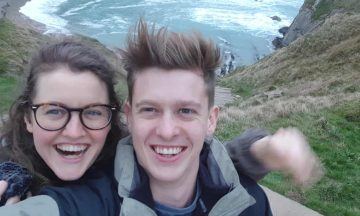
Elliot with his sister at Lulworth Cove, Dorset.

The first three decades of my life were pretty standard. Well, actually they were awesome, and everything was going pretty perfectly with regards to work, health, relationships and friends. I had plans for the future, too: learn some Spanish, see more of central America, and get a bit more out of it with some volunteering too.

I imagined settling down in my 30s or 40s with kids, a mortgage and so on. Or maybe I wouldn’t. Maybe my friends’ children would call me Uncle Elliot as their parents gathered in the kitchen looking slightly concerned about their single 45-year-old friend about to set off travelling around Mongolia. Either way, growing older with my mates and living my life to the full was always my ambition.

Of course, the second part of this storyline won’t be written now. It’s a shame I don’t get to see what happens. But everybody dies, and there will always be places and experiences missing from anyone’s life – the world has too much beauty and adventure for one person to see. I will miss marriage or children, blossoming careers and lives moving on. But I’m not alone in my life being cut short, and I think my time has been pretty good.

More here.  [Elliot died hours after The Guardian published this piece.]

The Paris Morgue

Amelia Soth at JSTOR Daily:

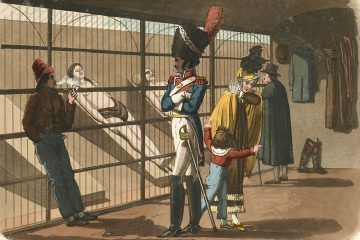
Behind a plate-glass window, framed by grand Doric columns, repose three bodies. Except for their leather loincloths, they are naked. From a pipe above each bed, a trickle of cold water runs down their faces. Their eyes are closed. They bear the marks of their deaths: one is swollen by drowning, one gashed by an industrial accident, another stabbed. A crowd of people gathers outside the window, staring at the bodies. This is the Paris Morgue, circa 1850.

Theoretically, the purpose of the display was to enlist public help in identifying unnamed corpses. But around the turn of the century, the morgue developed a reputation as a gruesome public spectacle, drawing huge crowds daily. The morgue was even listed in tourist guidebooks as one of the city’s unmissable attractions: Le Musée de la Mort.

more here.

The Media Learned Nothing From 2016

James Fallows in The Atlantic:

We’re seeing a huge error, and a potential tragedy, unfold in real time.

That’s a sentence that could apply to countless aspects of economic, medical, governmental, and environmental life at the moment. What I have in mind, though, is the almost unbelievable failure of much of the press to respond to the realities of the Trump age. Many of our most influential editors and reporters are acting as if the rules that prevailed under previous American presidents are still in effect. But this president is different; the rules are different; and if it doesn’t adapt, fast, the press will stand as yet another institution that failed in a moment of crucial pressure.

In some important ways, media outlets are repeating the mistake made by former Special Counsel Robert Mueller. In his book about the Mueller investigation, True Crimes and Misdemeanors (and in a New Yorker article), Jeffrey Toobin argues that Mueller’s tragic flaw was a kind of anachronistic idealism—which had the same effect as naivete. He knew the ethical standards he would maintain for himself and insist on from his team. He didn’t understand that the people he was dealing with thought standards were for chumps. Mueller didn’t imagine that a sitting attorney general would intentionally misrepresent his report, which is of course what Bill Barr did. Mueller wanted to avoid an unseemly showdown, or the appearance of a “fishing expedition” inquiry, that would come from seeking a grand-jury subpoena for Donald Trump’s testimony, so he never spoke with Trump under oath, or at all. Trump, Barr, and their team viewed this decorousness as a sign of weakness, which they could exploit.

More here.

“Belarmino,” a Hidden Masterwork

Richard Brody at The New Yorker:

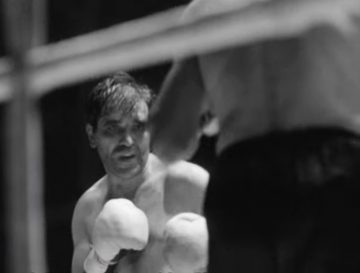
From the start, Lopes makes clear the fusion of style and substance that, no less than the fusion of reportage and reënactment, gives “Belarmino” its (and Belarmino his) artistic identity. The boxer—a former national champion in the featherweight division, who’s thirty-two and has been fighting for sixteen years—bounces down a long corridor to a training gym where, through a picture window, other athletes, all in striped shirts, are seen energetically working out as if in an angular dance scene choreographed by Jack Cole. Although others—younger, leaner, looser—spar and swarm, Belarmino, embodying the loneliness of the long-term boxer, punches the heavy bag with a fierce and solitary determination. It’s this very peculiarity—the essentially social and public nature of boxing versus the grimly encasing solitude of the boxer, the boxer’s desire for a private life and a social life versus the ferociously isolating dedication that the sport requires—which emerges in Lopes’s vision of Belarmino.

more here.

Cerebral Inception

Bob Grant in The Scientist:

You’d think that overseeing an entire issue of The Scientist focused on artificial intelligence would cause my mind to wander far into the future—robotic researchers formulating digital hypotheses, whizzing about in sleek, metallic labs. But immersing myself in stories about the novel insights and deep analyses enabled by smart instruments and machine learning did not transport me into a vision of science in the 23rd century.

Instead, I found myself thinking of the distant past, of a time when the first micro-vibrations of life were roiling the raw muck of early Earth. Rather than the grand sweep of what artificial intelligence may bring about—faster and more economical data processing, new insights, novel discoveries, and revolutionized workflows and transportation systems—I thought of the original form of intelligence on our planet. Intelligence on the molecular scale.

The Miller-Urey experiment of the 1950s began to shed mechanistic light on the dark mysteries of how Earth changed from an inanimate sphere to a planet bursting with life. But those famed researchers could zap into existence only amino acids, the building blocks of proteins. Later experiments pushed the chemical evolution toward life further by generating nitrogenous bases, the building blocks of RNA and DNA. But researchers have not yet succeeded in demonstrating a route from raw chemical materials to those crucial macromolecules. And it was through RNA, DNA, or both that life really burst from the starting blocks, those plucky nucleic acids acquiring a sort of self-motivation to replicate. That, I believe, was the dawn of intelligence.

More here.

Tuesday Poem

Eden Rock

They are waiting for me somewhere beyond Eden Rock:
My father, twenty-five, in the same suit
Of Genuine Irish Tweed, his terrier Jack
Still two years old and trembling at his feet.

My mother, twenty-three, in a sprigged dress
Drawn at the waist, ribbon in her straw hat,
Has spread the stiff white cloth over the grass.
Her hair, the colour of wheat, takes on the light.

She pours tea from a Thermos, the milk straight
From an old H.P. Sauce bottle, a screw
Of paper for a cork; slowly sets out
The same three plates, the tin cups painted blue.

The sky whitens as if lit by three suns.
My mother shades her eyes and looks my way
Over the drifted stream. My father spins
A stone along the water. Leisurely,

They beckon to me from the other bank.
I hear them call, ‘See where the stream-path is!
Crossing is not as hard as you might think.’

I had not thought that it would be like this.

by Charles Causley
from
Collected Poems 1951-2000
Picador, 2000