The Scramble to Defuse the ‘Feral Swine Bomb’

Diane Peters in Undark:

There are as many as 9 million feral swine across the U.S., their populations having expanded from about 17 states to 38 over the last three decades. Canada doesn’t have comparable data, but Ryan Brook, a University of Saskatchewan biologist who researches wild pigs, predicts that they will occupy 386,000 square miles across the country by the end of 2020, and they’re currently expanding at about 35,000 square miles a year.

“I’ve heard it referred to as a feral swine bomb,” says Dale Nolte, manager of the National Feral Swine Damage Management Program at the United States Department of Agriculture. “They multiply so rapidly. To go from a thousand to two thousand, it’s not a big deal. But if you’ve got a million, it doesn’t take long to get to 4 [million], then 8 million.”

More here.

Simulating Democracy

James Gleick in the New York Review of Books:

“Which category have they put you in?”

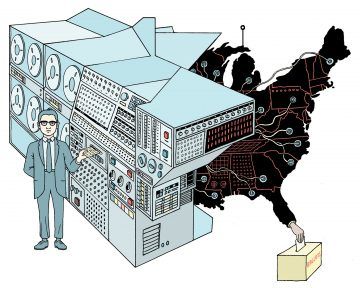
This sinister question—at least, it was meant to sound sinister—headlined the advertising copy for The 480, a 1964 novel by Eugene Burdick. His previous best sellers, The Ugly American and Fail-Safe, had caused sensations in political circles, and the new one promised to do the same. Its jacket featured the image of a punched card. The title referred to 480 categories of voter, defined by region, religion, age, and other demographic characteristics, such as “Midwestern, rural, Protestant, lower income, female.” Many readers recoiled from the notion of being sorted into one of these boxes. The New York Times’s reviewer called The 480 a “shock novel” and found it implausible.

What was so shocking? What was implausible? The idea that a company might use computer technology and behavioral science to gather and crunch data on American citizens, with the nefarious goal of influencing a presidential election.

In the 1950s and 1960s this seemed like science fiction. Actually, The 480 was a thinly disguised roman à clef, based on a real-life company called Simulmatics, which had secretly worked for the 1960 campaign of John F. Kennedy. Burdick had been a political operative himself and knew the Simulmatics founders well. The company’s confidential reports and memoranda went straight into his prose. And the 480 categories—listed in an appendix to the novel—were the real Simulmatics voter types, the creation of what one of its founders called “a kind of Manhattan Project gamble in politics.”

Simulmatics was founded in 1959 and lasted eleven years. Jill Lepore mentioned its involvement in the Kennedy campaign in These Truths (2018), her monumental history of the United States; she was already on the trail of the story she tells in her new book, If Then.

More here.

Greil Marcus’s Gatsby and the end of tragedy

Jackson Arn in The Point:

For good reason, The Great Gatsby is one of the most admired and talked-about books of the twentieth century. And that reason is, of course, that it’s really short—47,094 words, to be exact. I read it for the first time in a few hours at a swim meet (the aptness of the setting wasn’t clear to me until Chapter 8) and probably would have finished sooner had it not been for the snatches of Eminem coming from somebody’s boombox. You can count the book’s speaking roles on your fingers, and any high school sophomore can skim it the night before the big exam. Assign that to millions of teenagers for sixty-odd years, and a Great American Novel is born.

I don’t mean to belittle what Fitzgerald achieved in his most famous work: the grandeur of his themes, or the calm thrust of his narrator’s voice, or the fine shading of his descriptions (the bit about the juice machine button pressed two hundred times by a butler’s thumb has mocked my feeble attempts at lyricism for years). But not all beautifully written books sell half a million copies a year, and it’s no coincidence that Gatsby—rather than The Adventures of Augie MarchInvisible Man or Gravity’s Rainbow, to name three American novels of equal splendor but considerably more bulk—is the rare classic that everyone remembers the gist of. There is much less of it to forget.

So much less, in fact, that readers may find themselves remembering things Fitzgerald never wrote.

More here.

Thoughts into words

Eli Alshenatsky in aeon:

What is it about the proposal that strikes me as so disturbing?’ Reading through an article describing a local government measure, I feel opposition rising within me. Normally, forming an opinion about such things would take me some time. But not here. The proposal instantly strikes me as unjust. My reaction is not just intellectual; it is visceral. My emotions are engaged. My imagination is exercised. As I imagine the proposal playing out in practice, the distinctive brand of injustice seems to be jumping out of every word on the page.

I decide to sort out my problem with the proposal in writing, by replying to the colleague who forwarded me the article. ‘It’s unfair!’ Impatiently, I blurt out the kernel of what bothers me about it. But the statement is so general as to be almost empty. ‘Heavy-handed. Quietly authoritarian. Positively harmful.’ More words suggest themselves to me and, after a few false starts, I regain my confidence and press the formulation forward with each sentence. I edit some words, and the correction puts everything in order. Reading over what I wrote, I recognise that, even though there is room for elaboration, at this moment these words accurately capture my position. I have found the words to express my thought.

The gulf between our solitary thoughts and the words that would convey them to others constantly confronts us all. The thoughts we struggle to articulate might be as momentous as a transformative moral epiphany or as ordinary as an insight into a movie or the hurtful behaviour of a friend. They might seem hopeful or alarming, frivolous or serious, lead us to find value in certain things, or worry about others. They might be thoughts that we long had but never articulated or instantaneous insights in which something entirely new and unfamiliar suddenly comes to mind. In many cases, we articulate these thoughts in order to get clear on what they are; we wouldn’t bother making the effort if they were clear to us already.

More here.

Sunday Poem

A Portrait in Greys

Will it never be possible
to separate you from your greyness?
Must you be always sinking backward
into your grey-brown landscapes—and trees
always in the distance, always against a grey sky?
……………………… Must I be always
moving counter to you? Is there no place
where we can be at peace together
and the motion of our drawing apart
be altogether taken up?
…………………………………. I see myself
standing upon your shoulders touching
a grey, broken sky—
but you, weighted down with me,
yet gripping my ankles,—move
……………………. laboriously on,
where it is level and undisturbed by colors.

by William Carlos Williams

Saturday, September 19, 2020

A Timely Collection of Vital Writing by Audre Lorde

Parul Seghal at the NYT:

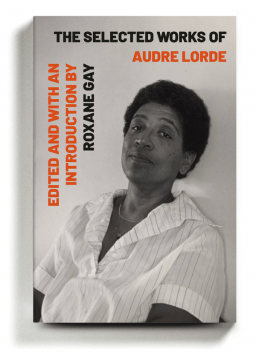
Lorde loved to be in dialogue, loved thinking with others, with her comrades and lovers. She is never alone on the page. Even her short essays come festooned with long lines of acknowledgment to those who have sharpened their ideas. Ghosts flock her essays. She writes to the ancestors and to women she meets in the headlines of the newspaper — missing women, murdered women, naming as many as she can, the sort of rescue and care for the dead that one sees in the work of Saidiya Hartman and Christina Sharpe. In “The Cancer Journals,” in which she documented her diagnosis of breast cancer, she noted: “I carry tattooed upon my heart a list of names of women who did not survive, and there is always a space left for one more, my own.”

more here.

The world’s central banks are starting to experiment. But what comes next?

Adam Tooze in The Guardian:

Are we seeing the end of the supremacy of the US dollar? With soaring government spending and gaping deficits are we on the cusp of a great surge of inflation? In light of the extreme financial measures required by the Covid-19 crisis and the alarming polarisation of US politics, the markets can be forgiven for asking such dramatic questions.

But it is worth reminding ourselves that as recently as March, the whole world was crying out for dollars. And far from fearing inflation, the problem actually facing central banks is how to avoid sliding into deflation. Falling prices are a disaster because they squeeze debtors – think negative equity in housing markets – and create a vicious circle of postponed purchases, leading to falling demand and further deflation.

In response to the threat of deflation, there are, indeed, changes afoot. But these take the form not of some dramatic collapse, but of a series of subtle but important adjustments in central bank policy.

More here.

America’s Dire Inequality Demands a New Conceptual Framework

Lynn Parramore interviews Lance Taylor over at INET:

Lynn Parramore: In your new book, you name wage repression as the biggest driver of inequality in the U.S. over the last several decades. Your conclusion differs from many who have studied the issue, such as Thomas Piketty, who theorized that inequality is caused mainly by a tendency of profits to run ahead of the growth rate in the economy. What’s different about your take?

Lance Taylor: Piketty & Co. deserve a lot of credit for using tax and other data to estimate how income distribution differs across households over 200 years. The question is, what explains these differences?

I wanted to analyze how income differences among various kinds of households (poor, middle class, and affluent) came about over time. That meant drilling down into macroeconomic indicators as well as the data associated with the various industries in which people worked and the streams of income they received from them.

Özlem Ömer and I assembled what we needed by reworking Congressional Budget Office data along the lines of the U.S. Bureau of Economic Analysis (BEA) National Income Accounts. This allowed us to look at both macroeconomics and individual industries or sectors — 16 in all.

We studied changes in the structure of payments, employment, and output of products and services across these 16 sectors. What we found is that except in volatile and low-profit agriculture and mining sectors, real wages grew less rapidly than productivity since around the time of Reagan’s presidency. Wage shares decreased, but profit shares increased at the industry and macro levels, and the money from those profits ended up in the pockets of business owners and the wealthy instead of being shared.

For the most part, Americans workers have been working more productively, but they haven’t been getting paid for it due to forces that aren’t natural and inevitable. Wage repression doesn’t just happen.

More here.

Antifa Dust

Michael Scott Moore in the LA Review of Books:

IN 2005, I covered a raucous political rally in the German town of Gera, near Weimar, featuring neo-Nazis who wanted to field a candidate for chancellor during the national election that brought Angela Merkel to power. Their man was a belligerent politician with a mustache named Udo Voigt. Skinheads and more conventional-looking Germans — including Birkenstock-wearing young families — gathered in the dappled sunlight of an enclosed park for speeches and music. Local police had surrounded the park’s perimeter to keep counterprotesters marching against the rally in Gera’s cobblestoned streets from clashing with the skinheads. Police turn up whenever neo-Nazis march in postwar Germany — without them there would be riots.

A far-right band in the park had just finished a set of racist thrash music while tech workers arranged the stage for a speech by Voigt. Behind them a banner for the NPD, Germany’s most significant neo-Nazi party at the time, fluttered in the wind. I happened to ask a pregnant woman pushing a stroller across the grass why she voted NPD. Familie und Vaterland, she said. Policies favoring German families, German priorities. She felt alienated by Gerhard Schröder’s Social Democrats and Merkel’s more conservative CDU/CSU — the major parties — and although she cast herself as a simple dissident against the German mainstream, the racist fog of the rally was hard to ignore.

She gave me a gentle smile as she explained her problem with Germany’s conventional parties. “They put up with too much corruption,” she said.

I took notes, which a lot of people regarded with suspicion. Udo Voigt mounted the stage between black columns of amplifiers and spoke with his sleeves rolled up, like a man with work to do. He gave the usual populist far-right line: anti-immigrant, anti-establishment, anti-journalist, pro-German blood and soil. The next time I saw a similar event was 10 years later, when US networks started to televise Donald Trump’s campaign rallies.

More here.

The Political Economy of Saving the Planet

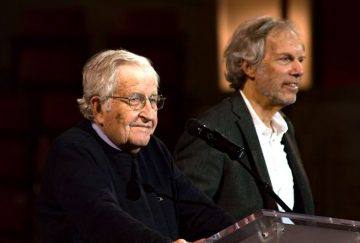
Noam Chomsky and Robert Pollin talk to C. J. Polychroniou in Boston Review:

C. J. Polychroniou: How does the coronavirus pandemic, and the response to it, shed light on how we should think about climate change and the prospects for a global Green New Deal?

Noam Chomsky: At the time of writing, concern for the COVID-19 crisis is virtually all-consuming. That’s understandable. It is severe and is severely disrupting lives. But it will pass, though at horrendous cost, and there will be recovery. There will not be recovery from the melting of the arctic ice sheets and the other consequences of global warming.

Not everyone is ignoring the advancing existential crisis. The sociopaths dedicated to accelerating the disaster continue to pursue their efforts, relentlessly. As before, Trump and his courtiers take pride in leading the race to destruction. As the United States was becoming the epicenter of the pandemic, thanks in no small measure to their folly, the White House cabal released its budget proposals. As expected, the proposals call for even deeper cuts in healthcare support and environmental protection, instead favoring the bloated military and the building of Trump’s Great Wall. And to add an extra touch of sadism, “the budget promotes a fossil fuel ‘energy boom’ in the United States, including an increase in the production of natural gas and crude oil.”

More here.

The Wages of Whiteness

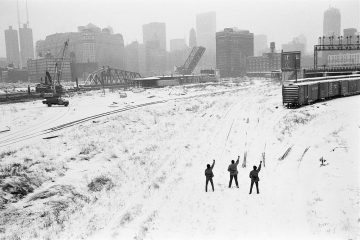
Black Panthers, Chicago, 1969

Hari Kunzru in the NY Review of Books:

In 1981 members of a revolutionary group called the Black Liberation Army robbed a Brink’s armored van at the Nanuet Mall in Rockland County, just outside New York City. In the robbery and a subsequent shootout with police, a guard and two police officers were killed. Assisting this Black Nationalist “expropriation” operation were four white Communists, members of a faction of the Weather Underground called the May 19 Communist Organization. They acted as getaway drivers, and three of the four were unarmed, yet they were convicted of murder and sentenced to decades in prison.

One of these white participants, Kathy Boudin, told a skeptical Elizabeth Kolbert, who interviewed her in prison for a 2001 profile in The New Yorker, that she didn’t know anything about the target of the robbery, how it was planned, who was going to commit it, or the intended purpose of the money. She was approached only a day before it took place. This wasn’t mere ignorance, she explained, but a political act of faith. She told Kolbert:

My way of supporting the struggle is to say that I don’t have the right to know anything, that I don’t have the right to engage in political discussion, because it is not my struggle. I certainly don’t have the right to criticize anything. The less I would know and the more I would give up total self, the better—the more committed and the more moral I was.

More here.

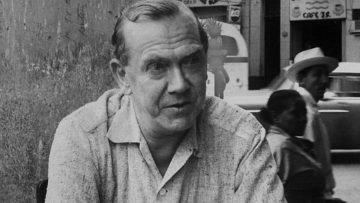
The paradox of Graham Greene

Nicholas Shakespeare in The Spectator:

Joseph Conrad’s death made Graham Greene feel, at 19, sitting on a beach in Yorkshire, ‘as if there was a kind of “blank” in the whole of contemporary literature’. Greene’s own death in 1991, aged 87, had a similar effect on many younger writers, myself included. For John le Carré, his most obvious successor, Greene had ‘carried the torch of English literature, almost alone’. His cool fugitive presence, in Martin Amis’s phrase, had been there all our reading lives. In an age of diminishing faith, he had used Catholic parables in a way that lent them a power beyond their biblical origins, mining the gospels rather as le Carré has mined the Cold War. Shaking his hand in Moscow in 1987, Mikhail Gorbachev spoke for an international audience: ‘I have known you for some years, Mr Greene’ — although it was unclear whether as an admirer of his novels, or if Russia’s president had seen his name in intelligence reports concerning Latin America.

About Greene’s character, less consensus reigns. Congenitally elusive, he refused to appear on television. ‘I feel I’ve got a copyright on my life,’ he explained to me, ‘and that people I know should have a copyright on theirs.’ How much of his secretiveness was vanity is hard to tell. Unable to pronounce the letter ‘r’, his instinct was for self-effacement — ‘I am so shy’ were his first words to Kim Philby’s Russian wife. Yet co-habiting the same skin — ‘faintly sunburned, with the texture of fine dry silk’, recalled one mistress, Jocelyn Rickards — there writhed a provocative exhibitionist whose love-making with Rickards as they travelled first-class by train to Southend was conducted in blatant view of those on the platforms.

Definitely, there were aspects of his life that he hated, even if others thought it a good thing to be him, and pinched his identity. When Greene learned of one impersonator being jailed in Assam, he proposed to interview him for Picture Post. But his double jumped bail, so the real Graham Greene couldn’t visit India for fear of arrest.

More here.

The Ruth Bader Ginsburg Fandom Was Never Frivolous

Megan Garber in The Atlantic:

In 2014, Kate Livingston created a quirky Halloween costume for her 12-week-old son. It featured a black, sleeved onesie. And a white silken collar. And a pair of large, plastic-rimmed glasses. Livingston snapped a picture of the cosplaying infant—he provided the cool scowl—and then added a caption, in blunt all-caps, to the photo she took: “I DISSENT.” Ruth Baby Ginsburg was born.

Justices of the Supreme Court have traditionally existed above the fray. They wear body-obscuring black robes, stay stoic at the State of the Union address, and prioritize a long-view approach to human events. But Ruth Bader Ginsburg, who died today at age 87, changed that model, because Ruth Bader Ginsburg lived within the fray: Particularly in her later years, she was a justice who was also a celebrity. There was Notorious RBG, the meme and the Tumblr and the book. There was On the Basis of Sex, the 2018 biopic telling the story of Ginsburg’s early years as a professor and a litigator. There was RBG, the documentary. There were Kate McKinnon’s swaggering impressions on Saturday Night Live (“You’ve been Ginsburned!”). And there was the array of RBG-themed goods: the prayer candles, the dolls, the coloring books, the jewelry. There are the collections of RBG-inspired collars. Hers is a visible fandom.

More here.

Saturday Poem

A Pile of Fish

—for Paul Otremba

Six in all, to be exact. I know it was a Tuesday
or Wednesday because the museum closes early
on those days. I almost wrote something

about the light being late—; the “late light”
is what I almost said, and you know how we
poets go on and on about the light and

the wind and the dark, but that day the dark was still
far away swimming in the Pacific, and we had
45 minutes to find Goya’s “Still Life with Bream”

before the doors closed. I’ve now forgotten
three times the word Golden in the title of that painting
—and I wish I could ask what you think

that means. I see that color most often
these days when the cold, wet light of morning
soaks my son’s curls and his already light

brown hair takes on the flash of fish fins
in moonlight. I read somewhere
that Goya never titled this painting,

or the other eleven still lifes, so it’s just
as well because I like the Spanish title better.
“Doradas” is simple, doesn’t point

out the obvious. Lately, I’ve been saying
dorado so often in the song I sing
to my son, “O sol, sol, dorado sol

no te escondes…” I felt lost
that day in the museum, but you knew
where we were going having been there

so many times. The canvas was so small
at 17 x 24 inches. I stood before it
lost in its beach of green sand and

that silver surf cut with pink.
I stared while you circled the room
like a curious cat. I took a step back,

and then with your hands in your pockets
you said, No matter where we stand, 
     there’s always one fish staring at us.

As a new father, I am now that pyramid
of fish; my body is all eyes and eyes.
Some of them watch for you in the west

where the lion sun yawns and shakes off
its sleep before it purrs, and hungry,
dives deep in the deep of the deep.

by Tomás Q. Morín
from the
Academy of American Poets

Friday, September 18, 2020

Martin Amis, Christopher Hitchens and the long road to reaction

Thomas Meaney in The New Statesman:

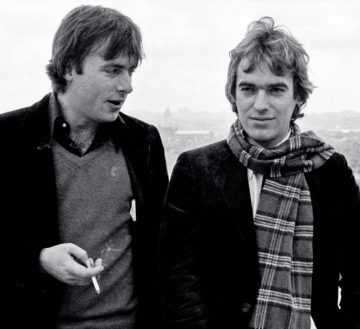
It would hardly have surprised Christopher Hitchens, his unsanguine views of the afterlife under no bushel, that among the trials and stations awaiting his departed soul there would be passage through a  Martin Amis novel (he had already endured being packed into The Pregnant Widow in the character of Nicholas Shackleton). Inside Story – the Fleet Street tease of the title notwithstanding – evinces a protective, even proprietary attitude towards the goods to be delivered. The cover features an arresting image of the two grands amis – both formerly of this parish – on the cusp of their prime. Hitchens is on the left, holding his cigarette mid-abdomen like a paintbrush. His as yet unravaged face seems to be gauging whether his last remark has landed with Amis, who looks into the distance, appearing simultaneously satisfied and anxious.

The novel, however, is more than a testament to a sacred bond. Inside Story whiplashes the reader between more decades (roughly from the start of Amis’s career in 1973 with The Rachel Papers, right up to the age of Trump) and more figures than his memoir Experience (perhaps Amis’s best book to date, and certainly his most finely structured).

More here.