Matto Mildenberger and Leah C. Stokes in the Boston Review:
 Over a decade ago, California put a price on carbon pollution. At first glance the policy appears to be a success: since it began in 2013, emissions have declined by more than 8 percent. Today the program manages 85 percent of the state’s carbon pollution: the widest coverage of any policy in the world. California’s effort has been lauded as the “best-designed” carbon pricing program in the world.
But while the policy looks good on paper, in practice it has proven weak. Since 2013 the annual supply of pollution permits has been consistently higher than overall pollution. As a result, the price to pollute is low, and likely to remain that way for another decade. This slack in the system has made the policy better at revenue collection than changing corporate behavior.
This is not a surprise.
More here.
 Maybe my book is rotten,” F Scott Fitzgerald told a friend, in February 1925, shortly before the publication of The Great Gatsby, “but I don’t think so”. If the first half of his sentence was perfunctory, the second half was the wildest kind of understatement. By that point, Fitzgerald knew what he had achieved. Six months earlier, he informed Maxwell Perkins, his editor at Scribner’s, that his work in progress “is about the best American novel ever written”. And Perkins’s reaction had done little to shake his sense of confidence. He called the book “a wonder”, adding: “As for sheer writing, it’s astonishing.”
 What is America really fighting over in the upcoming election? Not any particular issue. Not even Democrats versus
  Katrina vanden Heuvel in The Nation:
 Sweet Dreams tactfully sidesteps whether some of the New Romantics mirrored the celebrity-for-celebrity’s sake aspirations of many of today’s vloggers and influencers. But Jones makes a convincing case that their penchant for what used to be called “gender-bending” and their sartorial obsession with self-expression as “a platform for identity” foreshadows a lot of 2020’s hot-button topics. The book is excellent on the movement’s origins both in the aspirational teenage style cult that built around Bryan Ferry in the mid-70s and the more fashion-forward occupants of the same era’s gay clubs and soul nights, who saw the clothes Malcolm McLaren and Vivienne Westwood sold in their boutique Sex not as harbingers of spittle-flecked youth revolution but as a particularly outrageous brand of couture: it’s often written out of punk’s history that, at precisely the same time the Sex Pistols’ career was getting underway, there were people in Essex dancing to disco dressed exactly like Johnny Rotten.
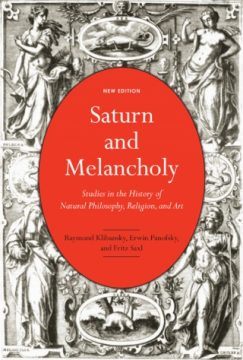 If melancholia may be “[s]ometimes painful and depressing, sometimes merely mildly pensive or nostalgic,” then this new edition is, in its own right, a melancholic exercise, a wistful homage to the once-world in which the book was produced. It is also melancholic from the perspective of the contemporary reader who is able to fathom the shear catholicity of mind necessary to produce a Meisterwerk of this sort. But it is in fact that very nostalgia that is in question in the book proper, for the study lays out just how persistently the posture of scholar, artist and anchorite alike has been one of despair at the path that separates them from the great transcendence lying on the horizon, whether that goes by the name of God, the eternal intellect or the Mallarmean “Book.” And in this respect, the history of melancholy itself joins up with the story of the long, arduous path by which the book came into being.
 Radhika Coomaraswamy in Daily FT (Sri Lanka):
 I
I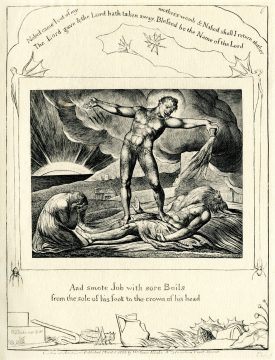 I thought of the biblical story of Job last month when I was asked to speak to the National Partnership for Hospice Innovation. How would I counsel others to cope with losses so terrifying and unfair? How could those grieving find a sense of hope or meaning on the other side of that loss? In my research I found myself drawn to the powerful rendition of the Book of Job by the 18th-century British poet, artist and mystic William Blake, in particular his collection