Arundhati Roy in The Guardian:
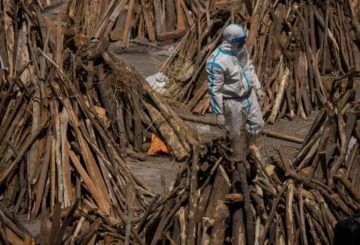 During a particularly polarising election campaign in the state of Uttar Pradesh in 2017, India’s prime minister, Narendra Modi, waded into the fray to stir things up even further. From a public podium, he accused the state government – which was led by an opposition party – of pandering to the Muslim community by spending more on Muslim graveyards (kabristans) than on Hindu cremation grounds (shamshans). With his customary braying sneer, in which every taunt and barb rises to a high note mid-sentence before it falls away in a menacing echo, he stirred up the crowd. “If a kabristan is built in a village, a shamshan should also be constructed there,” he said.
“Shamshan! Shamshan!” the mesmerised, adoring crowd echoed back. Perhaps he is happy now that the haunting image of the flames rising from the mass funerals in India’s cremation grounds is making the front page of international newspapers. And that all the kabristans and shamshans in his country are working properly, in direct proportion to the populations they cater for, and far beyond their capacities. “Can India, population 1.3 billion, be isolated?” the Washington Post asked rhetorically in a recent editorial about India’s unfolding catastrophe and the difficulty of containing new, fast-spreading Covid variants within national borders. “Not easily,” it replied. It’s unlikely this question was posed in quite the same way when the coronavirus was raging through the UK and Europe just a few months ago. But we in India have little right to take offence, given our prime minister’s words at the World Economic Forum in January this year.
Modi spoke at a time when people in Europe and the US were suffering through the peak of the second wave of the pandemic. He had not one word of sympathy to offer, only a long, gloating boast about India’s infrastructure and Covid-preparedness. I downloaded the speech because I fear that when history is rewritten by the Modi regime, as it soon will be, it might disappear, or become hard to find. Here are some priceless snippets:
“Friends, I have brought the message of confidence, positivity and hope from 1.3 billion Indians amid these times of apprehension … It was predicted that India would be the most affected country from corona all over the world. It was said that there would be a tsunami of corona infections in India, somebody said 700-800 million Indians would get infected while others said 2 million Indians would die.”
“Friends, it would not be advisable to judge India’s success with that of another country. In a country which is home to 18% of the world population, that country has saved humanity from a big disaster by containing corona effectively.”
Modi the magician takes a bow for saving humanity by containing the coronavirus effectively. Now that it turns out that he has not contained it, can we complain about being viewed as though we are radioactive?
More here. (Note: Thanks to Nazli Raza!)

 Coming on the heels of the Neuralink announcement earlier this month—complete with video showing a monkey playing Pong with its mind, thanks to a wireless brain implant—researchers with the BrainGate Consortium have successfully demonstrated a high-bandwidth wireless brain-computer interface (BCI) in two tetraplegic human subjects. The researchers described their work in a recent paper published in the journal IEEE Transactions in Biomedical Engineering.
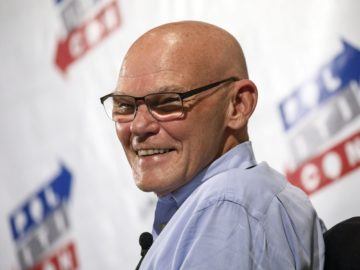 James Carville: You ever get the sense that people in faculty lounges in fancy colleges use a different language than ordinary people? They come up with a word like
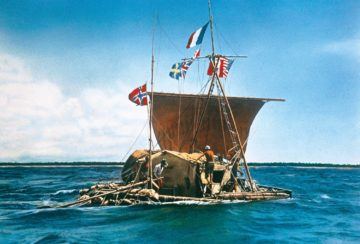 As he later told the story in Kon-Tiki: Across the Pacific by Raft, he was brushed off by many in the scientific establishment — and so went to extraordinary lengths to prove the theory’s plausibility, reconstructing the ancient journey by sailing across the sea on a wooden raft in 1947. This spectacular feat captured the imagination of the world, and researchers, skeptical as they might have been, have ever since debated what really had happened in prehistoric times between South America and Polynesia (the group of Pacific islands stretching from New Zealand to Hawaii). Most scientists never accepted the amateur anthropology in which Heyerdahl couched his theory, but the mystery of an ancient trans-Pacific journey was a live one. All sorts of evidence would be marshalled, sometimes seeming to affirm Heyerdahl in part, sometimes seeming to show him entirely wrong.
 Milman Parry was arguably the most important American classical scholar of the 20th century, by one reckoning “the Darwin of Homeric Studies.” At age 26, this young man from California stepped into the world of Continental philologists and overturned some of their most deeply cherished notions of ancient literature. Homer, Parry showed, was no “writer” at all. The
  At the core of Anton Chekov’s short story, ‘
 Released from the silo of conventional philosophy, I found the neuroscientists at the medical school to be uniformly hospitable and curious about what I was up to. A human brain was indeed delivered to me in the anatomy lab, and holding it my hands, I felt an almost reverential humility toward this tissue that had embodied someone’s love and knowledge and skills. It looked so small, relative to what a human brain can do.
 In cities big and small, hospitals are too full to accept new patients and diagnostic centers take up to three days or more to do chest scans of those who might have Covid-19. Doctors and hospital staff are completely exhausted.
 “In North America we pose a far greater risk to our bats than they do to us,” said O’Keefe, a bat ecologist and professor of environmental science at the University of Illinois at Urbana-Champaign. COVID-19 is a zoonotic disease, an illness that jumped from animal hosts to humans. But disease transfer isn’t just a one-way street. It takes only a bit of evolutionary bad luck to turn a bat’s head cold into a human’s killer. But it takes only a little more for the same virus to jump from humans to other animals. Zoonosis begets reverse zoonosis, which can, in turn, come back around to zoonosis again. A virus we give to a bat could, someday, come back around to reinfect us. Animals’ health is ours, ours is theirs, theirs is ours.
 Polidori: Well, America is a Protestant country. Protestants don’t take so well to pathos, so they think that I’m a reactionary, because I am making misery look beautiful. And so because of this, I am minimizing the plight of the victims. I only get this in Anglo-Saxon countries, the rest of the world doesn’t think that way.
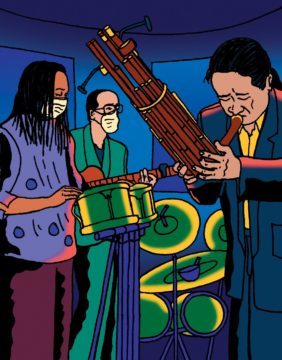 On the stage of an empty concert hall, the Austrian-born composer
 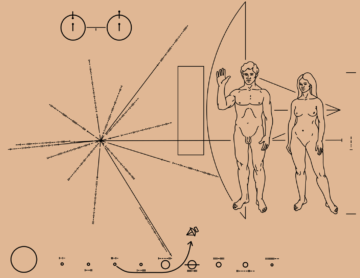 I often think about George Berkeley’s observation (without recalling quite where he offered it) that when we think we are imagining to ourselves the heat of the sun, what we are really imagining is the heat of a stove or a similar familiar source of mundane household warmth. A stove is already hot enough to reduce my hand to ash fairly quickly. And without a hand left, without any nerve endings to give me any report at all on the external world, I’m hardly in a position to note the difference between 300 degrees Fahrenheit and 5,700 degrees Kelvin. Both, Berkeley thinks, are just too darn hot.