Triggering the Body’s Defenses to Fight Cancer

Lina Zeldovich in Nautilus:

One day in 2010, when oncologist Paul Muizelaar operated on a patient with glioblastoma—a brain tumor infamous for its deathly toll—he did something shocking. First, he cut the skull open and carved out as much of the tumor as he could. But before he replaced the piece of skull to close the wound, he soaked it in a solution containing Enterobacter aerogenes,1 bacteria found in feces. For the next month, the patient lay in a coma in an intensive care unit battling the bacteria he was infected with—and then one day a scan of his brain no longer showed the distinctive signature of glioblastoma. Instead, it showed an abscess, which, given the situation, Muizelaar deemed a positive development. “A brain abscess can be treated, a glioblastoma cannot,” he later told the New Yorker. Trying it, he thought, was worth the chance. He had done this only as a means of last resort in a couple of hopeless cases—but ultimately, his patients still passed away, which led to a scandal that forced him to retire.

Muizelaar’s approach may sound beyond outrageous, but it wasn’t entirely crazy. For over 200 years medics have known that infections, particularly those accompanied by fevers, can have a strange and shocking effect on cancers: Sometimes they wipe the tumors out. The empirical evidence for these hard-to-believe cures has been documented in medical literature, dating back to the 1700s. In the 19th century, some doctors tried treating cancer patients by deliberately infecting them with live bacterial pathogens. Sometimes it worked, sometimes the patients died. Injecting people with dead bacteria worked better and, in fact, saved lives, at least in some cancers. The problem was that it didn’t work consistently and repeatedly so it never became an established treatment paradigm. Moreover, no one could explain how the method worked and what it did. Doctors speculated that infections somehow revved up the body’s defenses, but even in the early 20th century, they had no means of elucidating the mysterious force that devoured the tumor.

More here.
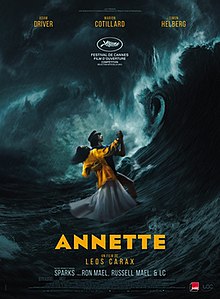
Two Cinematic Takes on Masculinity

Erick Neher at The Hudson Review:

“I’m a storyteller” is a common self-description for virtually everyone in the film industry these days, from directors and scenarists to publicists and marketers. The phrase is a quintessential humble-brag. It carries a sense of modesty: “I may have a profoundly intricate knowledge of my craft, but at heart I’m no different from the people spinning a good yarn for their kids.” But it also holds a whiff of epic continuity, placing the speaker in a line that reaches back to Homer, and beyond that to the nameless bards who first narrativized our species into civilization. All to say: the phrase has passed through ubiquity to become an increasingly mocked cliché. Which is why it was so refreshing to hear the French director Leos Carax say in a recent interview with the New York Times, “I’m not a storyteller.” He’s right. He’s a poet, a provocateur, an artist—but anyone attending a Carax movie expecting narrative coherence, character logic, or shapely story arcs will be sadly disappointed. “I try to compose emotional scores, like movements that flow into minor and major keys,” Carax continued. And indeed his films, including his latest, Annette, have more in common with modern music than they do with theater or literature.
more here.

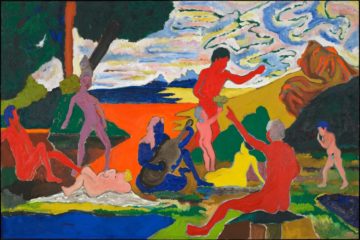
Bob Thompson’s Improvisations

J. Hoberman at The Point:

However reductive it may be to call the painter Bob Thompson the Jean-Michel Basquiat of the 1960s, the comparison is inescapable.
Thompson is the subject of the current retrospective, “This House Is Mine,” at the Colby College Museum of Art in Waterville, Maine, and like Basquiat he was a Black artist who quickly developed a recognizable signature style that blossomed in a gritty, mainly white, Lower Manhattan bohemia. Like Basquiat, Thompson was deeply into music and drawn to musicians. And like Basquiat, Thompson died young, leaving a body of work by turns cryptic and accessible. Basquiat was an art-world phenom anointed by Andy Warhol, and so prolific that he was thought to be suffering from burnout when he overdosed on heroin at 27. Thompson, although never as celebrated, was also a hot young artist—his last one-man show in New York broke attendance records at the Martha Jackson Gallery, then a vanguard uptown venue—and then, just short of 29, he died from an overdose in Rome in 1966.

more here.

Tuesday Poem

The Wages of History

Men’s negligence and their
fatuous ignorance and abuse
have made a hardship of this earth.
Living on these plundered
hillsides of Kentucky is harder
for crops and for men too
than the terraced slopes
of Tuscany or Japan, where care
has had a history centuries
old. As if chance and death
and sorrow were not enough,
we must contend with stones
laid bare by the dream of
ease to be found in money, as if
our forefathers dug in the dark
virgin loam for gold, and found
only bare stones and the grave’s
ease. Doomed, bound and doomed
to the repair of history or to death
we must cover over the stones
with soil for tomorrow’s bread
while the present eludes us.
For generations to come we will not
know the decency and the poised ease
of living any day for that day’s sake,
or be graceful here like the wild
flowers blooming in the fields,
but must live drawn out and nearly
broken between past and future
because of our history’s wages,
bad work left behind us,
demanding to be done again.

by Wendell Berry
from
Farming-A Hand Book
Harvest Books, 1967

Sunday, November 7, 2021

At Home with Gish Jen

Mike Harvkey in The Millions:

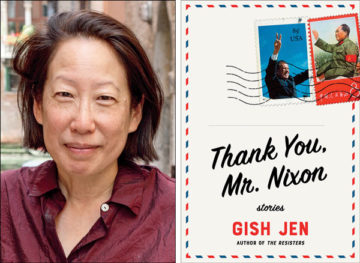
The characters of Thank You, Mr. Nixon, Gish Jen’s expansive new collection of superconnected short stories, are restless. They leave China for America and return, leave America for China and return, traveling between the two countries and cultures as if through a revolving door. Jen, like the second-generation Americans in her book, understands what it is to be “hybrid,” and the inherent tension that requires her characters to engage in frequent acts of translation—linguistic, cultural, and generational—whether they wish to or not.

Born on Long Island in 1955, Jen says she came of age “at the height of multiculturalism, when I was supposed to be writing about my Chinese roots.” But growing up in Scarsdale, N.Y., she learned more Yiddish than Chinese—an experience she mined for her very funny second novel, 1996’s Mona in the Promised Land, about a Chinese girl converting to Judaism.

More here.

The ‘bullet’ airplane that could revolutionize business aviation

Jacopo Prisco at CNN:

Otto Celera 500L, it’s one that catches the eye. It looks like no other plane out there, and for a good reason: unique aerodynamics.

The shape of the Celera is designed to drastically reduce drag by allowing air to flow very smoothly over the surface of the plane. That makes the aircraft less power-hungry, which means it burns less fuel.

“This gets us four to five times the efficiency of other turboprop aircraft, and seven to eight times the efficiency of jet aircraft,” says William Otto Jr., CEO of Otto Aviation.

In numbers, that means operating costs that trounce those of similarly sized business planes. According to Otto Aviation, flying on the Celera will cost $328 an hour compared to $2,100, with a fuel economy of 18 to 25 miles per gallon — similar to that of a large SUV — compared to two to three miles per gallon.

All of that with enough space for six passengers, a speed of 460 miles-per-hour and a range of 4,500 miles, comparable to that of an airliner. Is it all too good to be true?

More here.

There are six main narratives of globalization, all flawed

Anthea Roberts and Nicholas Lamp in Aeon:

Isaiah Berlin understood the parable of the fox and the hedgehog – ‘the fox knows many things, but the hedgehog knows one big thing’ – to illustrate two styles of thinking. Hedgehogs relate everything to a single vision, a universally applicable organising principle for understanding the world. Foxes, on the other hand, embrace many values and approaches rather than trying to fit everything into an all-encompassing singular vision.
Debates about economic globalisation are often dominated by hedgehogs – actors who interpret and evaluate the dynamics and consequences of globalisation through a single lens. Take the narrative that dominated the debate about globalisation in the West from the collapse of the Soviet Union until the global financial crisis in 2008. On this view, economic liberalisation promised to grow the pie so that everyone – developed and developing countries, rich and poor – would be better off. This confident perspective touted free trade as a win-win outcome that would create peace and prosperity for all.

In recent years, this view has been challenged by a variety of narratives that stress that economic globalisation produces many losers.

More here.

The ongoing impact of Edgar Allan Poe

Sudipto Sanyal in The Smart Set:

What is it about Poe that grips the popular imagination so, like the medieval Iron Shroud shrinking inward and threatening to crush the narrator of “The Pit and the Pendulum”? Who was he, and what strange Romantic resonances does he emit that continue to fascinate us?

“The oldest and strongest emotion of mankind is fear, and the oldest and strongest kind of fear is fear of the unknown,” wrote that other fantasist H. P. Lovecraft. In his stories — and even his poems — Poe brings forth, as if out of thin air, a grotesque world fully crystallized. It is utterly self-contained and frequently terrifying, a radical break from our mundane realities (also self-contained and terrifying, but in less unknowable ways). Reading Poe, we learn remarkably little of the New World in the middle of the 19th century — no Mexican-American War, no California Gold Rush, no westward ho!, no rumblings over slavery.

More here.

Sunday Poem

Your Data is Political

Your presence rises from scavenging: ages and words
and webs and signs. You’ve become a target but without
the old spy store gadgets. I’d like to know what you know,
not just your count. I click on you, then you click back,
precious darling surface. We add, poke, text.
On my iPhone, you’re called The Outlier.
Your profile pic of a yellow vase
is so allusory, so art, or your skirt flips up and you’re viral,
or someone else outs you as a double-crossing wife
because it’s Old West open season on Facebook.
Pages ripple with alacrity, with betrayal and Outlook keeps
the other engine purring and sneaky. Two presences.
The real and the fable vanish before you and to them
within barcode, a cornucopia of insight
(a family’s fleecing, caravans of product, blurry pirated video).
I’ll play Sarah McLachlan over your visage, elegiac, or someone
will paste your face onto the porno performance artist
baptized with secretion. I’ll be the cultural anxiety,
and you can be the Luddite. We’ll be a perfect pairing
of antediluvian (the wine) and digital (the host).

by Carmen Giménez Smith
from:
Milk & Filth
University of Arizona Press, 2013

A Permanent Home in the Mouth of the Sun

Cat Lachowskyj in Lens Culture:

Standing in the middle of a room previously inhabited by a now-absent figure can conjure an eerily potent atmosphere, traceable through sensations rather than words. Perhaps it’s because so much of what shapes the edges of any individual’s persona resides within the colors they prefer, their cooking and cleaning smells, or the sounds they regularly hear emanating from the pipes in their walls or a creak in their floorboards. When a person’s body exits their habitat, all the things that previously swirled in and around their tangible body remain, suspended in the air in a thick, viscous hum. These remnants permeate the objects the person leaves behind, too, charged with energy, appearing as sentient creatures rather than a lifeless pile of stuff.
When photographer Hannah Altman’s grandmother passed away in 2017, she left an interesting collection of objects in her home, some detailing her life, some used for Jewish ritual, and some broken and incomplete. The objects felt like a composite of her grandmother’s life, and as a photographer, Altman decided to document them with her camera. “I started photographing the Judaica in her collection, thinking about how objects are used and what stories they tell,” she explains. After establishing familiarity with the remnants, Altman shifted into world-making beyond the isolated documentation of trinkets, initiating a ripple effect in her own understanding of her new visual world. She reflects, “I photographed the Jewish objects, and then Jewish rituals, and then Jewish folklore, and it became clear to me that this idea of storytelling through Judaica extended beyond my immediate bloodline, into the collective Jewish community, which is deeply shaped by customs that are retold and retranslated over time.”

More here.

Early Civilizations Had It All Figured Out

Gideon Lewis-Kraus in The New Yorker:

Moments of sociopolitical tumult have a way of generating all-encompassing explanatory histories. These chronicles either indulge a sense of decline or applaud our advances. The appetite for such stories seems indiscriminate—tales of deterioration and tales of improvement are frequently consumed by the same people. Two of Bill Gates’s favorite soup-to-nuts books of the past decade, for example, are Steven Pinker’s “The Better Angels of Our Nature” and Yuval Noah Harari’s “Sapiens.” The first asserts that everything has been on the upswing since the Enlightenment, when we learned that rational argument was preferable to religious superstition and wanton cudgelling. The second concludes that everything was more or less O.K. until about twelve thousand years ago, when we first beat our swords into plowshares; this innocent decision, which must have seemed a good idea at the time, heralded an era of administrative hierarchy, state-sanctioned violence, and the unchecked proliferation of carbohydrates. Perhaps what readers like Gates find valuable in these books has less to do with the purported shape and direction of history than with the broad assurance that history has a shape and a direction.

Both stories, after all, adhere to a model of history that’s at once teleological (driven by specific forces to arrive at the foreordained present) and discontinuous (such magical things as farming and rationality emerged from the woodwork, unlocking successive stages of developmental maturity). They generally agree that the crucial rupture divided some original state of nature from the grand accession of civilization. Their arcs of irrevocable decline or compulsory progress are variations on themes that were given their most recognizable modern elaborations by Thomas Hobbes and Jean-Jacques Rousseau. Pinker takes up the Hobbesian notion that early human existence was a brutish war of all against all. Harari takes rather literally Rousseau’s thought experiment that we were born free and rushed headlong into our chains. (“There is no way out of the imagined order,” Harari writes. “When we break down our prison walls and run towards freedom, we are in fact running into the more spacious exercise yard of a bigger prison.”) In both accounts, guilelessness and egalitarianism are exchanged for knowledge and subordination; the only real difference lies in the cost-benefit assessments of that trade.

About a decade ago, the anthropologist and activist David Graeber, who died suddenly last year, at the age of fifty-nine, and the archeologist David Wengrow began to consider, in the wake of Occupy Wall Street, how they might contribute to the burgeoning literature on inequality. Not inequality of income or wealth but inequality of power: why so many people obey the orders of so few.

More here.

Saturday, November 6, 2021

A Celebration Of Scientist Rosalind Franklin

Katy Guest at The Guardian:

The first page of Howard Markel’s comprehensive history The Secret of Life reads like the opening scene of a movie. “On February 28, 1953, shortly after the chapel bells struck noon, two men hurtled down a stairwell of Cambridge University’s Cavendish Physics Laboratory. Bursting with exhilaration, they had just made the scientific discovery of a lifetime … ” Delving into the human lives and relationships behind “the race to unravel DNA’s structure”, the book frequently zooms in on such visual details, from the “crusty yellow remains” of fried egg at Francis Crick’s breakfast table to the “clickety clack” of Rosalind Franklin’s heels echoing “on the slick, wet marble floor” of King’s College London.

A movie needs a hero and a villain, and in this story they are Franklin – brilliant, female, Jewish, misunderstood – and James Watson, whose “mean-spirited” 1968 memoir “commandeered the historical record with boundless guile and cunning”.

more here.

The Life of James Ivory

Alexandra Jacobs at the NYT:

Merchant and Ivory, normally working with the writer Ruth Prawer Jhabvala, were one of the most dominant cinematic forces of the late 20th century, rolling out luxuriously appointed adaptations of E.M. Forster and Henry James novels, with the occasional more contemporary anomaly like Tama Janowitz’s “Slaves of New York.” Merchant died in 2005; Jhabvala in 2013. After decades conjuring the Anglo-American aristocracy clinking cups in gardens and drawing rooms, Ivory, the survivor, is ready to spill the tea.

He spills it not in the typical big autobiographical splash but in dribs and drabs: letters, diary entries, tumbling sense-memories of fashion, food and furniture (and the other F-word), with scores of appealingly casual photographs sprinkled throughout.

more here.

Titans: Tracing the rise and the politics of asset manager capitalism

Benjamin Braun and Adrienne Buller also in Phenomenal World (image: Joëlle Tuerlinckx, ‘the biggest-surface-on-earth scale 1:1’ (‘la-plus-grande-surface-au-monde scale 1:1’), 2006)

In mid October 2021, when BlackRock revealed its third quarter results, the asset management behemoth announced it was just shy of $10 trillion in assets under management. It’s a vast sum, “roughly equivalent to the entire global hedge fund, private equity and venture capital industries combined,” and a nearly ten-fold increase in only a handful of years for a firm that first broke the $1 trillion mark as recently as 2009. Since the 2008 Financial Crisis, we’ve witnessed in BlackRock the rise of an undisputed shareholder superpower, but the firm, while exceptional, is not alone. Alongside its closest rival Vanguard, these two firms control nearly $20 trillion in assets and a combined market share of more than 50 percent in the booming market for exchange-traded funds (ETFs). And they’re not just big—they’re “universal,” controlling major stakes in every firm, asset class, industry, and geography of the global economy. It’s an unprecedented conjuncture of concentration and distribution, one which has prompted fierce debate over what this new era of common, universal, and increasingly passively allocated ownership means. For some, the new regime contains the seeds of a socialist-utopian economic vision; for others, it’s an anticompetitive, “worse than Marxism” nightmare.

At the heart of the debate is the theory of universal ownership, which contends that because today’s asset management giants are universal owners with fully diversified portfolios, they should be structurally motivated to internalize the negative externalities that arise from the conduct of individual corporations or sectors. Whether social inequality or the climate crisis, proponents of universal ownership contend that the enormous externalities of corporate capitalism will, eventually, diminish shareholder returns, and therefore universal owners should and will act to minimize them. It’s an elegant theory, but is it true? Ultimately, the answer to this question hinges on how we understand ownership.

More here.