
Category: Archives
The Feeling Of Snow
Charlie Fox at Cabinet Magazine:
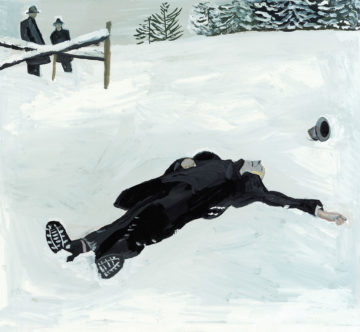 On the afternoon of Christmas Day 1956, in a snow-covered field on the outskirts of the small Swiss town of Herisau, some children and their dog discovered the body of a dead man, hand clutched tight to his stilled heart. It was the writer Robert Walser, who had died that day, aged seventy-eight, while out walking far from the mental institution where he had dwelled for the previous two decades. A photograph taken by the local medical examiner Kurt Giezendanner shows the body at rest, left arm thrown out as in the style of a sleeper midway through a restless night, while two shadowy figures at the margins look on. The sorrow of the scene is rather gently assuaged by the odd fact that Walser’s hat, perhaps moved by a breeze, lies at a modest distance from his body, as if it has leapt off his head to cartoonishly express surprise at its owner’s death. A few distant trees squeeze into the top of the frame like awkward mourners paying their respects. The snow, even on the ground but for a few shaggy lumps close to his boots, appears at first to be nothing more than a dazzling absence, as if the dead Walser were floating on a white winter sky.
more here.
The Life And Times Of Federico da Montefeltro
Sarah Dunant at Literary Review:
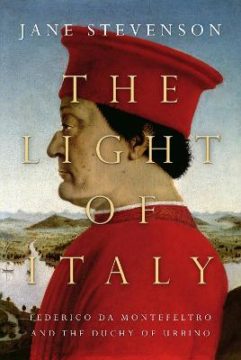 Federico is a figure well worthy of attention. Born on the wrongish side of the blanket in 1420s (it was a crowded part of the bed at that time in Italy), he became ruler of Urbino in his early twenties after the assassination of his unpopular half-brother. While there is no evidence that he was involved in the plot, he was hovering conveniently nearby when it happened. The citizens who approached him to take over presented him with a list of unnegotiable demands, the most stringent of which was to abolish a set of recently introduced taxes and promise not to impose new ones. In itself, this was an impressive demand in a country filled with minor despots. Even more impressively, Federico kept his word.
His solution? To earn an alternative fortune from war. ‘Mercenary’ is a dirty term now, but it once stood for an honourable and highly lucrative line of work: selling your military expertise and soldiers to the highest bidder in a country made up of city-states and power blocs, such as Naples, Venice and the papacy, all of which needed to field armies.
more here.
Sunday, December 26, 2021
Botox, billionaires, and bitcoin: 2021 in charts
Rani Molla in Vox:
 This year, mercifully, saw quite a few notable improvements over the last. In 2021, vaccines became widely available, and many of the experiences we had to forgo in 2020, the first year of the pandemic, have begun to return in the second. Unemployment is low, and wages are rising. That’s not to say we’re out of the woods with the pandemic. In fact, more Americans died of Covid-19 in 2021 than in 2020. And, motivated by widespread misinformation, a sizable portion of the eligible population still has not gotten a vaccine, even as variants like delta and omicron make it hard to feel at ease. Meanwhile, the richest Americans are accumulating even more wealth, and high inflation rates are making everyone’s money worth less. Of course, many of this year’s trends existed long before the pandemic, though the public health crisis has certainly kicked some into high gear. What follows is a series of charts that attempt to illustrate some of the major trends of 2021. All data is from what was available in mid-December.
Vaccination rates are rising, but they may never be high enough
Currently, about 61 percent of Americans are fully vaccinated, while 72 percent have received at least one dose. That rate is lower than much of the rest of the developed world, trailing China, Canada, and the UK, among others. While vaccination numbers have steadily ticked upward, thanks to a combination of public health campaigns and employer mandates, a good chunk of Americans — 13 percent — say they’ll never get the vaccine.
More here.
Nature and Art
From City Journal:
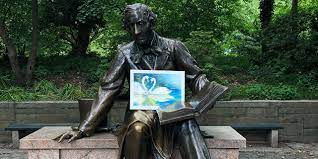 Matthew Mehan is the director of academic programs for Hillsdale College in Washington, D.C., and assistant professor of government for the Van Andel Graduate School of Government. He is also the author of two children’s books (both illustrated by John Folley): Mr. Mehan’s Mildly Amusing Mythical Mammals and the recently published The Handsome Little Cygnet. He spoke with City Journal associate editor Daniel Kennelly about his books and the state of children’s literature.
Tell us about The Handsome Little Cygnet. Is it a retelling of Hans Christian Andersen’s The Ugly Duckling?
Yes, but with a contemporary twist. Set in Manhattan’s Central Park, the story follows a father and mother swan and their baby cygnet as he tries to understand what he is and who he is meant to be. Unlike the original Ugly Duckling, this little swan starts knowing exactly what he is and who his parents are. But due to some confusing and ugly spray-paint—essentially vandalism of Central Park’s Gapstow Bridge—our plucky little cygnet gets confused. How he comes back to what he is meant to be—that is the core of this touching story.
Why did you decide to set the story in Central Park, in the heart of the nation’s densest urban area?
While there is the Ugly Duckling echo, I can’t say it was only for that reason. I also wanted to give New York City a little pick-me-up. The book has that feel of the city, with landmarks and vistas of Central Park and the surrounding skyline. Between Covid-19, riots, crime, and Bill de Blasio, it just seemed like New York needed a little love. I even hide a few N95 masks in the refuse of the ugliest place our little cygnet wanders into!
I also wanted Manhattan and Central Park for a deeper thematic reason. The book’s theme of identity—trying to figure out what we are so we can become who we are meant to be—involves two things: first, our nature; second, some artful work to make that nature truly thrive. Think of a rose bush (nature) and some lattice work to prop it up (art). That’s what it means for a happy girl to become a thriving woman, for a boy to become not just an adult male, but a real man—nature and art. Well, in the press and din of a city full of manmade buildings, bridges, and roads, there’s Central Park, a beautiful mixture of nature and art. That’s why we feature both wildlife found in the park (nature) and monuments, bridges, and sculptures found in the park (art).
More here.
Why life is faster but depression is lower in bigger cities
Andrew Stier in Psyche:
 Cities are bastions of opportunity. They are filled with vast numbers of people meeting friends and family, visiting restaurants, museums, concert halls and sporting events, and travelling to and from jobs. Yet many of us who live in cities have occasionally been overwhelmed by the activity. At other times, we might feel ‘alone in the crowd’. For decades, the conflicting experiences of city living have led urbanites and scholars to ask: are cities bad for mental health?
The conventional wisdom and scientific answer for more than half a century has been ‘yes’. This question is becoming increasingly important as global urbanisation unfolds: around two-thirds of the world’s population will live in cities by 2050. Bigger cities, which have more of what makes a city a city, would seem to be particularly bad for mental health. A typical explanation invokes factors such as noise, crime and short, callous social interactions (think about New York City’s reputation for rudeness) to argue that big cities create sensory and social burdens that city dwellers constantly have to combat psychologically. While this explanation appears to be supported by some evidence that rural areas might, on the whole, have lower depression rates than cities, there is scant evidence that these particular factors cause higher depression rates in cities, and no investigation of how bigger cities compare with smaller cities.
More here.
NASA’s James Webb Space Telescope launches on epic mission to study early universe
Mike Wall in Space.com:
 NASA just got a $10 billion space telescope for Christmas.
An Ariane 5 rocket launched today (Dec. 25) from Europe’s Spaceport in Kourou, French Guiana, at 7:20 a.m. EST (1220 GMT; 9:20 a.m. local time in Kourou), carrying the highly anticipated, long-delayed James Webb Space Telescope — and the hopes and dreams of countless astronomers, astrophysicists and planetary scientists around the world — into the final frontier.
The huge telescope will peer at the universe’s first stars and galaxies, sniff the atmospheres of nearby alien planets and perform a variety of other high-profile, high-impact work over the next five to 10 years, if all goes according to plan.
Joseph E. Stiglitz: The Inflation Red Herring
Joseph E. Stiglitz at Project Syndicate:

Slight increases in the rate of inflation in the United States and Europe have triggered financial-market anxieties. Has US President Joe Biden’s administration risked overheating the economy with its $1.9 trillion rescue package and plans for additional spending to invest in infrastructure, job creation, and bolstering American families?
Such concerns are premature, considering the deep uncertainty we still face. We have never before experienced a pandemic-induced downturn featuring a disproportionately steep service-sector recession, unprecedented increases in inequality, and soaring savings rates. No one even knows if or when COVID-19 will be contained in the advanced economies, let alone globally. While weighing the risks, we also must plan for all contingencies. In my view, the Biden administration has correctly determined that the risks of doing too little far outweigh the risks of doing too much.
More here.
All The Science You Need To Make Your COVID-19 Decisions
Maggie Koerth in FiveThirtyEight:
 If there’s one thing we’ve learned since March 2020, it’s that pandemics are all about hard decisions. It’s hard to keep track of the information that helps us make those choices — let alone notice or remember when new science and expert recommendations come along. At FiveThirtyEight, we want to help. We’ve read the science and have come up with broad assumptions you can make based on where the evidence is. When the science changes, so will the assumptions: We’ll be updating this page regularly as new research is published.
We think these assumptions will help you more easily make decisions for yourself and your family. (But do let us know if there are risk-assessment questions you think we’re leaving out.) We want this tool to be something that helps take the stress out of decision-making so that you can worry more about the best way to live and less about the virus.
More here.
Thomas Kinsella (1928 – 2021) poet
Steve Bronski (1960 – 2021) musician
Joan Didion (1934 – 2021) writer
Saturday, December 25, 2021
Alfred Döblin’s Surreal Foray Into Climate Fiction
 Joe Bucciero in The Nation:
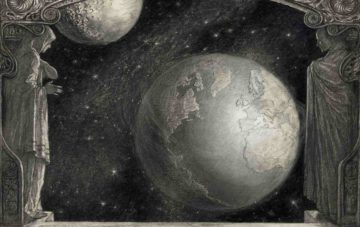
lfred Döblin’s sprawling 1924 epic, Berge Meere und Giganten—recently translated into English for the first time as Mountains Oceans Giants—begins in a relatively near future when the earth is on a crash course for disaster. “None were still living of those who came through the war they called the World War,” Döblin writes. A fading memory in the space of the text, World War I retained a decisive influence over the author’s Weimar Republic in both symbolic and material terms. The German scholar Rudolf Kayser was likely thinking of the brutality of mechanized trench warfare when he remarked, in 1932, that the human race was “dying of its own works.” By then, the Great Depression and contemporary political turmoil would have colored his outlook as well (the Weimar Republic itself “died” early the following year). If some Germans in the interwar period saw promise in technological acceleration, more dreaded its consequences. Facing threats from the sky to the factory floor, people had to wonder: How long could humanity hold out?
In Mountains Oceans Giants, Döblin tenders an answer through a speculative history that covers some 600 years across nine semi-chronological chapters. The centuries witness torrents of both innovation and catastrophe—indeed, the latter often because of the former—that project concerns common to Döblin’s post–World War I moment (new borders, migration, corporatization). His book reads at times like an encyclopedia, akin to Moby-Dick, focusing less on individual characters than on the events and effects of European development. By the opening chapter, the West has become a technocracy, abjuring national designations in favor of uniform industrial “townzones”: Berlin, London, New York, among others.
More here.
The Epistemic Seduction of Markets
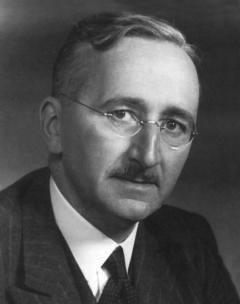 Lisa Herzog in The Raven:
I grew up in the 1990s in a tiny Northern Bavarian town, at the border between what was then West Germany and Czechoslovakia. The hilly landscape with its quiet woodlands and baroque church steeples continued seamlessly on both sides. But on the Czechoslovakian side, all the buildings and the infrastructure appeared old and dilapidated. When my family took its first car trips after the fall of the Iron Curtain, my father would navigate around the potholes of neglected streets while I would sit in the back seat and anxiously stare at the washed-out facades of farmhouses, which the front gardens full of hollyhock and asters hardly managed to hide. The 19th-century villas in the once grandiose spa of Mariánské Lázně—where Goethe had met his last love, the 17-year-old beauty Ulrike von Levetzow—seemed sad shadows of their past glory. I saw hardly any supermarkets or other shop windows with wares; people seemed to buy food in faceless concrete buildings sitting at dimly lit crossroads.
Run-down buildings, with aging plaster peeling off, no loud billboards (though they would come very soon)—it seemed that the communist economic system that was meant to be a workers’ paradise was unable to provide them with paint for their houses. The fall of the Iron Curtain predictably generated a tidal wave of worker migration, with Czechoslovakians seizing opportunities in the capitalist West. In the rural border regions, we met Czechoslovakian music teachers (the spa orchestras from the communist era had been disbanded), construction workers, and nurses, for whom a salary in Deutsche Mark meant a fortune. Supermarkets and hardware stores from Western chains would quickly set up shops across the border. European Union projects to renovate streets and buildings followed.
The visual impressions were clear for those Europeans in the early 1990s who could witness both sides: capitalist countries were colorful, the former communist countries were grey. It was the time when political scientist Francis Fukuyama used the Hegelian phrase “the end of history” to declare that the combination of capitalism and democracy, the “Western” system, was the best of all possible systems. And at the core of this triumph was one institution that continues to fascinate friends and foes alike: the “free market.”
More here.
Stoics as activists
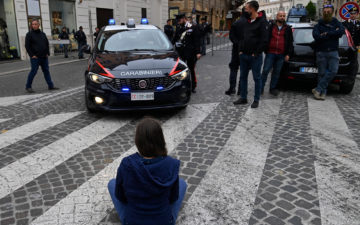 Massimo Pigliucci in Aeon:
The year is 133 BCE. The place Rome. Tiberius Gracchus, a tribune of the plebes, is killed in the streets, together with 300 of his supporters. He had angered many in the Senate by sponsoring anti-aristocratic legislation, in particular redistribution of land, a shortened military service, and broadened access to the privileges afforded by Roman citizenship. It is a well-known episode in the history of ancient Rome.
What is less known is that Tiberius had been advised all along by a Stoic philosopher, Gaius Blossius, one of many examples of Stoics deeply involved with politics and social reforms. Gaius had worked for years with Tiberius to improve the condition of the common people. When he saw his friend slaughtered, he left Rome and decided that the time to play by the rules had passed. Plutarch tells us that Blossius moved to the province of Asia (modern western Turkey), where he joined a rebellion against Rome led by Eumenes III, a pretender to the throne of Pergamon. The revolt was initially successful. Eumenes was able to seize a number of cities in Anatolia, conquer the island of Samos (where both Pythagoras and Epicurus had been born), and kill the Roman consul, Publius Licinius Crassus. However, the Roman Senate eventually dispatched another consul, the experienced Marcus Perperna, to the region, and he was able to extinguish the revolt. When the upraising failed, Blossius committed suicide, in typical Stoic fashion.
Stoicism has seen a surprising revival in recent years, and has become a popular philosophy of life, a kind of Western response to Buddhism (with which it has much in common). However, it remains the subject of a number of criticisms, some more justified than others. Despite multiple episodes like the one featuring Blossius, modern critics of Stoicism claim that the philosophy is self-involved and lacks resources to meaningfully engage at the political level.
More here.
How Chinese Restaurants Conquered Christmas
Fiona Chandra in LAist:
 In 2019, the year Keegan Fong opened Woon, he decided he would close the HiFi restaurant on Christmas Eve and Christmas Day. When he reopened on December 26, he was slammed for four straight days. Many of his Jewish customers asked, “Why weren’t you open on Christmas?!” That was when Fong realized how important the ritual of eating at a Chinese restaurant on Christmas was, and not just for Jews.
The tradition probably originated in Manhattan, where Jewish and Chinese immigrants clustered in neighborhoods near each other. Rabbi Joshua Plaut also theorizes in his book, A Kosher Christmas: ‘Tis The Season To Be Jewish, that because neither culture celebrates the holiday, they’re “outsiders” on Christmas” so there’s an inherent affinity there. Plus, Chinese restaurants tend to stay open every day of the year, holidays be damned. Whatever initially drew diners to Chinese restaurants on Christmas, they’ve become a beloved destination for holiday feasts on both coasts, and everywhere in between.
More here.
What It Means to Be ‘Book-Wrapt’
Julie Lasky in The New York Times:
 At the turn of the millennium, Reid Byers, a computer systems architect, set out to build a private library at his home in Princeton, N.J. Finding few books on library architecture that were not centuries old and in a dead or mildewed language, he took the advice of a neighbor across the street, the novelist Toni Morrison. Ms. Morrison “once famously said if there is a book you want to read and it doesn’t exist, then you must write it,” recalled Mr. Byers, 74, in a video chat from his current home, in Portland, Maine. The project stretched over a generation and culminated this year in a profusely illustrated, detail-crammed, Latin-strewn and yet remarkably unstuffy book called “The Private Library: The History of the Architecture and Furnishing of the Domestic Bookroom,” published by Oak Knoll Press.
…“Entering our library should feel like easing into a hot tub, strolling into a magic store, emerging into the orchestra pit, or entering a chamber of curiosities, the club, the circus, our cabin on an outbound yacht, the house of an old friend,” he writes. “It is a setting forth, and it is a coming back to center.” Mr. Byers coined a term — “book-wrapt” — to describe the exhilarating comfort of a well-stocked library. The fusty spelling is no affectation, but an efficient packing of meaning into a tight space (which, when you think of it, also describes many libraries). To be surrounded by books is to be held rapt in an enchanted circle and to experience the rapture of being transported to other worlds. So how many books does it take to feel book-wrapt? Mr. Byers cited a common belief that 1,000 is the minimum in any self-respecting home library. Then he quickly divided that number in half. Five hundred books ensure that a room “will begin to feel like a library,” he said. And even that number is negotiable. The library he kept at the end of his bunk on an aircraft carrier in Vietnam, he said, was “very highly valued, though it probably didn’t have 30 books in it.”
“What’s five times 40?” Alice Waters, the chef and food activist, recently asked. (The question was rhetorical.) “Two hundred, 400, 600, 800,” she calculated, apparently scanning the bookcases around her and adding up their contents (she was speaking on the phone). “And then probably another 800,” she said, referring to other rooms in her Berkeley, Calif., bungalow.
More here.
Joan Didion, Where I Was From (2003)
My own little thoughts on Joan Didion, at Image Journal:
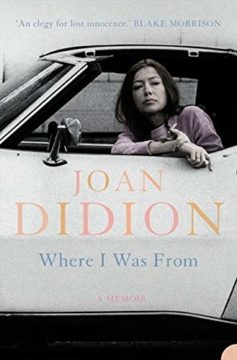 Joan Didion is not a nice person. I would almost put her in the category of Michel Houellebecq and Witold Gombrowicz. But not quite. I’m not sure what quality it is that holds her just at the cusp of “evil writer” without her falling in. Perhaps it is that she believes, though she would never put it this way, in the redemptive capacity of the act of writing.
This book is nowhere near her best or most interesting. But it is special to me. Like Didion, I grew up in California, more or less. Nobody writes about the sad longings of Californians as Joan Didion does. Nobody hates California as much as she does. And nobody, therefore, cares about it quite as much either.
And then there is the prose of Joan Didion. Hard stuff much of the time. Sentences that don’t hesitate for a second in laying the matter, whatever the matter be, bare. Exposing the shit for the shit that it is. Ruthless sentences. But oh, there is a payoff. An unexpected beauty, even. A tenderness that comes out of old hardhearted Joan in the last instance.
In the end, she is a lover. At the terminus of her excoriating prose, being a person always comes down to love.
more here.
Joan Didion Chronicled American Disorder
Parul Sehgal at The New York Times:
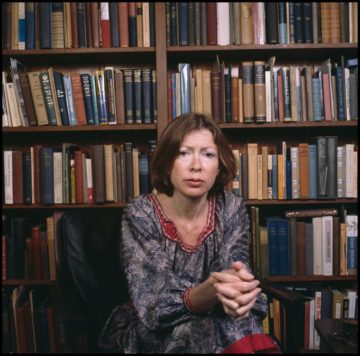 Joan Didion was 5 years old when she wrote her first story, upon the instruction of her mother, who had told her to stop whining and to write down her thoughts. She amused herself by describing a woman who imagines she is about to freeze to death, only to die burning instead.
“I have no idea what turn of a 5-year-old’s mind could have prompted so insistently ‘ironic’ and exotic a story,” she later wrote. “It does reveal a certain predilection for the extreme which has dogged me into adult life.”
For half a century, Didion, who died on Thursday at 87, was the grand diagnostician of American disorder in essays of strong, unmistakable cadence, churning with floods and fire.
more here.
Joan Didion, The Art of Fiction
Joan Didion at The Paris Review:
 INTERVIEWER
What are the disadvantages, if any, of being a woman writer?
DIDION
When I was starting to write—in the late fifties, early sixties—there was a kind of social tradition in which male novelists could operate. Hard drinkers, bad livers. Wives, wars, big fish, Africa, Paris, no second acts. A man who wrote novels had a role in the world, and he could play that role and do whatever he wanted behind it. A woman who wrote novels had no particular role. Women who wrote novels were quite often perceived as invalids. Carson McCullers, Jane Bowles. Flannery O’Connor, of course. Novels by women tended to be described, even by their publishers, as sensitive. I’m not sure this is so true anymore, but it certainly was at the time, and I didn’t much like it. I dealt with it the same way I deal with everything. I just tended my own garden, didn’t pay much attention, behaved—I suppose—deviously. I mean I didn’t actually let too many people know what I was doing.
more here.