
by Marie Snyder
 The quest for the answer to Who am I? is often an attempt to separate ourselves from our influences. Do I like to garden, or is that just a suburban social convention that has influenced me towards an action so I fit in. If I pave my yard to be unique, is that what I want, or am I just copying non-conformists? Where is the line between what I like for real and what I’ve been persuaded to like? That line of investigation culminates in the ultimate question: Can we know ourselves with any certainty?
However, I’ve noticed that when people talk about wanting to let out their real self, often the “real” version they want to foster is actually the instinctive or reflexive version — the part that rises up by impulse unfiltered by any inhibitions. But those inhibitions are from our capacity for reason. They come from our complex pre-frontal cortex. If the real self is just our impulses, then we’re discarding reason as if it’s artificial, and as if our impulses have been unaffected by society. Being real is then reduced to being licentious. We can also see the troubling place where this notion has led: people satisfying their every whim in order to be true to themselves. This is just giving license to the id (Freud) or appetitive (Plato) parts of ourselves, which requires no forethought. We might feel most real with our best friend because it’s only there that we can say our most offensive thoughts, but is that being our real self or is that just cultivating the worst version of ourselves?
But maybe there is no self that’s real.
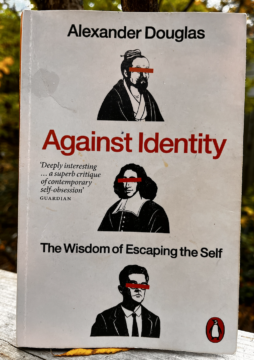
Alexander Douglas’s book, Against Identity: The Wisdom of Escaping the Self, explores the overlapping theories of three men: Zhuangzi (aka Chuang-tzu), a 3rd century BCE Taoist, Baruch Spinoza, a 17th century Dutch philosopher, and Réne Girard, a 20th century French academic. They all take a similar stance against the notion of a fixed and rigid identity. Douglas writes in a thorough yet entertaining way. The writing is teacherly, repeating and consolidating ideas as he dives deeper into the arguments and refutes potentially opposing ideas to help us understand how it can possibly be the case that we don’t have a distinct and solid identity.
I wrote about this idea previously, leaning on Locke and Hume who both argue that any kind of stable identity is unknowable. To Hume, who may have studied Buddhism, a self is “nothing but a bundle or collection of different perceptions, which succeed each other with an inconceivable rapidity, and are in perpetual flux and movement.”
Douglas goes much further with it. Here’s the gist as far as I understand it: We like to think we’re unique individuals, but every part of who we are was copied from someone else. Maintaining the illusion that we are self-invented is a problem in itself. Then once we have a trait that we’ve cultivated, we feel admired when others copy us. A second problem then arises from the copiers of our model becoming our rivals. Being copied feels great until others start to do it as well as or better than us, which sparks competitiveness. Divisiveness within families, friends and nations, and between countries is often because of this rivalry. The solution to both problems is to recognize that we are a mishmash of concepts we’ve seen modelled by others in the world that are up for grabs by anyone, and then notice the fluidity of our self, which is always moving and changing and picking up what others put down. We’re in a perpetual state of becoming. Once we accept that we’re copying others, we can choose the models that we follow, which makes us responsible for ourselves. So, if we can take a step back from holding tight to a sense of a uniquely crafted, solid identity, the sense of rivalry will end. In other words, if you want world peace, start by getting over yourself!
I hadn’t read any Zhuangzi before this, and only knew him from his famous dream of being a butterfly causing him to question if perhaps he’s a butterfly dreaming he’s a man, but I have a decent enough command of Lao Tzu’s Tao Te Ching to help with some concepts along the way, particularly the very first chapter, which reads,,
“The tao that can be told
is not the eternal Tao
The name that can be named
is not the eternal Name.
The unnamable is the eternally real.
Naming is the origin
of all particular things.”
Once we put a label on a person, we’re wrong. A label can’t capture the complexity of a human being; there’s so much missing. But also, we’re constantly changing, so any quality or trait we stamp on someone could be mistaken moments later. However, we want people to be stable and consistent and predictable. How do we manage in the world if we can’t stamp the people around us with clear identities or some indication of who they are and how they’re likely to act in a given situation? I’ll come back to that.
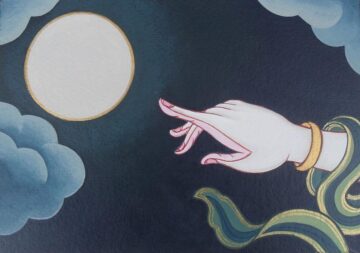
The first few pages of Douglas’s book explain a story that’s revisited throughout. It’s an ancient Chinese parable from Zhuangzi about three emperors: Shu (brief), Hu (sudden), and Hundun (chaos). Hundun had a face without any holes, like an uncarbed block, and the other two emperors tried to help him by drilling openings in his face in a “violently creative act.” Douglas writes, “This is the story of how we receive identity from our peers and how, when we do so, something is destroyed within us. The power of the undefined is lost by being forced into something definite.” Even well-intentioned structures can harm beings that are already whole. Chaos is not disorder to be corrected but vitality to be preserved: “the power of the undefined is lost by being forced into something definite.” When we are pinned down, it separates our “wo,” a self-chosen identity out of multitudes, from our “wu,” the undefined self that can be pointed to but never identified, like pointing to the moon. Spinoza refers to these concepts as, respectively, the self-acquiescence to one identity out of a multitude, and the soul in the acquiescence to the soul. Our wu can take on all manner of forms, but is never fully any one of them and doesn’t ever exclude other possibilities. It’s always “unselfing.” I think of this in terms of Arthur Diekman’s The Observing Self; from that perspective, it’s the self that goes unseen and undefined but observes our embodied self.
Spinoza brings in the idea that we are all copying each other, which leads to competition and conflict. We can resolve this conflict if we all follow the same model (like Jesus), but that doesn’t let us rise above one another, so people will still create rivalries. The other option is to live in a state of bliss and stop being bothered by who we are. This is the preferred option, but, to me, it feels so much harder.
How do we just stop caring about our identity?
What Girard adds to the mix is the concept of memetic desire. We want to have a unique self and have radical freedom by hiding, from ourselves and the world, the reality that our identity is borrowed from others. This is the “romantic lie” that pretends we have a separate, original, and consistent essence. Once we accept that we’re an amalgamation of plagiarized parts, then we “have liberation by realizing you’re continually embracing mimesis.” What we are is our capacity to imitate, which we lose when we narrow it down to one model (even Jesus). If we’re fluid, allowing our identity to shift through a multitude of potential models, then we never lose capacity.
We can’t ever stop imitating what we see and hear around us, but we can widen the range of choices to a point. Although we think we want the freedom or the ability to have every option open to us, that’s like having to choose a book from every book ever written rather than being influenced by a review. Imitation saves us time by narrowing down our choices. But our desire in reading or watching or clicking “like” isn’t just to be entertained, there’s always an element of wanting to be the kind of person who likes that thing. Furthermore, mimetic desire is the desire to continue to exist as the thing we are, which creates a strong aversion to change. Douglas further explains in this video, “Because we don’t have an intuitive notion of what we are, we have no choice but to look to others to answer the question of our own being … then the rest of our desires grow on that foundation.” It explains why some people would rather die than renounce their faith or politics or give up their current way of life.
Girard explains that the conflict that starts when we desire similar things grows in society until we create a scapegoat to destroy in order to relieve the tension. We conform just enough to avoid being that scapegoat! And I think it’s well known that we also avoid surpassing others to avoid conflict. This could be one path to understand a tendency to diminish ourselves in order to keep the peace instead of bringing forth our best self. Keep your head down. The scapegoat we exile or destroy in order to maintain a system could be someone who’s a bit odd, but it could also be someone who is so good it makes us feel bad about ourselves. However, as Douglas explains, this cultural dynamic shifted with Jesus. His was a scapegoat story with a victim that is clearly innocent. Revealing the mechanism of the scapegoating takes the power out of it, somewhat.
So, we can be happier if we can remain indefinite beings in flux, but changing our identity can feel worse than death, so “we lock ourselves into unsustainable patterns.” A symptom of this is lots of busyness: distraction through scrolling, travelling, redecorating, etc. We want to control events and others, and this hyperactivity leads us to extremes: it’s exhausting, yet it feels like the more comfortable path.
How do we get off this treadmill to be a fluid undefined self?
For Zhuangzi, acting without identity means letting things happen spontaneously and acknowledging our lack of control over outcomes, but how do we let things happen spontaneously when we need to pay the bills? There’s a famous parable of a farmer unaffected by his prize horse running away, only to have it return with more horses (told here by Alan Watts), which illustrates that we can’t know the outcome of an event, so it doesn’t make sense to have any judgment around the best thing anyway. The acceptance that we are already affected by luck and can’t affect outcomes with any certainty anyway, doesn’t alter the outcome, it just removes the anxiety and perturbations that surround our internal clinging to the fantasy we hold in our head about who we could be.
For Spinoza, even compassion can be a problem. The striving to feel what others feel can create ambition and envy since it comes from a craving to influence others. And then it can create potential rivals. People align with others based on resemblance, which enable communities to establish shared norms that define the range of acceptable identities. In doing so, the society excludes anything outside of this range: “Identities are thus born out of violence.” It’s a risk to be different, but being the same can also cause rivalries, so the only solution is to avoid a solid identity. Douglas has a great discussion around the power of the crowd here:
“Spinoza defines shame as ‘sadness concomitant with the idea of some action of ours, which we imagine others to disparage,’ while glory is ‘joy concomitant with the idea of some actions of ours, which we imagine others to praise.’ … Glory and reputation in the eyes of the crowd are crucial for the development of political institutions. … The power of the crowd drives you to care about your identity, and the more you care, the more the crowd has power over you. Having the crowd change its mind about you provokes feelings of panic” (100-101).
Worse than the crowd trying to morph you into an acceptable range of identity is the reality that you can do all the right things and still have your reputation tanked because some rival want to dethrone you! If you try to cultivate your own identity separate from the crowd, you can appear to be a try-hard or a poseur. It looks inauthentic to try to create yourself, so you have to try to appear to just happen to be precisely what the crowd was looking for.
Or you can step outside of the game to reject the idea of having a solid identity: “The less attached you are to any particular determination — the more readily you can flow from form to form, being carried along by the endless transformation — the less troubled you are by external things” (114). Douglas refers to the Taoist Han Suyin‘s words: “We cannot stop the eternal insubstantial change, demand a conclusion, fix with a name, presuppose an end. … There never is an end. Only a way.” and clarifies that, “It is not an ’emptiness’ but really a fullness of being beyond identity” (118).
For Girard, we have to accept we’ll always follow models and we’ll never be original. We don’t actually want all the things we buy or the associations we make, we’re just trying to solidify an identity. (It’s a lot cheaper to copy minimalists, and that’s a choice we can make.) We crave identity because we don’t have a discoverable solid inner self.
My only qualm with the book is that Douglas uses Jay Garfield’s book to try to connect these ideas to the Buddhist notion of nonself, or Anatman, and it didn’t quite work as well as a sutta might have. From my understanding of Buddhist nonself, a person is made of five aggregates that are constantly changing: body, feeling, perception, thoughts, and consciousness, and we can’t find a self in any one of them. So when they say wisdom is the acceptance of the impermanence of being, it’s not just accepting that we will no longer exist one day, but that we are no longer the same as we were moments ago. That certainly feels in the same ballpark.
There’s so much more going on in this book. It was a slippery read for me, with many points that made perfect sense while I was reading it, but then were hard to conceptualize after the fact. My brief takeaway might be best expressed from this line from Buddhist psychotherapist Mark Epstein: “I did not have to know myself analytically as much as I had to tolerate not knowing.” We can live without trying to be consistent and predictable just by accepting that we are inconsistent. All we’re giving up is the pretense of some ideal. We’re still stable beings in our general constitution, so there will always be some level of predictability from day to day. Accepting the fluidity of an undefinable self might be captured like the ocean: it’s constantly changing yet more or less in the same place when we look for it. Something like that.
Enjoying the content on 3QD? Help keep us going by donating now.