
by Marie Snyder
 The quest for the answer to Who am I? is often an attempt to separate ourselves from our influences. Do I like to garden, or is that just a suburban social convention that has influenced me towards an action so I fit in. If I pave my yard to be unique, is that what I want, or am I just copying non-conformists? Where is the line between what I like for real and what I’ve been persuaded to like? That line of investigation culminates in the ultimate question: Can we know ourselves with any certainty?
However, I’ve noticed that when people talk about wanting to let out their real self, often the “real” version they want to foster is actually the instinctive or reflexive version — the part that rises up by impulse unfiltered by any inhibitions. But those inhibitions are from our capacity for reason. They come from our complex pre-frontal cortex. If the real self is just our impulses, then we’re discarding reason as if it’s artificial, and as if our impulses have been unaffected by society. Being real is then reduced to being licentious. We can also see the troubling place where this notion has led: people satisfying their every whim in order to be true to themselves. This is just giving license to the id (Freud) or appetitive (Plato) parts of ourselves, which requires no forethought. We might feel most real with our best friend because it’s only there that we can say our most offensive thoughts, but is that being our real self or is that just cultivating the worst version of ourselves?
But maybe there is no self that’s real.
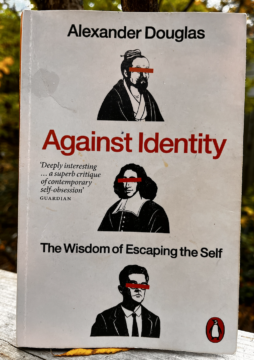
Alexander Douglas’s book, Against Identity: The Wisdom of Escaping the Self, explores the overlapping theories of three men: Zhuangzi (aka Chuang-tzu), a 3rd century BCE Taoist, Baruch Spinoza, a 17th century Dutch philosopher, and Réne Girard, a 20th century French academic. They all take a similar stance against the notion of a fixed and rigid identity. Douglas writes in a thorough yet entertaining way. The writing is teacherly, repeating and consolidating ideas as he dives deeper into the arguments and refutes potentially opposing ideas to help us understand how it can possibly be the case that we don’t have a distinct and solid identity. Read more »