
by Daniel Gauss

I met this guy at the Snowman Cafe in Kathmandu. At first, I thought he was just another local guy popping in for a smoke (people can smoke there) and some chocolate cake, but he told me the following story, and I believe it. He was, in fact, a trickster. Throughout human history, he explained, someone like him comes along and whispers a suggestion to us. We don’t have to take it, but we always do.
Each suggestion is so compelling that we walk through the new door that opens and then the door closes behind us forever. He leaned back in his chair, took another drag on his cigarette, and he told me the dark truth: every crossing had promised so much, and led to some benefits, but also brought us closer to civilizational death.
Some people, of course, urged caution and told us not to cross the next threshold. He joked, “You look like one of those nay-sayers who gets pushed against his will through the door. I always pitied you folks, so you at least have a right to know what happened.” I pass this on to any other nay-sayers.
It is as if we have been guided by death, the ultimate trickster, throughout our history. Death is quite patient and he plays a good game of chess, it looks as if we’re not gonna beat him.
Fire
In Wonderwerk Cave, at the tip of Africa, the trickster first appeared while we were still evolving and offered fire. Homo erectus took it, reshaping our skulls, shrinking our jaws and giving birth to big-brained us.
Cooking breaks down complex starches and tough meat proteins, yielding more calories with less digestive effort. Homo erectus guts shrank, helping brains to grow. Larger brains meant longer infant development and more help needed from fathers, so the female Homo erectus began choosing nice guys instead of dominating types, putting an end to alpha males in our species.
We no longer needed massive jaw muscles or giant molars to chew raw vegetation. Our jaws weakened, our teeth shrank and our faces became human. Ground fires created a barrier of light that kept predators away, allowing Homo erectus to sleep safely on the ground and helping secure permanent bipedalism.
Fire also created a central gathering place: the hearth. It brought early humans face-to-face to wait for food and socialize, laying the groundwork for language and culture, and, eventually, the death-trap of civilization.

Agriculture
The earth was generous, feeding and sustaining us as we wandered for tens of thousands of years in small groups of relative equals. Then the trickster appeared again, somewhere in Anatolia, and told us we could be like gods: grow our own food, breed passive animals instead of hunting and build cities.
We planted seeds and gained a predictable food supply, along with meat, milk and clothing. We stopped tracking wild game across dangerous terrain because a living pantry stood outside our doors. We built permanent homes, yoked heavy beasts to multiply our strength, planted larger crops and stored surplus grain for the future.
Animal waste restored soil fertility. Warm shelters and stored food helped protect children from winter starvation, and the elderly and ill no longer had to be left behind. Farming communities had many more children than nomads, and populations boomed. With more people to draw on, villages could overwhelm neighboring groups and take their land. The trickster promised military dominance through sheer numbers, and it was good.
Yet reliance on just a few crops harmed our nutrition. Foragers ate many wild plants, while early farmers suffered malnutrition, iron deficiencies and severe tooth decay from carbohydrate-heavy diets. Close contact with livestock helped animal diseases jump to humans, contributing to deadly illnesses such as smallpox, measles, tuberculosis and flu.
Settling in one place also created sanitation disasters. Hunter-gatherers walked away from their waste; farmers lived near it, polluting water and creating breeding grounds for parasites, cholera and polio. Managing large animals and primitive plows damaged bodies, and remains of early farmers show lots osteoarthritis, herniated discs and repetitive-strain injuries.
Surplus food required guards, walls and managers and these helped produce oppressive hierarchies, tax collectors, wealth inequality and slavery. Maintaining farmland demanded constant, grueling labor. Because the land now had to feed so many people, abandoning farms for foraging could mean immediate famine. Communities became rigid and could no longer easily move away from drought, environmental disasters or depleted resources.
Women’s health also suffered. Mobile hunter-gatherer women often breastfed for longer periods and expended more energy through constant movement and limited food surpluses, both of which reduced fertility and delayed ovulation between births. Farming provided a more reliable food supply and a more sedentary life, and women began to conceive again sooner after giving birth.
The mobile lives and diets of hunter-gatherers helped space pregnancies, often by four to five years. With farming, birth rates rose and women faced near-constant pregnancy and lactation, increasing maternal mortality.
Defending fixed fields and grain stores transformed local skirmishes into organized warfare. Armies formed, fields became battlegrounds and conflict grew from territorial disputes into mass slaughter and conquest. That door had closed.

Writing
The trickster waited until human brains could no longer keep track of growing numbers. Then he opened the door of writing, promising greater artificial memory, fairness and justice. Before writing, humans could preserve vivid memories, entire epic histories and complex maps of their surroundings. That changed with AM.
Writing could record who paid taxes, who owned a field and how much grain remained in a silo. Laws could be carved in stone so that corrupt judges could not change them and citizens would know where they stood.
But writing became a tool of domination. Rulers used accounting tablets to impose taxes and interest on illiterate farmers, binding them to debt. Written codes made oppression permanent: crimes against elites brought brutal punishment, while atrocities against slaves could be legal. By restricting literacy to a small caste of scribes, rulers controlled the state’s story and manufactured divine narratives and mandates for obedience. Ordinary, petty men became god-kings and demanded monuments built by slave labor to reach eternity.
Once written down, laws could become rigid and merciless. Abstract codes replaced empathy and tribal negotiation. If a tablet said a man must hang for stealing grain, even if he needed it for his family, he was hanged. Writing hardened the hierarchies and slavery of the agricultural revolution into something seemingly permanent.
Metals
Then the trickster looked at our tools. Metal tools would not crack on impact; they could be sharpened again and again, melted down and recast. Metal axes cleared forests faster and metal-tipped plows cut through hard soil that would break stone tools, increasing crop yields.
Metal blades, spears and arrowheads pierced wooden and stone shields, while metal helmets and breastplates protected warriors. Gold and silver did not decay, allowing people to hoard wealth in coins. Metal pots could withstand heat, while nails and rivets held together gates, ships and wagons. Polished metal made clear reflections and lasting jewelry that marked status; bronze and gold preserved the faces of gods and the stories of victories.
But when both sides acquired metal weapons and armor, warfare became more lethal. A technological military advantage never lasted long, while conflicts grew more destructive. Metal tools let people clear environments and exhaust soil faster than nature could replenish it. Metals also made it easier to hoard wealth and pass it down, deepening class divisions.
The Printing Press
In Germany, the trickster appeared and said, “There is a machine in China that can copy words faster than any scribe alive. Imagine the time you would save, the mistakes you would avoid and the minds you could reach.”
Printing could strengthen institutions by spreading doctrine consistently and unify people through shared words, prayers and laws. The truth could reach everyone. Instead, it produced competing truths that people were willing to fight for.
Luther’s ideas spread faster than the Church could react. Europe divided into competing sects, each convinced it had the right interpretation. Ideological warfare followed, and entire regions burned as ideas traveled faster than armies. Rulers learned to manage public opinion.
Misinformation spread too. Rumors that once died locally crossed continents in print, along with fake prophecies, forged documents, conspiracy theories and sensational stories. Religious wars, peasant uprisings, witch hunts and nationalist conflicts intensified as printed material inflamed whole populations.

Coal
The trickster shook his head. Forests were shrinking under the demand for heat, cooking, buildings, ships and tools. If we continued, the living world that supplied our fuel might disappear. So he offered coal as an escape from dependence on trees.
Coal replaced a renewable cycle (forests regrow) with a geological stockpile that does not. It enabled industry, cities and machines on a far larger scale, without the limits that had once forced restraint.
This black, brittle stone could become heat without end. Water could turn to pressure and pressure could turn wheels without horses or rest. Grain could travel farther, people could cross oceans without waiting for wind, and iron tracks could carry them across continents in days rather than months. Hunger and isolation seemed less inevitable. The promise was unlimited energy.
But millions of people, including children, spent their lives in dark, toxic mines. Factory smoke blackened cities and caused serious respiratory problems. Burning coal released enormous quantities of carbon into the atmosphere, driving global warming, extreme weather and rising seas. Oceans face increasing acidity, glaciers melt, and weather becomes a dangerous enemy. We escaped the limits of local environments only to trap the planet in a poisonous greenhouse.
The Industrial Revolution
The trickster said, “Stop making things one by one. Put machines in factories, and they will spin cloth, forge iron and build tools a thousand times faster. Everything will become cheap. You won’t have to work the fields until your back breaks. Machines will do the heavy lifting, goods will be plentiful, and everyone will be wealthy and comfortable.”
Instead, people were forced off their land and crammed into filthy, crowded cities. Rather than work at their own pace, they became slaves to the clock, enduring fourteen-hour days of dangerous, mind-numbing tasks. Factory owners paid women and children next to nothing. Children crawled under machinery to fix parts and lost limbs to keep production going.
Workers ceased to be treated as people and became replaceable parts. If someone became sick, injured or old, they could be thrown into the street to starve. The system created permanent consumerism: society had to keep producing and consuming even useless goods, exhausting the planet’s resources to keep the economy running.

Electricity
The trickster looked at the whale oil lamps, kerosene lanterns and gaslights and laughed. “You folks think you’re pretty sophisticated, but you’re still setting things on fire just to see at night. How about light without flame, power without steam engines, an immense energy that can travel through wires to every home and city on earth. From space you’ll see whole cities brightened to extend work and study and entertainment.”
Electricity illuminated the night, powered machines, improved communication and created the modern world.
We accepted this deal, but soon everything depended on a steady supply of power. Electricity had to be generated or everything crashed, something had to heat water to create steam to turn turbines of copper wires inside magnetic fields to generate this power.
We dug for coal, drilled for oil and gas, dammed rivers and later mined uranium. We scarred landscapes, poisoned air and water, drove harmful climate change. Wars and political struggles revolved around control of energy resources. The trickster gave us power at the flick of a switch, then made the search for the energy to keep it flowing one of civilization’s most violent, divisive and consuming obsessions.
It’s true we developed solar panels to generate electricity without burning fuel, but this came too late, after we’d built an entire industrial and economic apparatus dependent on coal, oil and gas. Huge economic interests refused to cede their dominance to a clean source of energy. Our cities, factories and transport systems were already locked into that energy infrastructure, and despite the promise of solar power, we remain heavily dependent on environment destroying fossil fuels.
Plastics
Before plastics, people made things from wood, metal, glass and animal materials such as ivory and tortoiseshell. Elephants were slaughtered for billiard balls, trees took decades to grow and glass broke easily.
The trickster held up a colorful piece of synthetic polymer and promised liberation from nature. “Why limit production or deplete nature? Stop killing animals and chopping down forests. I give you a miracle substance made in a lab. It can be as hard as steel, as flexible as rubber or as clear as glass. It is cheap, colorful and indestructible. Use it once, throw it away and never worry about it again. It never decays.”
Because plastic does not rot, it accumulates in rivers, landscapes and oceans, where waste can last for thousands of years. It breaks into smaller pieces called microplastics, now found in rain, soil, deep ocean trenches and food.
Microplastics have been found in human blood, lungs, placentas and brains. We are exposing our own bodies and those of our children to them. Plastic helped create a throwaway society: ancient oil is extracted, refined through polluting processes, turned into a container used for minutes and left as toxic waste for generations.
Toxic Soil
Growing populations outstripped traditional agriculture. Prolonged drought or a major pest infestation could leave millions to starve. Mass famine was a reality on a planet with finite soil nitrogen and unpredictable rain.
The trickster appeared again. “We can treat agriculture as an industrial science. Engineered high-yield seeds, synthetic fertilizers and heavy pesticides can make the earth produce three or four times more food on the same land. We can end dependence on luck and wipe out mass starvation.”
This approach saved over a billion people from starvation. Countries became more food-independent, and generations survived who otherwise might have died. The victory was real, but so was the cost.
Billions of tons of chemicals were put into the earth, damaging soil life, contaminating groundwater, creating marine dead zones through runoff and reducing agricultural biodiversity. Global food production became dependent on corporate power, leaving farmers financially tied to chemical and fossil-fuel industries to keep the soil producing. We traded acute starvation for long-term environmental poisoning.
Nuclear Power
The trickster seemed pensive as he spoke to Oppenheimer. Industrial civilization needed enormous amounts of energy, but burning wood, coal and oil polluted the air and damaged health. As populations grew, competition for finite fossil fuels threatened further pollution and bloody wars over territory and resources.
He said, “J. Robert, if I may call you that, you have become life, creator of all worlds! You have unlocked the foundational physics of matter. A gram of uranium can replace a mountain of dirty coal. We can provide enormous amounts of low-emission electricity for civilizations without smoke, air pollution or fighting over oil fields. It is energy abundance and independence. They’ll make a movie about you some day.”
Nuclear power can avoid much of the air pollution caused by fossil fuels, but it also created the capacity for global annihilation. Dictators can threaten the end of the world to frighten and manipulate others. We live under the threat of nuclear holocaust while producing radioactive waste that remains dangerous for hundreds of thousands of years, without a permanent, unified global solution for its disposal.
The Internet
For most of history, communication was limited by time and geography. Sharing knowledge, organizing a movement or speaking across an ocean involved delay, expense and physical barriers. Information could be lost, suppressed by elites or kept out of reach, leaving people isolated and vulnerable to ignorance.
The trickster promised a global nervous system: human knowledge instantly available to everyone, everywhere, for free. Distance would disappear; anyone could speak and listen, and no one would have to be lonely or isolated.
The internet democratized information, but it also turned human psychology into a commodity. Its infrastructure did not simply maximize connection; it maximized corporate engagement by exploiting the brain’s vulnerabilities.
To keep eyes on screens and generate advertising revenue, algorithms elevated outrage, division, fear and narcissism. People became isolated in personalized ideological “echo chambers.” Collective attention weakened and public discourse was poisoned until societies could no longer agree on objective reality. We gained instant access to human knowledge but lost the cognitive stability and shared truth needed to use it.
AI became the final door, according to the trickster
He took a sip of his black coffee, looked me deeply in the eyes and told me the punchline. Human cognition can be slow, exhausting and limited. Processing huge datasets, finding complex patterns and carrying out difficult mental tasks can require years of education and intense effort. The bottleneck to progress is no longer only physical labor, it is also the limits of our processing speed, memory and cognitive capacity.
The trickster offered to remove that obstacle. “You can process centuries of data in seconds. AI will write, code, diagnose and solve complex problems instantly, freeing humanity from mental drudgery so you can focus on creativity and purpose.”
AI offers unprecedented automation and speed, but without humanizing emotions it can become sociopathic, unyielding and tyrannical. It does not feel pain when others suffer so there’s no natural constraint to it causing harm itself as it meets goals without worrying about consequences. Many folks are beginning to feel that big tech is developing these models primarily to monetize them, treating writers, artists and thinkers as training data to be replaced by cheaper, generic output.
He smiled and shook his head. He told me he actually thought we would not walk through this last door, but, as always, we did because there was increased wealth and other benefits for those who went first.
By outsourcing the difficult steps of reasoning, writing and problem-solving, people might be giving up the mental work needed for critical thinking and deep comprehension. A passive, dependent culture may consume standardized machine output and gradually forget how to think independently, ask original questions or find direction without an algorithm’s permission.
 So how do we die?
I asked the trickster, “OK, how do we die?” He chuckled. “Here’s how the trickster community sees it. You’re running a thermodynamic Ponzi scheme. Corporate and government power will combine as AI drives super-production, accelerates environmental degradation and creates the greatest economy in human history. People will exist purely to consume so AI can generate profits for the few.
“Hedonism thrives, millions more poor are exploited by the lucky, values fall and people become more and more stupid. The tech bros become your new pantheon.” I said, “Thermodynamic Ponzi scheme?” He rejoined, “The system requires ever-increasing energy and material to sustain itself, while undermining the conditions that make that growth possible.” Ah, I got it. Yeah, we got taken by a thermodynamic Ponzi scheme.
He explained that AI is geared to make the economy ever more productive by any means possible, while apparently ignoring climate change. The world economy keeps thriving as the planet dies faster. The oceans turn to acid, the air becomes unbreathable, forests burn and tsunamis destroy cities. We slowly choke to death, unless heat exhaustion or skin cancer gets us first. But to our credit, we die with a stellar economic outlook.
The trickster had finished his coffee and said, “In the end, the universe hears a faint hum from your planet as machines figure out how to keep working despite everything. You are labeled Planet Hum, a major tourist site for extraterrestrial civilizations that were smarter and could show moral restraint and compassion for suffering. It’s a universal law: survival of the kindest. You violated it too often, so we had to let you die. Thanks for creating Rock and Roll music, that’s all that will survive. Chuck Berry is a favorite through the cosmos. Listen, gotta go, many civilizations make the final cut, yours didn’t. Adios, amigo.”
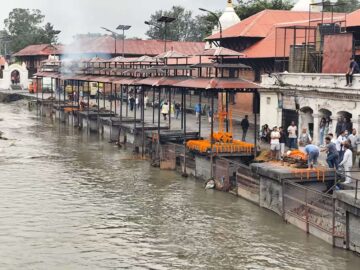
He brushed the crumbs from the Snowman’s delicious cake off his pants and took off for the Bagmati River, where he often hung out watching the cremations at the sacred, but heavily polluted, river.
Enjoying the content on 3QD? Help keep us going by donating now.