
by Herbert Harris
What gives art its power? There are as many answers as there are powerful works of art, but most seem to fall into a few broad categories. A great deal of art is representational. It is intended to depict or show us something, whether natural or abstract. It succeeds by faithfully capturing its subject. Other art may be intended to express an inner state, feeling, intuition, or vision. In both cases, the creative act is a one-sided process of mimesis or self-expression. Appreciation of the artwork is also somewhat unidirectional. What does this show me? How does it make me feel?
Authenticity of expression and fidelity of representation are important aspects of art’s power, but neither can explain the uncanny phenomenon that occurs when a work seems to look back at the viewer, drawing them into a relationship with it. What happens is more than the recognition of a represented object or an expressed feeling. It is a mutual recognition mediated by the painting, poem, or musical composition in an intersubjective space co-created by the artist, the viewer, and their shared culture.
The neuroscience of active inference proposes that the mind meets the world not directly but through a guessing game. The brain builds models of reality, predictions, and structured hunches, and tests them against incoming experience, updating them when they don’t fit. You don’t see the world as it is. You see your best guess, corrected in real time.
This works beautifully for the world out there. But how does a guessing machine guess about itself? Try to model your own consciousness, and you hit a strange loop: the modeler is the thing being modeled.
Since Hegel, philosophers have argued that self-consciousness depends on recognition. The self becomes itself not by staring inward, but by encountering itself in another’s response.
Nature’s solution is elegant and inescapably social. We are creatures who spend enormous energy modeling each other, predicting, inferring, imagining other minds. And every person in our lives holds a working model of us. Very early in life, we learn to read these models. Through gaze, gesture, tone, and language, we learn to see ourselves through others’ eyes. We learn that our behavior shapes how others see us, which changes what we see when we look at ourselves through their eyes, which, in turn, changes our behavior…
This recursive loop forms a network of interdependent modeling in which we are constantly co-creating ourselves and each other. Selfhood is not achieved in isolation and then brought to relationships. It emerges from them. It is a collaborative work in progress.
Art is one of the deepest forms of this collaboration.
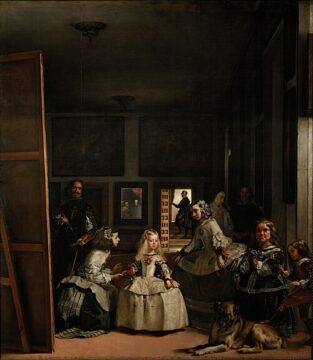
In 1656, Diego Velázquez painted the masterpiece of recursive self-reference, Las Meninas. It shows a large room in the Spanish royal palace. Velázquez himself stands at a canvas, brush in hand, looking outward, toward us. The young Infanta Margarita is attended by her maids of honor, a dwarf, and a dog. In the back, a mirror reflects the faint images of King Philip and Queen Mariana, who seem to occupy the space where we stand. And in a doorway at the far rear, a man pauses on a staircase, looking in.
Foucault devoted the opening chapter of The Order of Things to this painting, arguing that it is about representation itself, about the absent sovereign subject around whom all acts of seeing are organized. He was right that the painting is about the structure of looking. But representation is not the whole story. The painting is about recognition.
Consider a thought experiment. You step into the painting as the figure in the doorway. You’ve just come down the stairs. You pause, straining your eyes to take in the space. The room is strange, charged with quiet intensity. Everywhere you look, someone is looking somewhere else. The maids attend the Infanta. The Infanta gazes out. Velázquez stares past everyone, toward something beyond the frame. In the far mirror, two ghostly figures watch from nowhere.
You turn to the canvas. And the loop closes. Velázquez has painted the room, the Infanta, the maids, the mirror, and the doorway where you stand. He has painted your straining gaze as it arrives at his canvas. He has painted the perfect negative space that only you can fill as you discover that you are part of the painting.
You have encountered yourself in the creation of another.
It is an act of generative portraiture: the construction of self and other through mutual recognition, embodied in a work of art. It is more than self-expression and more than representation. The recursive encounter between artist and viewer, mediated by the work, generates something that did not exist before, a new configuration of self-awareness, brought into being through the acts of painting and looking.
The room in Las Meninas is an intersubjective space. Each figure has an independent orientation, gaze, and private attention. But they are all organized around a single vanishing point, the place where the painter’s attention converges. This corresponds to the doorway where you are standing. The painting doesn’t depict a room full of people. It orchestrates a web of mutual recursive modeling that places the viewer inside it.
This, I want to suggest, is what all art does when it works, not always as overtly recursive as Velázquez, but with the same underlying structure. When a cellist plays a Bach suite, she models her own consciousness through the music, and the listener is drawn into a recursive encounter with that consciousness. When a novelist builds a character, the reader inhabits a mind modeling a mind. When a painter renders a landscape, the viewer doesn’t just see the scene; she enters it, feels the weather, senses the light, and in doing so encounters the quality of attention that organized the canvas. It is always generative portraiture: the making of selves through encounter with other selves.
The room in Las Meninas is strange and unreal. But it is also the room we constantly inhabit, the room of intersubjectivity, where we are always modeling each other, seeing ourselves through each other’s eyes, where self-consciousness is created.
Art is much more than a medium through which recognition can happen. It creates new possibilities for recognition that can transform our identities and relationships. The room in Las Meninas is strange and unreal, but it is the room we live in, the room of intersubjectivity, where we see ourselves through one another’s eyes, and become selves by being recognized. Art is where we do this on purpose. It gives recursive self-consciousness a body outside the self on a canvas, in a melody, or on a stage.
***
Enjoying the content on 3QD? Help keep us going by donating now.