“The cinema can, with impunity, bring us closer to things or take us away from them and revolve around them, it suppresses both the anchoring of the subject and the horizon of the world… It is not the same as the other arts, which aim rather at something unreal or a tale. With cinema, it is the world which becomes its own image, and not an image which becomes world.”
Giles Deleuze, Cinema 1: The Movement Image
Take 12 images and splice them end to end: a shaded length of acetate through which a bright white light is to be shone. This makes one second of film. The reel spools onwards, as the seconds tick by, and from these independent images (isolations of time separated in space) an illusion of coherence emerges.
During a recent flurry of internet activity I stumbled across the work of Takeshi Murata. His videos, having made their way, legitimately or otherwise, into the mysterious Realm of YouTube, have achieved something of a cult status. Among various digital editing techniques Murata is one of the most famous purveyors of the 'Datamoshed' video. A sub-genre of 'glitch-art', datamoshing at first appears to be a mode of expression fine-tuned for the computer geek: a harmless bit of technical fun with no artistic future. But as I watched Murata's videos, from Monster Movie (2005), through to Untitled (Pink Dot) (2007) I became more and more convinced that datamoshing has something profound to say about the status of the image in modern society. Furthermore, and at the risk of sounding Utopian, datamoshing might just be to film what photography was to painting.
Take a human subject. Any will do. Have them sit several metres from your projection, making sure to note that their visual apparatus is pointing towards, and not away from, the resulting cacophony of images. There is no need to alert the subject to your film. Humans, like most animals, have a highly adapted awareness of movement. Your illusion cannot help but catch their attention. As soon as the reel begins to roll they will be hooked.
Cinema is all pervasive. Not just because we all watch (and love) movies, nor that the narratives emerging from cinema directly structure our modern mythos. Rather it is through the language of cinema, whether we are sat in front of a screen or not, that much of the past hundred years of cultural change, of technological and political upheaval can be understood. For Walter Benjamin, whose writings on media appeared almost as regularly as the images flashed by a movie projector, the technology of film fed into and organised the perceptual apparatus of the modern era.



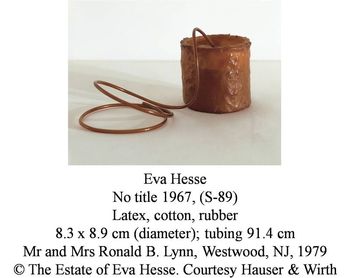
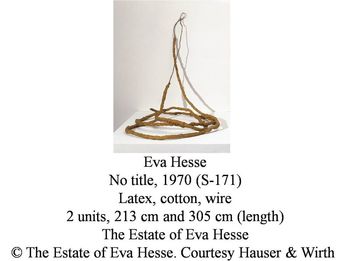 Hesse's creative talent had been evident since childhood. At the age of 16 she graduated from the New York School of Industrial Arts, later attending the Pratt Institute of Design. But by December 1953 she had dropped out to study figure drawing at the Art Students’ League, whilst also working as a layout artist for Seventeen magazine. Then, in 1957, she graduated from Cooper Union in New York, going on to study at Yale with the assistance of a Norfolk Fellowship.