David Schneider
T.S. Eliot might well have smirked at the events of the Naughty Oughties. By one yardstick, they came in with a bang and ended with a whimper, trussed up and devoured by the dirty deeds, done extravagantly, of the stuffed men, the hollow men.
Back in the green days of Communism's defeat (which we, in our typical hubris, called capitalism's victory) an American president spoke of creating a “bridge to the 21st century.” Of course, this was dismissed as mere rhetoric by less (publicly) priapic politicians. Through the hindsight of the intervening years, however, it's become clear that such a bridge was indeed necessary. The left and right banks of America, blue in mood and red in face, were left hanging by chads on a Bridge to Nowhere, suspended within a fiction called The End of History.
History, that's the rub – history, and its myths. From the very first days of the Bush Administration, I sensed that the conservative American consciousness, boiled down into its thick molasses, was simply in fear of the future. We were held back, as a nation, by a persistent fear (predominently by those who witnessed the chaos of the '60s) that history Xeroxes itself; that any struggle towards positive change, any at all, was a fool's errand, doomed to devolve back to Fascism or Communism, except this time with the extra added bonus of nuclear apocalypse. And those of us who came to oppose this nation's decisions perhaps understood ourselves as being held back, from advancing a grade in a school called Democracy and the Pursuit of Happiness. Held back, by a dubiously legitimate leader who clearly attended Bible School dutifully but spoke as if he himself hadn't passed the 3rd grade.
History, as Morpheus said, is not without a sense of irony. And it doesn't like to be declared deceased.
I know we want to leave this low, dishonest decade, but I say: not yet, not quite yet. There are still a few days in which we may legitimately consider what happened to us, before the tsunami of ever-present tensions crashes down upon us anew.
From my peculiar and partial vantage point, every great American crisis of the '00s – Y2K, the Dot-Com Collapse, The Great Indecision, 9/11, Iraq, Abu Ghraib, Katrina, global warming, the Media Crisis, and the Financial Crisis – stemmed from our inability to integrate the hyperspeed advances in media technology with our aging infrastructures – physical, economic, managerial, governmental, and moral. This is the chasm that needed and still needs to be bridged – it is, I believe, the parsing of Clinton's metaphor.
And from this chasm (with ceaseless turmoil seething) I saw two great übercrises mingling, and seeding the events of the Double Zeroes: a Crisis of Information, and a Crisis of “Reality.” Information: too much of it, in terms too jargonized, too euphemized, and too fractured. “Reality”: a state of being controlled by the new technologies of media, without sufficient intellectual tools or time for us to interrogate adequately.
Yeah, whatevs, you say. Too subtle by half, you say. It's the “postmodern condition,” get over it. Or: hubris and incompetence, failing upward rather than failing better, same as it ever was. Or: The Matrix. Live in the sewers, Neo, and jump buildings in your brain (got a better idea?) Sorry, folks, but I need to plumb a little deeper than those keyword searches.
The first true terror I felt in this decade, the first moment I perceived a great unraveling, was not on September 11, 2001. The date was May 8, 2002, when MTV broadcast the episode of “The Real World: Chicago” that was filmed on 9/11.
Read more »



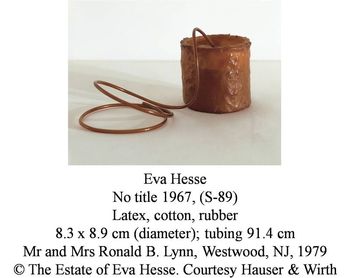
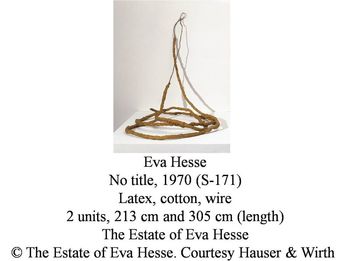 Hesse's creative talent had been evident since childhood. At the age of 16 she graduated from the New York School of Industrial Arts, later attending the Pratt Institute of Design. But by December 1953 she had dropped out to study figure drawing at the Art Students’ League, whilst also working as a layout artist for Seventeen magazine. Then, in 1957, she graduated from Cooper Union in New York, going on to study at Yale with the assistance of a Norfolk Fellowship.