5 THINGS YOU DIDN’T KNOW ABOUT AFRICA

By Tolu Ogunlesi

1.

Africa their Africa

AfricaWhen Western tourists talk about Africa somehow it seems to me that what they really mean is East and Southern Africa, places like Namibia and Kenya and Botswana and parts of Uganda where you will find safaris and zebras and elephants and lakes in abundance.

When I think of Tourists' Africa I almost never think of Nigeria. Tourists stay away from a country like Nigeria – those masses of foreigners to be seen at the arrival terminal of the Lagos International Airport (MMIA) are diplomats and NGO-types and oil workers and journalists and researchers, and maybe spies. (And of course the occasional ‘Nigerian letter’ victim desperately hoping to recover a lost fortune). For most of them there will be the lure of money to be made / earned – as hardship allowance or crazy business profit. Nigeria is one country where foreigners come to make money, not fritter it away on guided tours and lakeside resorts.

In the Congo they will be aid workers and diamond-seeking businessmen and gorilla savers; ditto the Sudan (minus the gorilla-savers and businessmen). In Liberia and Sierra Leone they will be IMF and World Bank officials. In Guinea Bissau they will mostly be cocaine merchants and US drug enforcement agents.

Read more »

Monday, July 19, 2010

Academic War About War

by Frans de Waal

[Film by The Department of Expansion.]

For many years, anthropologists and biologists have been comparing the aggression of animals with human warfare. It started with Konrad Lorenz in the 1960s, and remains a popular endeavor. We have an aggressive instinct that leads to warfare, hence war will always be with us. This message was a bit hard to accept from Lorenz, an Austrian who served in the German army during WWII, but the debate continues as seen in the video above featuring interviews with Steven Pinker, Richard Wrangham, and myself.

Part of the problem is that modern warfare seems to have little to do with the raw aggressive instinct. Modern warfare rests on a tight hierarchical structure of many parties, not all of which are driven by aggression. In fact, most are just following orders. The decision to go to war is typically made by older men in the capital. When I look at a marching army, I don’t see aggression in action. I see the herd instinct: thousands of men in lock-step, willing to obey superiors.

In recent history, we have seen so much war-related death that we imagine that it must always have been like this, that warfare is written into our DNA. In the words of Winston Churchill: “The story of the human race is War. Except for brief and precarious interludes, there has never been peace in the world; and before history began, murderous strife was universal and unending.” But is Churchill’s warmongering state-of-nature any more plausible than Rousseau’s noble savage? Although archeological signs of individual murder go back hundreds of thousands of years, we lack similar evidence for warfare (such as graveyards with weapons embedded in a large number of skeletons) from before the agricultural revolution. Even the walls of Jericho — considered one of the first pieces of evidence of warfare and famous for having come tumbling down in the Old Testament — may have served mainly as protection against mudflows.

Long before this, our ancestors lived on a thinly populated planet, with altogether only a couple of million people. Before this, about 70,000 years ago, our lineage was at the edge of extinction living in scattered small bands. A study of mitochondrial DNA by genographer Doron Behar suggests: “Tiny bands of early humans developed in isolation from each other for as much as half of our entire history as a species.” These are hardly the sort of conditions to promote continuous warfare. My guess is that for our ancestors war was always a possibility, but that they followed the pattern of present-day hunter-gatherers, who do exactly the opposite of what Churchill surmised: they alternate long stretches of peace and harmony with brief interludes of violent confrontation.

Comparisons with apes hardly resolve this issue. Since it has been found that chimpanzees sometimes raid their neighbors and take their enemies’ lives, these apes have edged closer to the warrior image that we have of ourselves. Like us, chimps wage violent battles over territory. Genetically speaking, however, our species is exactly equally close to another ape, the bonobo, which does nothing of the kind. Bonobos can be unfriendly to their neighbors, but soon after a confrontation has begun, females often rush to the other side to have sex with both males and other females. Since it is hard to have sex and wage war at the same time, the scene rapidly turns into a peaceful gathering. Lethal aggression among bonobos has been unheard of.

Read more »

Seriously, What About Cousin Marriage?

Justin E. H. Smith

*

Books consulted for this essay:

Sidibe John Boswell, Christianity, Social Tolerance, and Homosexuality: Gay People in Western Europe from the Beginning of the Christian Era to the Fourteenth Century. 8th Edition. University of Chicago Press, 2005.

Robin Fox, Kinship and Marriage: An Anthropological Perspective. Cambridge University Press, 1967.

Maurice Godelier, Les métamorphoses de la parenté. Paris, Fayard, 2004.

Lewis Henry Morgan, Systems of Consanguinity and Affinity of the Human Family. London, 1871.

Martha C. Nussbaum, From Disgust to Humanity: Same-Sex Marriage and Constitutional Law. Oxford University Press, 2010.

Andrew Sullivan, Virtually Normal. An Argument About Homosexuality. Vintage, 1996.

Göran Therborn, Between Sex and Power: Family in the World, 1900-2000, Routledge, 2004.

*

I recently spelled out some of the reasons why I remain doubtful about the prospects for transforming marriage, worldwide, into a gender-indifferent institution. (It is only the worldwide perspective that interests me.) I have not heard, in reply, any substantive arguments against the reasons I give for my doubts, and I have therefore decided that it might be a good idea to try one more time, and this time to make my call for serious engagement more explicit. I would sincerely like to know whether there is something I am missing.

I have been alarmed to see a sort of orthodoxy emerge as if out of nowhere over just the past few years (many of you will be old enough to remember when, in the not-so-distant past, Andrew Sullivan was condemned as a betrayer and a domesticator of the gay spirit for his powerful defense of same-sex marriage in Virtually Normal; I hope no one will try to tell me that everyone who condemned him at the time was, wittingly or un-, an enemy of human rights). This orthodoxy, like its opposite and indeed like all orthodoxies, presumes that any questioning of it amounts to hostility. There is no room in either of the prevailing orthodoxies that have formed around the controversy over same-sex marriage for someone like me: someone who supports marriage equality, but doubts, based on a thorough but admittedly incomplete reading of historical and anthropological scholarship, that the concept of marriage is in fact flexible enough to ever be transformed in such a way that marriage will cease to be heterosexual by presumption.

That is, I believe that we are right to decide to make same-sex unions equal before the law, but that it is not up to us to decide that the primary meaning of 'marriage' will cease to be 'basic unit of kinship, involving the monogamous pair-bonding of a male and a female'. This meaning will remain primary not only because other-sex couples are, as everyone agrees, statistically more common than same-sex couples, but because there is a fairly rigid system of organization in societies throughout the world that continues to be based on a presumption of gender dimorphism, and that continues to take cross-gender pairings as the elementary units of social reality. This is not what I want (I personally couldn't be less interested in 'defending' traditional marriage, though as it happens I don't think it's going to need defending), but rather what I believe to be the case.

I also believe that the movement for marriage equality misunderstands its contingency and ignores the historical forces that brought it into being. One of the triggers of my coming-out as a skeptic occurred a few months ago, when I happened to be speaking with a group of acquaintances who are also outspoken defenders of marriage equality. When quite unexpectedly the topic of first-cousin marriage came up, they began snickering like little boys: like little boys I might add, who in the not so distant past found mirth in every occurrence of the word 'gay'. This caused me to note that there is a certain selectiveness in what counts among educated Western liberals as 'doing the right thing' (a phrase we hear so often, and have heard most recently in connection with the legalization of same-sex marriage in Argentina).

Read more »

The Minangkabau: Mixing Islam and Matriarchy

By Usha Alexander

Woman09 “In your marriage, who is the boss?” our driver, Arman, asked in a playfully provocative tone, like he was setting up the punchline of a joke.

My partner and I looked at each other, laughed, and shrugged. Arman belonged to the Minangkabau, the society recognized among anthropologists as the world’s largest and most stable surviving matriarchy* (though some prefer to call it a gylany, matrix, matrifocal or matricentric society, or something else to avoid conjuring images of mythical Amazons). Knowing this, I presumed his question was part of a routine entertainment for tourists.

“For us it is the woman who is boss,” he continued, predictably. “The woman has all the privileges; she owns everything. The men, we own nothing.”

Indonesia I knew that the Minangkabau, like most Indonesians, are Muslims. In May 2009, one of the first things I noticed upon arriving in their homeland—a stretch of volcanic highlands running along the western coast of Sumatra—was that a higher percentage of women here wear the hijab (here called jilbab) than did further north, near Medan and around Lake Toba. In fact, well over half of the adult women covered their hair in public. But here, as elsewhere on Sumatra, the headscarf appears to be as much a fashion statement as a covering for modesty. It’s often brightly colored or festooned with beads, sequins, rhinestones, small brooches, lace, or shimmery ribbons. Many women sport styles with a dainty sun visor in the front. Pretty much anything you can do to a hat is done to the Sumatran jilbab.

These observations, and Arman’s good humor at his lack of patrimony, made me wonder how I should understand the Minangkabau matriarchaat (their word, borrowed from the Dutch). What truce had been struck between Islam and matriarchy?

§

MtMerapi In the small villages surrounding Mount Marapi, which lies at the center of the Minangkabau creation myths, Arman lead us down tangled lanes lined with traditional Minangkabau homes. Many of these were great wooden structures, some as much as 300 years old, tattered or rotting in places, patched or expanded upon over the years. These traditional homes are long, each enclosing a broad rectangular hall over an empty ground floor, once used to house livestock. Their roofs are arched to suggest the horns of a buffalo. There were newer dwellings too, without the ground floor for livestock, with SUVs parked out front, satellite dishes growing like mushrooms of modernity from balconies and awnings.

Read more »

The Techno-Future and Pre-History of Toes

by Aditya Dev Sood

Grasp I was riding the 2/3 to Brooklyn the first couple of days I was back, when I saw this guy in a baggy pair of shorts, a T-shirt, and these kinda shoes I’d never seen before. They wrapped around each toe, exposing the toes basically, through the thin skin of the shoe. Years ago, I remember reading a children’s encyclopedia on Surrealist Art, where I saw a charcoal drawing of an empty pair of boots with laces whose burnished, buffeted folds drew further and further down to reveal toes. There was something spectral and scary about the catch in the mind, which confused shoe for feet, with the after-image of the even grosser idea that the skin of one’s feet might someday serve as the boots of another. These bizarre shoe-things with toes brought all that to mind and more. The mind understood sandals, it understood shoes, but these things were total genre busters – like the Sporks of footwear. They were somehow unseemly, uncanny, desirable. I had to have ‘em!

Grip I got online and found myself bang in the middle of a cultural revolution, where running is the leitmotif for a responsible and contemporary lifestyle. As many readers will already know, recent studies have suggested that human form emerges as a result of endurance running, whereby our distant ancestors ran and walk their prey to exhaustion and ultimate death. While we humans can easily be outclassed in a sprint and overwhelmed in a full frontal attack at close quarters, our intellect and genius for tracking was able to manifest a potentially overwhelming evolutionary advantage at long distances and over longer periods of time. Also relevant are recent pop-anthropological studies of Meso-American tribes who can still be observed running and hunting over long distances barefoot, perhaps evidence that we humans truly are born to run.

Ribbed for pleasure While there’s a small and growing sub-culture of barefoot runners these days, there’s also the view that this is a sure track to contracting Hepatitis C. This is because enough people have it, and enough of them are urinating out and about the city, so it is only a matter of time and chance for the moment when you have a cut on the palm of your foot, which becomes infected. But even in rural and remote regions of the world, walking or running barefoot can be a high-risk activity, exposing the body to hookworm, podoconiosis, and other neglected tropical diseases. Seen from this perspective, the shoe is a prophylactic, protecting the body from the diseases that may be locked into the loam of the earth. The goal of further design and innovation in shoes, therefore, should be to afford the flexibility and sensation of going bareback, while still ensuring that users enjoy safe sports.

Read more »

Blame the Victims and Make Them Feel Guilty – Part 2

Cardinal ratzinger 01

Blame the Victims and Make Them Feel Guilty – Part 2

by Norman Costa

Part 1 of “Blame the Victims and Make Them Feel Guilty” can be found HERE.

{Synopsis of Part 1}

Benedict XVI, Supreme Pontiff of the Catholic Church, visited the United States in April of 2008. He addressed the sexual abuse of children in the American Catholic Church, but never once, in his public homily at The Nationals Stadium in Washington, D. C., did he say or indicate that the abuse was committed by members of the clergy and religious congregations.

Two months later, George Weigel, Catholic theologian, public intellectual, and official biographer of Pope John Paul II, gave an interview on Book TV's “In Depth,” aired on C-SPAN 2.

I was not so much disappointed with Weigel, as bewildered by his complete lack of understanding the nature and consequences of child sex abuse; he does not understand what is involved in treating victims of child sex crimes; and he doesn't have any semblance of insight into the psychology of the perpetrators of child sex crimes.”

Weigel failed to see that what he calls, “grave errors of judgment,” and “irresponsibility” on the part of many bishops “…are really manifestations of criminal behavior, psychopathy, behavioral and mental disorders, narcissism, selfishness, a sociopath's belief that rules don't apply to them, sinful disregard for the spiritual well being of the faithful, sinful failure as shepherds who should protect their flock from harm, and pure self interest.”

He goes on to say, with little subtlety, that victims of clergy sex abuse are crippling the Catholic Church in America, driving it toward bankruptcy, and will bring about the end of all catholic education, hospitals, and social programs in the United States. The victims may very well end up burdening the U. S. tax payers with huge social costs or may cause national social programs to reduce services.

George Weigel doesn't stop there. He burdens the victims with more guilt, because they are helping their undeserving attorneys get rich. He would like victims to feel guilty about using the U. S. civil tort justice system, in order to get compensation for their losses. He says the victims are using an unfair justice system that doesn't work because citizen juries (the conscience of the court) do not work. He suggests that it is typical for millions of dollars to be awarded for frivolous claims, and cites a complete untruth and fabrication to support his view.

Weigel makes a not-too-veiled and sickening proposal that some victims may not be worth the money, and shouldn't get a monetary damage award, if society determines that they are so damaged they can't be 'fixed' by a monetary judgment.

I did not say this in Part 1, but I say it here: Weigel seemed to me to prefer that the Church efforts, particularly financial, to help victims should be reserved for those who still love the Church. In my view, this is offering help only to those who pass a loyalty test, and discards those so ravaged by the clergy that they lost their faith in the Church and in their religion. The most severely injured get the least help – maybe none.

{End Synopsis of Part 1}

Read more »

Five days with David Foster Wallace: Colin Marshall talks to author and journalist David Lipsky

David Lipsky is a contributing editor at Rolling Stone and the author of Although of Course You End Up Becoming Yourself: A Road Trip with David Foster Wallace. Crafted out of transcripts of a five day-long conversation between Lipsky and Wallace on the tail end of the publicity tour for Wallace’s breakthrough novel Infinite Jest, the book reveals facets of the beloved author that have never before been seen publicly. Colin Marshall originally conducted this interview on the public radio program and podcast The Marketplace of Ideas. [MP3] [iTunes]
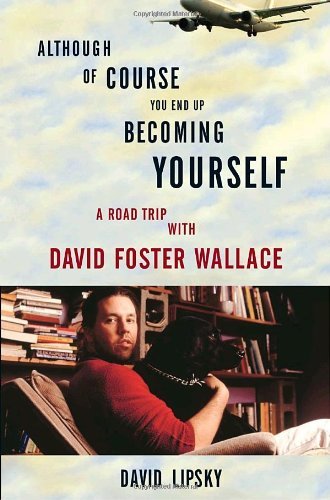
Lipsky I want to tell you one thing I imagine about the creation of this book. Tell me if it's right or wrong. As the listener probably knows by now, this book is made out of transcripts of tapes you recorded while you were on the road with David Foster Wallace for five days during his publicity tour for his big novel in '96 Infinite Jest.

Yeah, it was a lot of fun.

It sounds like it. You didn't end up writing the article that these notes were for, a Rolling Stone profile. That got canceled. So you had these laying around, I presume, stored somewhere. I would imagine, after David Foster Wallace's untimely death in 2008, your mind went immediately to these materials, all this conversation you had with Wallace. I imagine a huge, crushing sense of responsibility. You're thinking, “I've got to do something with themes, but what?” Is that accurate at all?

Well, no — it's interesting, but when I first heard that he had died, like a lot of people, I didn't think it was true. I got an e-mail from a friend, and I assumed it was a prank. Spending time with David, what you have a sense of is just how mentally healthy he was. If you had asked me in the summer of 2008 to name the most healthy, mentally, American writer, I would have without any hesitation, said David Wallace. He just seemed like he'd gone through something when he was younger, but he seemed healed. He seemed like someone who had a wise, funny, sharp way of looking at life, which would tend to make you live longer, not less long. I was shocked. My first response was just tremendous surprise.

You saw this health in him. Is that just from your experience with him in '96, traveling for a few days, getting the first-person encounter, or was that from his work as well?

It was from both. I only knew him for those five days, and in the five days what you read us talking about is just how he'd gone a very hard time when he was in his late twenties, and had found a way to experience the world after that. That was what I had been reading in his work, and what I'd then read in his work afterwards. The person who writes a story like “Good Old Neon”, the person who writes nonfiction like “A Supposedly Fun Thing I'll Never Do Again” or “Consider the Lobster”, is not somebody who hasn't had hardships or wouldn't know how to go through it. Somebody who has, in the full way of a life, tested themselves against hardship and come out with a kind of warm comic knowledge. That was one of the things you love about his work. That's one of the things readers always feel: he has seen all the crap stuff, all the hard stuff they've seen, but he's also still incredibly aware, incredibly alive and incredibly funny.

The story you mention, “Good Old Neon” — it's gotten a lot of re-reading in the wake of Wallace's death simply because of the character it describes. There's this character that goes toward an end by his own hand in the story, and it even holds up a character called David Wallace who has avoided that. You think of other stories like “The Depressed Person”, an illustration of this phenomenon of depression that it's now revealed he suffered from himself.

There seems to be so much there than indicates David Wallace understands all these problems and has somehow transcended them. I think of that as a big paradox of his life and how he wound up. Is that the same way you think about it? There's all this understanding, but he ultimately did succumb to the same thing it seemed he had a grasp on.

I did, and when I read “Good Old Neon” when it came out in book form in 2005 — I'm not a crying reader, but that's one of the only short stories I read and cried at the end of, because of this beautiful line when the narrator becomes David and says, “David Wallace emerging from years of literally indescribable war with himself, won with considerably more intellectual firepower than he had in high school in 1982. I felt that.

That's one of the nice things of spending time with someone: I knew what he was talking about. I felt this great sense of power and health in that line. As a reader, I felt that thing of what a life is, which is that someone who is awake and aware — the kinds of people who like to read, the kinds of people who turn to books to find a little bit more about their lives — they've all gone through that kind of internal, internecine conflict. To see him saying that — I hadn't seen him, then, for almost ten years — I felt very warm for him.
Read more »

Monday, July 12, 2010

Moral Dilemmas

ScreenHunter_01 Jul. 12 15.16 Moral philosophers spend a good bit of their time reflecting on what they call moral dilemmas. It is not entirely clear—nothing in philosophy is ever entirely clear—how to characterize them. But the usual course is to consider a case in which an agent is faced with two courses of action, only one of which can be chosen, and are such that there seem to be compelling reasons for each choice. By itself this would seem to be just a hard case; one in which the reasons are roughly equivalent and it is difficult to tell which set of reasons is stronger. But some philosophers claim that the situation can be much worse than this. It can be the case that the reasons are such that neither set over-rides the other. Or at least that with resources available for thought we cannot make such a determination. A consequence of this is supposed to be that no matter what we do we will be doing something wrong or failing to do something that we are required to do.

Examples abound in the literature. Sartre’s case of the student who wants to join the resistance but has an aging mother who lives with, and depends, on him. Sophie’s Choice to pick which of her two children will be killed by the Nazi concentration camp guard. If she refuses to pick one , both will be killed. Recently, I ran across a book—The Lone Survivor—which is an account of a group of Navy Seals on a mission in Afghanistan told by the only survivor of a failed mission. It presents an account of a moral choice that this group of four men had to make. The case is interesting to think about since it raises a number of different issues which are relevant to the theoretical notion of a moral dilemma, as well as the practical issue of how to think about such difficult and terrible choices.

The four men set out on a mission to try and locate a local Taliban leader – the head of a heavily armed group of Taliban. They do not know what village he is in so plan to remain concealed in some appropriate spot on a sparsely covered high-up mountain until they spot him and attempt to kill him. They discover such a spot and remain concealed, and still, for many hours in the hot sun. If they are spotted from above they are dead ducks. But the area above them seems completely empty. After many hours they hear a noise of soft footsteps above them and a man, wearing a turban and carrying an ax almost stumbles over them. They point their rifles at him and tell him to sit down when suddenly a flock of goats comes trotting up the mountain accompanied by two other men–more precisely one man and a boy around fourteen years old. All three men are distinctly unfriendly—which might be explained by discovering a heavily armed group of soldiers camped out on their farm.

Read more »

Cadmium

ScreenHunter_02 Jul. 12 15.52 When I set out to write a book on all the great and hidden stories on the periodic table, I figured I’d have to delve into some strange and uncomfortable history. There was the inevitable brush with the alchemists, and humankind’s almost instinctual lust for gold and silver. I even ended up mapping out the elements on the periodic table, to reflect the intellectual currents of the past few centuries. What I didn’t expect was how relevant all that history would seem today, how often the same themes would come up again and again in current events and the news. But if it’s anything, the periodic table is still a microcosm for understanding all the wonderful and horrible things about the world.

I had reason to think of this last month when McDonalds recalled over 13 million Shrek-themed drinking glasses after discovering in them high levels of cadmium, element forty-eight. Cadmium can undoubtedly be one of the most beautiful elements—it has a long history in art as a pigment, and helped old masters produce vibrant colors no other substances of the time could. Even today, some shades—like cadmium yellow—retain the name.

But as the famous biologist Edward O. Wilson once said “In the natural world, beautiful usually means deadly.” Wilson was referring to how the brightest colored snakes, frogs, and insects usually harbor the deadliest venoms. But his wisdom applies equally well to the periodic table. Cadmium is one of the more poisonous elements on the table, and has one of its most notorious histories. Yet we keep making the same mistakes with it again and again. In fact, the first widespread recall of consumer goods with cadmium also involved drinking glasses. (Plus ça change…)

Cadmium sits below zinc on the periodic table, which means pure cadmium looks and acts like zinc, including having the same shiny finish as zinc. So, in the 1940s, some manufacturers decided to plate drinking glasses with cadmium and sell them in department stores.

This was bad enough—some atoms of cadmium would naturally slough off every time somebody filled the glass—but became a big problem when summer rolled around and people began drinking fruit juices like lemonade. These acidic juices scraped cadmium atoms off the cup’s surface in droves, and people around America fell ill with intense pain and diarrhea. McDonalds didn’t line its Shrek glasses with cadmium—it was used in the brightly colored paints on the outside, calculated to attract children’s attentions. But in recalling the line, the fast-food company cited the same fear of children ingesting cadmium while they drank.

Read more »

A Diatribe from the Remains of Dr. Fred McCabe

by Daniel Rourke

About a month ago in handling the remains of one Dr. Fred McCabe I found rich notes of contemplation on the subject of information theory. It appears that Fred could have written an entire book on the intricacies of hidden data, encoded messages and deceptive methods of transmission. Instead his notes exist in the form of a cryptic assemblage of definitions and examples, arranged into what Dr. McCabe himself labelled a series of ‘moments’.

I offer these moments alongside some of the ten thousand images Dr. McCabe amassed in a separate, but intimately linked, archive. The preface to this abridged compendium is little capable of preparing one for the disarray of material, but by introducing this text with Fred’s own words it is my hope that a sense of the larger project will take root in the reader’s fertile imagination.

The Moment of the Message: A Diatribe

by Dr. Fred McCabe

More than ten thousand books on mathematics and a thousand books on philosophy exist for every one upon information. This is surprising. It must mean something.

I want to give you a message. But first. I have to decide how to deliver the message.

This is that moment.

I can write it down, or perhaps memorise it – reciting it in my head like a mantra, a prayer chanted in the Palace gardens. And later, speaking in your ear, I will repeat it to you. That is, if you want to hear it.

I could send it to you, by post, or telegram. After writing it down I will transmit it to you. Broadcasting on your frequency in the hope that you will be tuned in at the right moment. Speaking your language. Encoded and encrypted, only you will understand it.

I have a message for you and I want you to receive it. But first. I have to decide what the message is.

This is that moment:

This is the moment of the message

From the earliest days of information theory it has been appreciated that information per se is not a good measure of message value. The value of a message appears to reside not in its information (its absolutely unpredictable parts) but rather in what might be called its redundancy—parts predictable only with difficulty, things the receiver could in principle have figured out without being told, but only at considerable cost in money, time, or computation. In other words, the value of a message is the amount of work plausibly done by its originator, which its receiver is saved from having to repeat.

This is the moment my water arrived at room temperature

The term enthalpy comes from the Classical Greek prefix en-, meaning “to put into”, and the verb thalpein, meaning “to heat”.

For a simple system, with a constant number of particles, the difference in enthalpy is the maximum amount of thermal energy derivable from a thermodynamic process in which the pressure is held constant.

This is the moment the wafer became the body of Christ

The Roman Catholic Church got itself into a bit of a mess. Positing God as the victim of the sacrifice introduced a threshold of undecidability between the human and the divine. The simultaneous presence of two natures, which also occurs in transubstantiation, when the bread and wine become the body and blood of Christ, threatens to collapse the divine into the human; the sacred into the profane. The question of whether Christ really is man and God, of whether the wafer really is bread and body, falters between metaphysics and human politics. The Pope, for all his failings, has to decide the undecidable.

Read more »

Tomyris

Deadfish

By Maniza Naqvi

When the sun sets over the river turning its waters the color of molten gold and then liquid black, like the uninterrupted, robust, gush that flows at the gas pump— then, —when you are alone in the confused maze of your thoughts of hatred and hubris –then— now that you have time on your hands, to fish, does the writing of a story occupy you? Because you would need to tell it won’t you? Sentence it in the way you want to? Flesh out the outlines of yet another murder most foul? Surely you do. Now that you have the perfect view for it: of a place where the hangman’s noose brought its cruel justice for the punishment of an assassin’s crime. Do you wonder about the quakes, the spewing of ash and how the earth has shuddered? Author of assassinations, do you hear the sound of anguish carried to you on the evening breeze as the earth stirs and the waters gurgle? It is a mother’s grief and a mother’s wrath. When the waters turn black, she weeps: This is my body, this is my blood. Now you in your defeat, weep, now you suffer. Do you hear her? It is Tomyris sending you a message. Do you know her? How could you? For you have always defended empire—not those who have fought against it.

Tomyris the queen of the Massagetae lived with her people in her homeland north of the Amu Darya. In 530 B.C Cyrus the Great prepared to occupy her lands and as a pretext offered to marry her. She turned him down. What need was there for marriage? The Massagetae held as sacred the secret of nature: they understood the intricate connection between individual choice and advantage to society. Each woman had one husband, but she slept with anyone of her choosing.

Upon her refusal, his ruse made useless, Cyrus prepared to attack and invade the Massagetae. A messenger carried her warning to him: “King of the Medes, cease to press this enterprise, for you cannot know if what you are doing will be of real advantage to you. Be content to rule in peace your own kingdom, and bear to see us reign over the countries that are ours to govern’. His-story tries to erase them—the warriors the defenders the defeaters of blood thirsty cruel men.

Read more »

KAREN SWENSON’S TREK THROUGH POETRY AND THE WIDE WORLD

by Randolyn Zinn

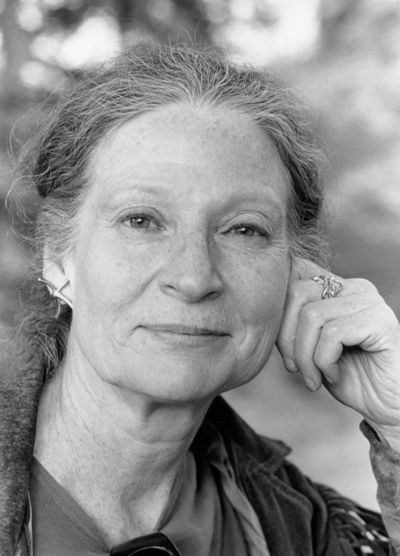
SwensonThis past spring I arranged to meet Karen Swenson at The Century Club in Manhattan. As I climbed McKim, Mead and White’s splendid marble Beaux Arts staircase to the second floor, I saw her sitting at the far side of the library, catching up with The New York Times. Her long braid was wound in a tight chignon and she was dressed in red from head to toe—a chic wrap dress, tights and shoes to match, even her self-designed down coat was tinted a rich cerise. I thought, is this the same woman who leads Southeast Asian treks in sneakers and corduroys two months out of each year for the last 27?

A native New Yorker, Karen told me she was in town only briefly before winging off to Europe, having recently sold her Manhattan apartment. Her fondest wish was to relocate to a city boasting an opera house and a major airport. Two contenders remained: Venice and Barcelona (the eventual winner).

Her poems have been published by The New Yorker and many literary journals, as well as Saturday Review. Her latest book, her fifth, is entitled A PILGRIM INTO SILENCE. Because she is a world traveler, articles on the subject of sojourning have been enjoyed by those who read The New York Times and the Wall Street Journal. Recently she has taught at both her alma maters, Barnard and NYU.

Read more »

Impressions of Karachi: A Photo Journal

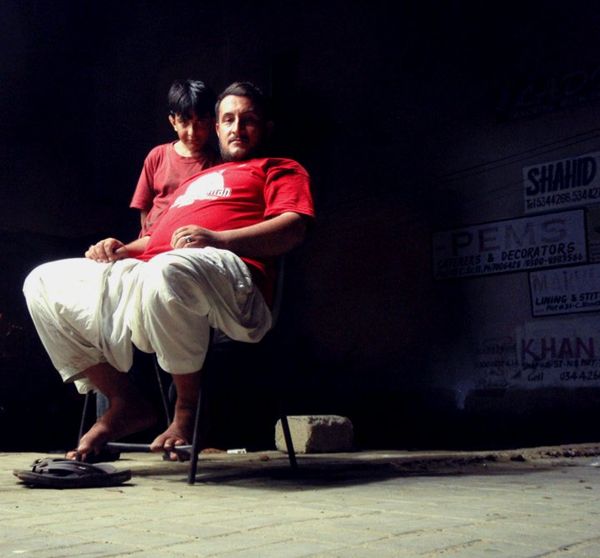
Tandoor owner

Greetings from sweltering Karachi,

As some of you know, I am spending the summer in Karachi. It's my first trip to the city of my birth in almost six years, and I've already been here a little over three weeks now. Here are a few things, picked rather arbitrarily, which I find to be very much the same as always:

  1. The sounds of rickshaws, scooters, street-vendors hawking stuff in a loud and crisp tone particular to their trade, a variety of birds (especially the quarking of crows), truck horns, the hammering of workmen, and other voices and noises which combine with the dusty smell to produce an ever-present aural/olfactory ambience so typical of Karachi that I am aware I am home when I awaken in the morning even before I open my eyes.
  2. The heat and the humidy: though by northeast-American standards it is quite extreme (many Pakistanis living in the West never return in May or June, so infernal are their memories of the blistering weather, and many such people asked me if I had lost my mind when they heard I was planning to arrive in Karachi a week before the summer solstice), I instantly found the weather comforting in a nostalgic way. Yes, both the heat and humidy are always there, but then they were always always-there when I lived here, and I am used to it. And we didn't have air-conditioning when I was growing up. We do now, at least for the hours that we have electricity (it cuts out 3-4 hours a day usually, sometimes more). The humidity is such that one almost swims through the air and one is drenched in sweat within a minute of stepping out of the shower, so it is a race to dry oneself quickly and step out of the fanless bathroom into the fanful bedroom before dressing. The ceiling fans here, by the way, are to ceiling fans in, say, your summer place in the Hamptons, what the jet engine of a Boeing 747 is to the propeller of a Cessna 172. If you had them in New York, you could blow-dry your hair into an early-Beatles mop in 45 seconds flat just by standing under one. Here, of course, one remains covered in a slimy film of dusty sweat even in the wind-tunnel-like conditions these fans generate. Heat rashes are common, and my lower legs are always itchy. Speaking of which, the best thing about extreme heat is that it keeps the mosquitos at bay. But, unfortunately, I know they are busy preparing for a massive assault and invasion in late July and August, just after the rains.
  3. The food is the same but I had forgotten just how good it is. Actually “good” doesn't even begin to describe the paradisiacal gustatory delights on offer both at home (I am staying with my brother) and in restaurants here. In America everything new is said to taste like chicken but this is a ludicrous formulation because even chicken doesn't taste like chicken there. Here, chicken actually has a flavor, and it tastes like, well, chicken. Fruits and vegetables are all organic, small in size, have spots where they are starting to become overripe (because they are not bred to look good or ripened in refrigerated trucks on the way to the supermarket) and bursting with what seems to my long-deprived palate to be concentrated flavor. I was shocked to remember what a carrot is supposed to taste like, for example (not like cardboard, which is what you must think, you poor people). In terms of sophistication, Pakistani cuisine is to Italian what Nabokov is to Dr. Suess. Sorry, that's just how it is. (There are ten aromatic spices alone–not counting other kinds of spice and other ingredients–which go into a commonly eaten chicken curry.) The lovely smell of fresh and hearty naan coming out of any tandoor here instantly brings to my mind the futile desperation with which fancy bakeries like Bouchon cater to the pretentious of Manhattan, and how much I hate such effete gourmandizing.
  4. I notice that without meaning to, or even realizing it, I have started cataloguing the effects of Karachi on all the senses, so I might as well mention the light: Karachi is just above the tropic of cancer, so the sun is only one-and-a-half degrees from completely vertically overhead near noon on June 21st, which results in a light the strength of which is literally stunning. To get a sense of it, turn the brightness knob on your TV (well, it probably isn't a knob, unless you have a pre-1980s TV, but you know what I mean) to max. That's what it looks like outside over here. Without sunglasses I get a headache in minutes. Heat stroke is a real risk of venturing outdoors in the afternoon. In general, the sun is a much angrier, less benign presence in these parts. In Urdu poetry sunshine is quite understandably a metaphor for adversity and difficulty, while the rainy season is romanticised into a symbol of joy and relief (from the sun). The light is very starkly beautiful though.
  5. The traffic: while an enormous number of improvements have been made in the roadways, including the construction of many under- and overpasses, new roads, bridges, and installation of traffic lights and road signs, they have been overwhelmed by the even greater increase in the number of cars, trucks, buses, minibuses, vans, rickshaws, motorcycles, scooters, and unimaginable vehicles of types beyond my humble powers of description–not to mention the crowds of pedestrians swarming orthogonally across the streets everywhere (Karachi has more people than all of Israel and Switzerland combined, and also more than the next five-largest cities in Pakistan combined. In fact, it's larger than 160 of the world's 200-and-some countries). In other words, the traffic is still the same. Oddly enough, and possibly because I first learned to drive in Karachi at the age of 14, I feel very comfortable driving here. Traffic here flows much like the cells in blood vessels: chaotically but efficiently. Driving here is relaxing in a bizarre way, because it's so unencumbered by stultifying rules of any kind. Instead, one guides one's car toward one's destination using the sort of natural proprioceptive sense that one uses to guide one's own body through a crowd. And having the driver's seat on the right side of the car somehow automatically cues one to drive on the left side of the road (a vestige of British colonial days) so that's not a problem either.

Read more »

Monday, July 5, 2010

Is For-Profit Education the Next Subprime Mortgage Crisis?

Picture 1By Olivia Scheck

In 2005, Yasmine Issa was a 24-year-old homemaker, raising twin toddlers in Yonkers, New York. Having just divorced, the newly single mom, with no college degree or professional training, was also in need of a job.

So, like 2.8 million others, Issa enrolled at a for-profit postsecondary school – the kind that you see advertised on TV and highway billboards – called the Sanford-Brown Institute in White Plains.

The program, for people training to become ultrasound technicians, included 12 months of classes, a 6-month internship and the assistance of their career services center, all for around $32,000. Issa used her savings and child support payments to pay for half of the training and took out a federal student loan of $15,000 to pay the rest.

What Issa didn’t realize, until she’d finished the program and spent five months unsuccessfully searching for a job, was that the Sanford-Brown ultrasound program was not accredited by the American Registry for Diagnostic Medical Sonographers (ARDMS).

Without a degree from an ARDMS accredited program, which she could have obtained for half the price at a New Jersey community college, Issa was left with no job prospects and thousands in student loan debt, which was now accruing interest.

Issa related these facts late last month at a senate committee hearing on the ticking time bomb that is for-profit education. But, believe it or not, Issa’s testimony was not the day’s most distressing.

That honor belonged to Steven Eisman, the portfolio manager whose foresight about the subprime mortgage crisis was profiled in Michael Lewis’ book The Big Short.

“Until recently,” the matter-of-fact financier began his testimony. “I thought that there would never again be an opportunity to be involved with an industry as socially destructive as the subprime mortgage industry. I was wrong.”

What followed was a chilling account of how the for-profit education sector has managed to capture billions of taxpayer dollars while, in many cases, bankrupting the students it was meant to educate.

Read more »

Government Isn’t The Problem, Private Enterprise Is: The Global Terrorism Of Al Qaeda, BP And Goldman Sachs

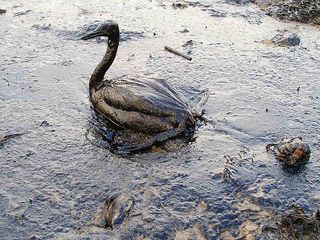
by Evert Cilliers (aka Adam Ash)  oil-spill pelican


Today there are three forms of terrorism threatening the world: political, financial and environmental terrorism. These three forms of terrorism are responsible for the destruction of human lives, livelihoods, property and the environment to a degree that rivals the ravages of war.

All three forms are executed by global, private-enterprise, non-state agents. Our inch-deep media have bestowed the moniker of terrorism on only one of these forms — the political-religious Al Qaeda variety — while leaving the other two off the hook.

This is a little like calling Ted Bundy a crazy serial killer and Jeffrey Dahmer a highly sensitive connoisseur of human protein.

Just consider the many attributes these three forms of terrorism have in common. All three are partly funded by tax dollars — via tax credits and subsidies, tax-payer bail-outs, and taxpayer-funded wars that serve as recruitment drives for political terrorists. All three expound a crazed fundamentalist faith affirming the rectitude of their respective causes. All three feel entitled to huge rewards for their destructive behaviors. All three leave it up to regular folks to clean up after them. All three are unapologetic about their activities (adding insult to injury, some may issue a belated apology to their victims). And all three display a bizarre indifference to human suffering, despite their rhetoric to the contrary.

Moreover, all three forms of terrorism have been enabled by one gaping sinkhole in the social fabric: they appear to have been aided, abetted and promoted by a lamentable lack of government oversight. In all three cases, the problem isn't too much government: it's too little government.

Here's a brief recap of the three forms of terrorism and their main achievements so far.

Political terrorism. Achievements: the death of 2,976 Americans in NYC on 9/11, and many other deaths in London, Madrid, Bali, India, and Iraq. Motive: anger at America's interference in the Middle East, including US backing of Israel against Palestinians and support of repressive Arab regimes, and US wars against Islamic states. Main agent of terrorism: Al Qaeda. Weapons: airplanes, suicide bombs, car bombs, IEDs, websites.

Financial terrorism. Achievements: Loss of 100 million jobs worldwide. Millions suffering from food insecurity. Wrecked economies. Many small business closings. A great loss of family homes. Motive: profit. Main agent of terrorism: Goldman Sachs. Weapons: speculative bubbles, debt securitization, unsafe derivatives, campaign contributions, regulatory capture, bad mortgages.

Environmental terrorism. Achievements: Bhopal, Exxon Valdez oil spill, Nigerian oil spills, Gulf of Mexico oil spill. Motive: profit. Main agent of terrorism: BP. Weapons: unsafe drilling practices, indifference to worker safety, 1960s clean-up technology, useless contingency plans, campaign contributions, takeover of regulatory agencies, misinformation about climate change, managerial indifference to risk and the environment.

Now let's take a look at the three main agents of terrorism in turn and see what government should be, but isn't, doing about them. In this order: Goldman Sachs, Al Qaeda and BP.

Read more »

Women’s Freedom – A Short Introduction to Why I Care

Womensrights Why have so many stopped fighting for women’s rights? We fight for “human” rights and discuss them as if they were a natural element of being human; groups lobby and defend, almost diabolically and with much vitriol, the rights of “animals” (species that are not human). Yet women’s rights, that better half of our species, remain a neglected element of secular discourse. It surprises me that so few of those who consider themselves secular humanists do anything concerning this important issue. This does not mean that many secular humanists do not think it important but there is a great divide between simply thinking it important and doing something to make it so. Not only do I think it important, I believe in my lifetime the liberation of woman, all over the world, for all time, is the single most important goal that we must defend, increase and enhance. The other goals which many of us long for, freedom of speech, lack of coercion, and so on, all are part of, and tributaries within, this pathway. By fighting for women, we fight for free speech and liberty; by defending their rights, we defend human rights; by finding the cause for their oppression we cease the cycle of violence and poverty within families around the world. Reports have suggested that a decrease in women’s freedom correlates to an increase in religious fanaticism. This does not mean that once women are free, all over the world, religious dogmatism, backward political regimes and patriarchal bullying will be banished from the earth; but there is little debate that the fight in itself will lead to a greater amount of freedom, more happiness and will result in woman no longer being the fodder for the religious wrath of backward mullahs and reverends.

According to estimates, which have more than likely increased, 70 percent of the two billion poor are women; two thirds of illiterate adults are women; employment rates for women are declining after increasing (yes, of course, the world wars are now over). At the same time many women are forced into veils and burqas, burnt for merely looking at men, stoned to death or buried alive for adultery, forced into sex, pregnancy and delivering HIV-infected children because they were raped, but if they were to report it, they would either be raped again, executed, exiled from their village or town or family. While this happens, the fashion industry booms with make-up and high-heels and plastic models and girls as thin as the paper they are pictured on, presenting us with yet another contrast to whether women really are in control of their bodies even in supposedly liberated societies. That is an issue unto itself, which I am not focused on, but it certainly should give us pause considering the areas we are dealing with. Modern writers, in the secular West, tell women to go back to the kitchen, obey the husband, be a mother, tie an umbilical cord around the house and hang themselves from it. “Feminine is good,” says women’s rights author, Nikki van der Gaag, “feminism is bad.” A lot of feminist views, philosophy and political goals truly deserve scorn, since they replace one tyranny with another; are subject to faith-based, dogmatic adherence rather than calculated sex equality. The vengeful world of patriarchal accident has given birth to a malicious view toward its women. As this highlights, the malicious desire is one of control – but I do not wish to instil Orwellian fears in big governments and little men.

Read more »

Monday Poem

1st Zucchini

Today I spied our first zucchini
which has followed its saffron flower
like a compliant stud swelling in shade
within a forest of coarse stubbled stems
under a tent of broad leaves
green as the second color of Christmas
a nativity here of the first order
all six inches of it looking to a future of sacrifice
in a sauté mingled with garlic and onions
growing now in the nest of nature
at the whim of god
. . . for want of a satisfying
rational explanation
…………………
by Jim Culleny
July 4th, 2010

Fire in the belly

100_6297 Am I an elitist? Am I looking down from the perspective of a middle-class ivory tower when I write about education and the need to reform our education system in innovative ways to help graduate more students who are better equipped to compete in the new global economy? I’ve certainly sometimes been accused of that over the last 7 months of writing for 3 Quarks. It’s a criticism that gives me pause. My children can read above grade level, aren’t having discipline issues, aren’t struggling with math; is this why I can afford the luxury of worrying about whether or not they are having their right-brained skills nurtured, whether or not they are being encouraged to not shy away from failure, but instead to use it to learn and grow? One of the comments suggesting this went “We can't even motivate a large percentage of children to finish high school, and now we are suppose to prepare the (obviously elite) students to work toward better life goals.”

First of all, I think that this comment misses my larger point: if school were less about rote memorization and instead involved a more integrated, creative curriculum, perhaps we would be better able to motivate more children to finish high school. But the comment does I think hint at a darker criticism: that I’m spouting some liberal, white, elite fantasy that is totally inapplicable to the kinds of educational issues that many schools, teachers and children face in this country, particularly in poor, urban areas.

I don’t agree, and I think to make that claim is to just throw in the towel rather than continuing to advocate for the right of every child to have the best possible education. Consider the Lyons Community School, a middle/high school in Brooklyn.

Read more »

Ambiently breaking reading conventions: Colin Marshall talks to experimental poet Tan Lin

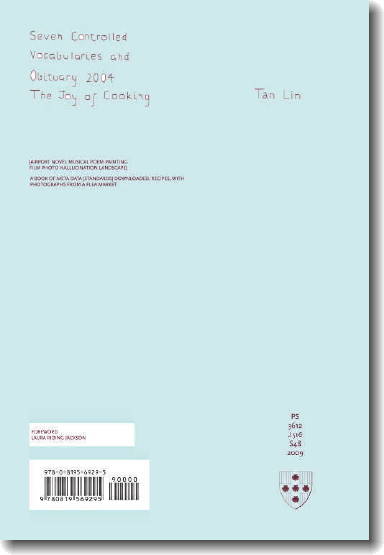
Tan Lin is a poet, professor of English and creative writing at New Jersey City University and author of the books Lotion Bullwhip Giraffe, BlipSoak01 and Heath (Plagiarism/Outsource). His latest book, Seven Controlled Vocabularies and Obituary 2004. The Joy of Cooking, uses its form to escape the notions, conventions and structures of the traditional reading experience. Colin Marshall originally conducted this conversation on the public radio program and podcast The Marketplace of Ideas. [download and show notes] [iTunes link]

Lin1 I read Seven Controlled Vocabularies sequentially, front cover then the pages in the order they were bound, then the back cover, but it does seem I could have read in any order I wanted. Is there an optimal reading strategy for this book?

No, I think it’s about dispersing reading into a number of different environments. One of them, of course, is to do with bibliographic controls that establish various genres, like architecture or film. Also, it connects to online reading practices. People have argued — I think Nicholas Carr most recently — that online reading is much more distracted, conversions of information into short-term working memory and then into long-term memory are disrupted. The book is designed, in some sense, for a kind of skimming. Once you insert pictures into a book, I think you’re in a different sort of textual environment. The book is supposed to open up and free a little bit of space around linear reading practices.

I know this is a huge question to get into, but what is the prime way you’ve made it prompt readers to get around their usual, deeply, deeply, deeply ingrained reading practices?

Maybe the deeply ingrained reading practices have to do with how people read books. But on the other hand, you’re always free to skim, to highlight, to jump around in a book. Again, in an online environment, these things are multiplied exponentially. This book plays with those notions. In some ways, it’s about translating a book into a different kind of reading environment. Part of it has to do with social networking. Part of it has to do with the commodification of attention, perhaps. Part of it has to do with basic online reading practices. There doesn’t seem to be an ideal way to read this. Maybe there’s a distracted skimming going on throughout the book that’s encouraged, but also the insertion of, say, bibliographic controls — oh, this is about architecture, or, oh, this is about poetry, or this is about photography — those help to stabilize the reading practices.
Read more »

Monday, June 28, 2010

Of National Character

With Especial Attention to the Americans, the Muscovites, the Magyars, and Various Balkanic Peoples, touching particularly upon their Aspirations to Global Hegemony, and their Use of Air-Conditioning.

Justin E. H. Smith

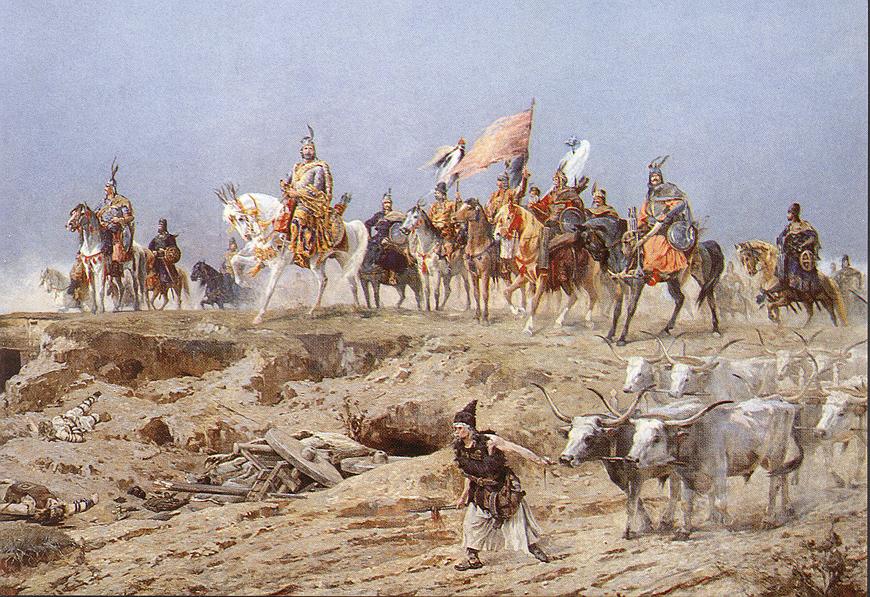
Feszty Organic nationalism, which emerged towards the end of the 18th century, supposed, or at least implied, that a nation bears some essential relationship to a particular territory. In the most mythologized version of this belief, the nation is thought, or at least said, to have arisen directly out of the earth, to be literally autochthonous, springing up from the depths without any connection to neighboring groups. Moderate nationalists of the period, such as Johann Gottfried Herder, sought for a way to defend national distinctness without resorting to such crude myth, and while they did not pretend that a people is born directly from the soil, they still hoped to tie national character to the way it is forged over the course of history out of a particular geographical nexus.

A clear demonstration that we are not in fact like plants, rooted in our national soil, is our ability to get up, should we so choose, and go somewhere else. We do not wilt and die, though we also do not remain quite the same. I am an expatriate, and it grows harder with each passing year for me to maintain a personal sense of what being American must mean. I have lived outside of the US steadily for seven years, and spent large segments of the decade before that outside of the country as well. Although I am fully connected, via the internet, to the American media that keep that country's pulse around the clock, it is increasingly difficult for me to maintain any real interest in domestic issues. Unlike nearly all the Americans I know, I am not really made angry, for example, by Glenn Beck. Outraged reactions to the latest stupid thing he has said strike me, I dare say, as a bit undignified. He is a buffoon, and he occupies a niche that has its equivalent in every time and place. Let him do his thing, and let us not stay tuned in to the networks that give him voice.

Expatriation, I mean to say, helps one to overcome the passions with understanding. As my identification with one or the other party to internal American conflicts diminishes, my perception grows sharper of the very long historical processes that give shape to current American life. Thus for example I often find myself trying to make sense for bewildered Europeans of western American crackpot libertarianism by arguing that it evolved directly from the settling of the frontier, with the ethnic cleansing and genocide that that involved, but also with a certain 'spirit' of freedom and individualism that cannot be valued nearly as much in dense urban centers. In turn, it seems reasonable to me to suppose that American imperialism, and the delusions of entitlement and superiority for which individual Americans abroad are so often criticized, flow directly from the late-18th and early-19th-century project of constructing America through expansion into the frontier. Oklahoma and the Phillipines and Iraq were just different stages of the same development, and this centuries-long process has something to do with the perception of the world, and of their place in it, often had by individual Americans.

Read more »