A Paris Review-style interview with E.O. Wilson
A score of books. Two Pulitzers. Papers that defined entire fields. So why did biologist Edward O. Wilson bother writing a novel? Because people need stories, he says. Wilson hopes his fictional debut from earlier this year, Anthill—about a young man from the South, militant ants, and the coupled fate of humans and nature—will help spark a conservation revolution.
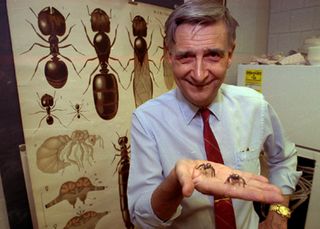
Edward Wilson: Fire away, and I’ll try to get back answers of decent interest, brevity, and so on.
Sam Kean: I’ve heard you say you have a policy of never taking any vacations. Was writing this book sort of a vacation for you?
EW: I would say in one sense I never take a vacation. I never go on a fishing trip. I never go to the beach except to study the ants who live in the sand. So in that sense I’ve never taken a vacation in my life. But I consider that most of the work I’ve done in my life is one continuous vacation. I don’t know how I’ve managed to get away with being paid for what I do. Because to me it’s a constant adventure and thrill.
And I have the advantage as a scientist, especially when working on ants, to do a search wherever I go. Even when I took my family on vacations—for them—and of course, I had to have leisure time with them!—I could do research wherever we went, because ants are ubiquitous. Even if you went to the beach somewhere, there are ant species. After all, they make up more than half the biomass of all insects. And ants are found form the arctic almost to the ends of the southern continents…
But here I am, nattering on about ants. We were talking about the book. Go ahead.
SK: So did you consider the book a vacation from science or a continuation of it?
EW: All three! That is, it combined all three of my key interests. One is science. Second is conservation of biodiversity. Third, is an exciting new experience: to plunge into a different mode of thinking and writing. Although maybe I should say that the mode of thinking is really not that different.
SK: Not that different from…?
EW: Science. Because the ideal scientist, I’ve always thought, is a person who thinks like a poet (or, if you wish, a novelist), who works like a bookkeeper, and—if he’s fortunate to be able to do so—who writes like a good journalist in explaining what has been found. But the difference between the creative process and writing science is that you don’t have the bookkeeper period.
On the other hand, if you have a science base, which this book certainly does, with the ant part, you can accomplish certain things. It’s the first time anyone has written of the cycles of the ant colonies as the ants themselves experience it—as best we can understand it from the science. And I think this is the first novel—it’s certainly the first southern novel—but it’s one of the very few American novels to pay close attention to the environment. Particularly the diversity of life in the environment.
Most novelists deal with the environment in phrases like, Went through the dark woods, looking for a dark path, you know, or, Found peace in a meadow filled with beautiful blooming flowers. That’s about as far as most novelists go. What I’ve done is to make the environment—and particularly that treasured habitat that a young Raphael Semmes Cody, the hero, spends the entire book designing and scheming and fighting to save—I made it virtually a character in the novel. Treated it as an entity, the ecosystem, almost as a character. So that in a sense it comes full circle to your question: The book has a lot of science in it.
Read more »