by Hasan Altaf
 There is a scene in Tony Kushner’s Angels in America where two characters, Louis and Belize, sit in a coffeeshop and Louis goes off on a long digression about America, about why democracy has succeeded in America (“comparatively, not literally, not in the present”), power and race in America, politics and freedom in America, everything, and Belize doesn’t really respond until later, when they meet again, at the Bethesda Fountain in Central Park. The first time I read this play was nearly ten years ago, but part of his response has stuck with me since then: “I live in America, Louis, that’s hard enough, I don’t have to love it.”
The play is set in New York in the 80s, in the shadow of Koch and Reagan and AIDS, and I read it first in the shadow of terrorism and Bush and Iraq, and then the scene came to mind again recently when I was listening to a show on the radio about American exceptionalism. The discussion among the panel was, as seems fairly typical for this show, careful and nuanced and balanced, but there developed in the end the general consensus that American exceptionalism was, has been, might still be and could be again a good thing.
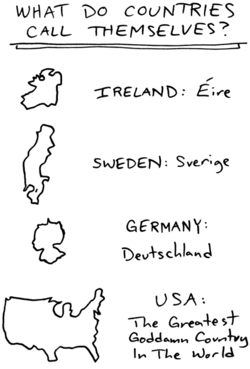
“De Tocqueville’s America” was the phrase that kept coming up, part of the frequent nods to the founding mythology of the country (immigrants, freedom, republic), to the journey of America, the perfecting of the union, what seemed a sort of moral Manifest Destiny. The argument was that America at its founding represented something that was, indeed, exceptional, and a return to that idea, that kind of exceptionalism, would be good, would be worth striving for. The thing though about Manifest Destinies is that there is always a cost, there are always Indians, and American exceptionalism in the eighteenth century or to de Tocqueville might have meant one thing but it has become something else now. At the very least, it has developed a darker tinge, stains that a simple return to the past cannot whitewash.
Read more »





 The late economist Hyman Minsky wrote that after fortunes inflate on the back of a speculative bubble, and after investors’ irrational optimism and overvalued assets inevitably collapse, an economy enters a “period of revulsion,” when people remember that it’s risky to bet big on an uncertain future. Likewise, it’s always during the depths of a hangover that a drinker remembers how whiskey invites its own overconsumption and swears that the only way to avoid another descent into this purgatory is to never touch the stuff again. But after the fog leaves and with a clear head regained, he forgets the pain after the party and declares another Manhattan to be an eminently reasonable investment. Of course, the trick is to recall at just that moment how miserable you’ll be after another three. A pessimistic economist faces the same cyclical popularity as a tee-totaling friend; a consoling voice the morning after becomes a buzz killer as soon as night falls again.