by Jeff Strabone
When Cy Twombly died last week on July 5, my first thought was that the greatest living painter had left us. That's because I am a simple fellow amused by such games as anointing The Greatest Living Painter and The Most Delicious Dinner Entrée in New York. (It's the duck at The Grocery on Smith Street.) Less foolishly, I hope, my second thought was that Twombly may have been the last great classicist in a world where classicism may no longer be an available position.
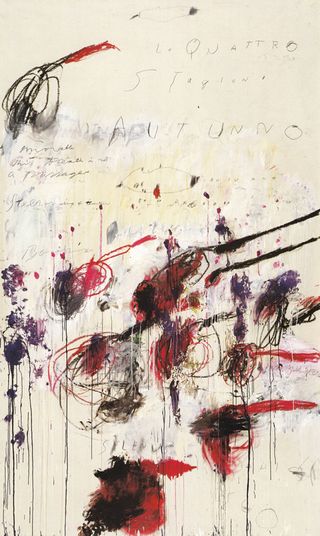
The obituary in the New York Times declared that Twombly was 'stubbornly out of step with the movements of postwar American art even as he became one of the era's most important painters'. Despite painting in a style that would not have been conceivable before the late twentieth century, Twombly stood outside his time chiefly because his deepest commitments were to an ideal of timeless classicism. Although he may have sidestepped the many competing art movements of his day, Twombly's classicism revealed a definite partisan affiliation: he was a Dionysian of the highest order.
All the recent notices remind us that Twombly was the painter who left New York. A more fitting epitaph would be that he was the classicist who went back to the source. Though he admired the beauty of his native Virginia, a place he said had more columns than all of Rome and Greece, he moved to Italy in his late twenties. His explanation tells us a lot: 'I've always lived in the south of Italy, because it's more excitable. It's volcanic.'
In literature and visual art, classicism is work that draws on ancient Greece and Rome, usually with reverent imitation. The poetry of Alexander Pope, for instance, is neoclassical because of its devotion to propriety, balance, and decorum in a way that was thought to mimic the values of the Augustan era in Rome. But classicism is not simply imitative. Any classicist worth our attention converts, in some distinct way, his traditional sources of inspiration into new methods, techniques, and styles.