by Hasan Altaf
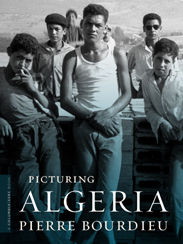
In Picturing Algeria: Pierre Bourdieu (Columbia University Press), the sociologist Franz Schultheis and the curator Christine Frisinghelli offer the reader an unprecedented selection of Bourdieu's photographs from Algeria, where he traveled for the first time as part of his national service, at twenty-five. He was to return again a few years later, as a lecturer at the University of Algiers, and he joined a research effort run by the Algerian arm of the French statistical institute. He helped produce two important books – one on labor migrants, and another that depicted the impact of brutal French resettlement policies. The photographs in Picturing Algeria date mostly from the time of this research, between 1957 and 1960, but they aren't just the snapshots of a researcher with a camera and some free time. Bourdieu's experiences in Algeria were to have a profound impact on his later life and work; as Craig Calhoun notes in his foreword, in Algeria Bourdieu was learning his trade, and “photography was one crucial way in which [he] gathered data – and developed his sociological eye.”
There is a strange kind of distance and balance in Bourdieu's photographs. Calhoun writes that “they are neither the completely naive snapshots of a newcomer nor products of a fully formed sociologist” – that is, they are neither picturesque, touristy snapshots, nor rote illustrations of theories. Even without any background information, the pictures suggest study, learning, research. They are usually square (he used a medium-format camera, rather than the standard Leica, partly to be more unobtrusive) and generally harshly lit – the highlights (a turban, a veil, a white teacup in the sun) can be almost painful. The picture that most struck me was of an elderly woman sitting in the dirt outside her home. She's sitting in the shade, but has one arm, elbow on her knee, stretched out, and in the sun her forearm bleaches transparent, pure white, like a negative or an X-ray.