
by Josh Yarden
The sound of money talking is echoing ever louder throughout the land. The recent ruling of the U.S. Supreme Court unfettered the ability of the wealthiest Americans to buy free speech in the form of deregulating contributions to political campaigns. In the words of Justice Stephen Breyer (writing for the minority in McCutcheon v. The Federal Elections Commission) “Where enough money calls the tune, the general public will not be heard.” We the people now have to raise our voices even louder if we are to have influence in our political system. It is all too easy to become discouraged, but we can begin to gather inspiration for social engagement by returning to explore first principles.
An old symbol for a new struggle
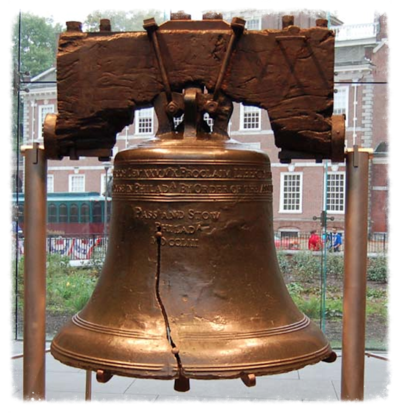
On any given day you might see a group of school children crowding around the Liberty Bell for a lesson on the history and the mythology of the United States of America. The Pennsylvania State House bell was commissioned to commemorate the fiftieth anniversary of William Penn's 1701 Pennsylvania Charter of Privileges. It later came to be known as the Independence Bell, associated with the founding of the nation, and eventually as the Liberty Bell, when it was adopted by the movement for the abolition of slavery.
The renaming of the bell by the abolitionists was inspired by the inscription, “Proclaim Liberty throughout the land unto all the inhabitants thereof,” quoted from the Book of Leviticus, chapter 25, verse 10. The part of the verse immediately preceding the quote speaks of hallowing the fiftieth year, known in biblical times as the jubilee year, and so it was fitting to choose this quote for a golden anniversary, but the rest of the text may surprise you. Leviticus 25 goes on to detail the requirements of the jubilee year. After seven periods of seven years, it is time to press the proverbial restart button on the nation's economy. “And you will return, each to his possession, each to his family will you return.” And it goes on from there to set forth what the inhabitants of the land are not allowed to do with the harvest that year.
The ancient Israelites were instructed that the process of amassing wealth comes to a halt every fifty years, when all property is returned to the original owners. (The books of Numbers and Joshua describe in detail the apportioning of the land to the families.) There can be no landed class lording over a peasant class. Come what may over the course of a lifetime, the system does not allow for the emergence of a sustained economic gap with a dispossessed impoverished population existing across the social divide from an institutionalized wealthy class.













![Image[1]](/wp-content/legacy/6a00d8341c562c53ef01a73d982b76970d-400wi "Image[1]")