by Madhu Kaza
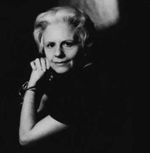
After I heard the recent news that Gabriel García Márquez had died, and after I'd read the obituaries and tributes, and reminisced about my own early encounters with his fiction, I knew it was time to read another great 20th century writer: and so this week I finally read Mercè Rodoreda's novel La plaça del Diamant. Rodoreda had become one of my favorite writers on the basis of a few short stories I'd read a couple of years ago in the collection My Christina. But I hadn't delved more deeply into her work. I knew that García Márquez had been a champion of her writing, and that a month after her own death in April, 1983 he wrote a moving tribute to her in the pages of the Spanish daily, El Pais.
In the piece titled, “Do you know who Mercè Rodoreda was?” García Márquez wrote of his grief at hearing the news of her death, not only because of his great admiration for her work, but also because outside of Spain her death had not been widely noted, and she hadn't received what he felt were her due honors. Rodoreda was born in Barcelona in 1908 and began publishing at a young age. After the Spanish Civil War, when the Catalan language was banned in public and the culture harshly supressed, Rodoreda went into exile. For nearly twenty years, until 1957 she published nothing. In 1962 she published La plaça del Diamant (translated as The Time of the Doves by David Rosenthal in 1981), widely regarded as her masterpiece and a masterpiece of Catalan literature. García Márquez wrote of her as an “invisible woman who wrote tough, beautiful novels in splendid Catalan.” Reading Rodoreda's work for the first time was as dazzling for him as his first encounter with the work of Juan Rulfo. Of The Time of the Doves, he remarked, “In my view, it is the most beautiful novel that's been published in Spain after the Civil War.”
The Time of the Doves narrates the experiences of Natalia, a young shop assistant in Barcelona in the bleak years before, during and just after the Civil War. Natalia is neither ambitious, nor assertive. At the beginning of the novel she goes to a dance only because, as she says, “It was hard for me to say no if someone asks me to do something.” It almost seems that Natalia marries the carpenter Quimet for the same reason; at the dance he announces that by the end of the year she will be his wife, and shortly thereafter, with little resistance, Natalia breaks off her previous engagement and marries him.