by Sebastian Normandin
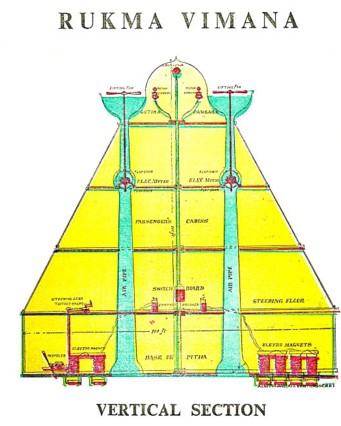
Their paper made a rather extraordinary claim. Citing evidence from an early 20th century text — the Vaimanika Shastra — the two men argued that the airplane was invented in the Vedic Age (c. 1500-500 BCE). In further interviews, Mr. Bodas claimed these flying vehicles — vimana — were huge and could fly to other planets. Unlike modern airplanes, the vehicles didn't just fly forward but were capable of making immediate course corrections and could suddenly fly left, right or backwards.
The vimana is a fascinating idea. Mentioned in the great Indian epics — the Mahabharata and the Ramayana — it translates as “spacecraft” or “aircraft”. The Sanskrit word “vi-mana” can be literally translated as “measuring out” or “traversing” or “having been measured out”. The vimana is also an architectural term for a tower above the inner sanctum (the sanctum sanctorum or Garbhagriha) of a Hindu temple. These two meanings are not necessarily unrelated, and there is a symbolic connection between the vimana as vehicle and as architectural structure. When a god sits in the chariot — the vimana as vessel or spacecraft — it is analogous to the architectural form, the tower. Symbolically the vimana as tower sits in a “heavenly” liminal space between the earthly temple and the realm of the gods. It is this “space”, whether vessel or that which lies between, that allows transportation between the heavens and earth.