by Matt McKenna
More than the thousands of articles laboriously describing the apocalyptic state of American politics in 2016, the low-brow Kevin Hart comedy Central Intelligence is the most efficient and accurate portrayal of the circus we’ve created out of our Presidential election process. In hindsight, it seems odd to expect long-read think-pieces in periodicals like the New Yorker to shed light on what is less of a democratic election and more of a reality show called “Who Wants to be the President”. Indeed, a run-of-the-mill summer comedy with the crass tagline “Saving the world takes a little Hart and a big Johnson” seems the more appropriate medium to comment on our equally crass election. So perhaps it shouldn't be surprising that director Rawson Thurber’s Central Intelligence isn’t just reasonably funny, but it also provides a legitimate critique of American politics.
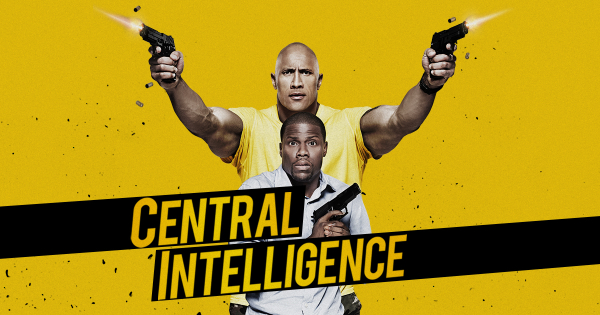
Central Intelligence co-stars Kevin Hart and Dwayne “The Rock” Johnson. Hart plays Calvin Joyner, an accountant who is bummed out because he used to be cool in high school, but now he’s boring. Johnson plays Bob Stone, a CIA operative who was bullied mercilessly in high school, but now he’s super jacked. Because Calvin was nice one time to Bob in high school, Bob recruits Calvin to help him on some cockamamie save-the-world mission involving satellites, access codes, and Aaron Paul implausibly portraying a CIA agent. The story, of course, doesn’t make sense, nor was it designed to make sense, which is the first clue the film is actually commenting on American politics.
The humor in Central Intelligence stems from the conflict between the diminutive Calvin and the gargantuan Bob. Calvin is a stuck-up white-collar jerk, and Bob is an naive violence-loving semi-idiot. The film has therefore patterned its leads after the stereotypes of the two major political parties in America; Calvin represents Democrats with their politically correct, holier-than-thou elitism, and Bob represents Republicans with their inability to solve problems in a way that doesn’t involve applying violence to something. Neither party gets a pass in the film–Calvin is frequently the butt of the joke as he sheepishly runs from conflict and is unable to take care of himself. And though he is able to beat people up, the motivation for Bob to develop his physically dominating stature is his feeling emasculated as an adolescent.