
by Mary Hrovat
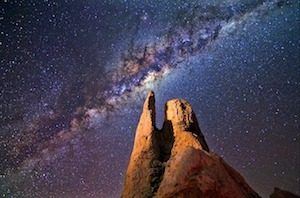 In 2018, Earth picked up about 40,000 metric tons of interplanetary material, mostly dust, much of it from comets. Earth lost around 96,250 metric tons of hydrogen and helium, the lightest elements, which escaped to outer space. Roughly 505,000 cubic kilometers of water fell on Earth’s surface as rain, snow, or other types of precipitation. Bristlecone pines, which can live for millennia, each gained perhaps a hundredth of an inch in diameter. Countless mayflies came and went. As of this writing, more than one hundred thirty-six million people were born in 2018, and more than fifty-seven million died.
Tidal interactions are very slowly increasing the distance between Earth and the moon, which ended 2018 about 3.8 centimeters further apart than they were at the beginning. As a consequence, Earth is now rotating slightly more slowly; the day is a tiny fraction of a second longer. Earth and the sun are also creeping apart, by around 1.5 centimeters per year, although the effect of tidal interactions is very small. Most of the change is due to changes in the sun’s gravitational pull as it converts some of its mass into energy by nuclear fusion.
The entire solar system traveled roughly 7.25 billion kilometers in its orbit about the center of the Milky Way. This vast distance, however, is only about 1/230,000,000th of the entire orbit.
In 2018, there were two lunar eclipses and three partial solar eclipses, each a step in the long gravitational dance making up the roughly 18-year saros cycle. During one saros cycle, eclipses with particular characteristics (partial, total, annular) and a specific Earth–Moon–Sun geometry occur in a predictable sequence; at the end, the whole thing starts again. This pattern has been repeating for much longer than humans have been around to see it.
I like knowing these bits of cosmic context because they link me to a larger world. I can echo the words of Ptolemy: “Mortal as I am, I know that I am born for a day. But when I follow at my pleasure the serried multitude of the stars in their circular course, my feet no longer touch the earth.” Read more »

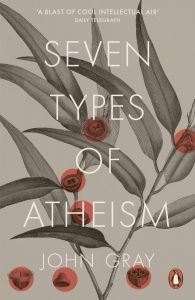 It is simultaneously awkward and exciting to read about your own consciously and responsibly adopted beliefs as something to be anatomized. It is also something atheists are not always much disposed to. On the contrary, perhaps: many forms of atheism present themselves as a consequence of free thought, of emancipation from tradition. The internal logic of their arguments prescribes that while religious beliefs, being non-rational, are in need of cultural or psychological explanation, atheism is really just what you will gravitate towards once you finally start thinking. One question here will be whether this is necessarily the case.
 Certain phrases choke us with their ubiquity at some point:
 As we approach the end of the year, it’s that time again. Not to flip the page to the next month, but to buy a new calendar. (Who am I kidding? It’s probably only me and your grandmother who still uses paper wall calendars…) And also to reflect.
 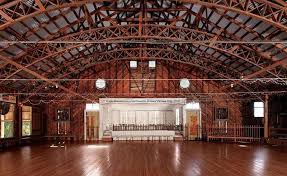 Guinea and Redhead were part of a large food chain. Beyond campus’ freshly-baked sidewalks, a Cowboy Mafia ferried contraband from the south. They landed small prop planes on ranch land outside of town, cut powder with dental anesthetics and broke up the bales. Their wares clumped on our cafeteria trays and glinted in tiny screw-top bottles. The capo, a local big-hat business man,who ran a palatial kicker-dance hall and owned the ranch. That legit business and his crew’s discipline kept them out of jail. Maybe a hat full of cash in the bargain.
 Philosophers are supposed to ask Big Questions. The Big Questions is the title of a popular introduction to philosophy and of a long-running BBC programme in which people discuss their ethical and religious perspectives. But since we philosophers, following in the footsteps of Socrates, claim to practice critical thinking, it behooves us to ask whether Big Questions are a good idea.
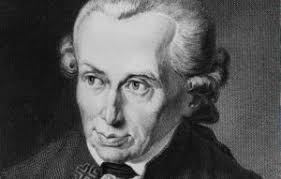 In his Critique of Pure Reason (1781) Kant claimed that in denying knowledge he was “making room for faith.” Inevitably, though, faith in God, the soul and the afterlife has declined dramatically since Kant’s time, especially among intellectuals. There are virtually no articles published in philosophy journals today that treat the existence of God or the immortality of the soul as live issues. Science does not explicitly teach us that there is no God and no heaven, any more than it teaches us that there are no fairies or vampires. But the default attitude of most professional philosophers today is that in such matters the absence of evidence amounts to evidence of absence.

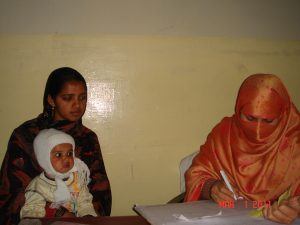 Mandra health center, outside Islamabad, on this spring morning, without the cacophony and confusion of health centers in the city, was the picture of serenity. An emaciated woman of indeterminate age sits coughing in the corridor, in a chair that bears the logo of the United States Agency for International Development, next to a little girl with dry shoulder length hair and yellow eyes, one bare foot resting upon the other. I make a provisional diagnosis—pulmonary tuberculosis for the woman, viral hepatitis for the girl, both diseases endemic in Pakistan.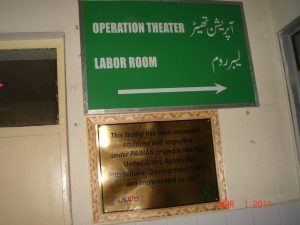
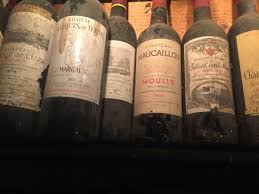 From its origins in Eurasia some 8,000 years ago, wine has spread to become a staple at dinner tables throughout the world. Yet wine is more than just a beverage. People devote a lifetime to its study, spend fortunes tracking down rare bottles, and give up respectable, lucrative careers to spend their days on a tractor or hosing out barrels, while incurring the risk of making a product utterly dependent on the uncertainties of nature. For them, wine is an object of love.
 Academics have a privileged epistemic position in society. They deserve to be listened to, their claims believed, and their recommendations considered seriously. What they say about their subject of expertise is more likely to be true than what anyone else has to say about it.