by Jeroen Bouterse
“Am I ever going to use this later?” As a math teacher, I seem to be getting this question about once a month (which is actually less frequently than I would have predicted). It is asked with varying degrees of openness to the idea that a satisfying reply is even conceivable, but almost invariably by students who are probably justified in believing that their tertiary education or future career is going to involve few linear equations indeed.
Rather than trying to conjure up some practical situation in which one might need to solve a fractional equation, I usually suggest that math may be worthwhile even if it turns out you can safely forget the techniques you learned in school. Isn’t this puzzle fun, doesn’t it make for good mental exercise, don’t you feel yourself getting a little bit smarter? Implicitly, I am banking on the idea that math improves your thinking. But what does that mean?
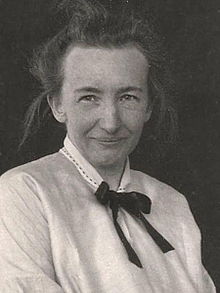
Recently, I stumbled upon a pamphlet from the 1920s that turned out to be both a feast of recognition and a source of further questions. Its author was Tatiana Ehrenfest-Afanassjewa. A Russian mathematician and physicist, Ehrenfest-Afanassjewa spent much of her time teaching mathematics and developing a program of mathematical pedagogy. Having worked in St Petersburg, she moved to the Netherlands in the 1910s when her husband, Paul Ehrenfest, became a professor of physics at Leiden University. Read more »
 I wrote the first draft of this post on my typewriter. Like much of my other writing, this piece began as handwritten notes and drafts typed on a nice little portable typewriter, which is a little younger than I am and which I expect to use for the rest of my life.
 The traveler comes to a divide. In front of him lies a forest. Behind him lies a deep ravine. He is sure about what he has seen but he isn’t sure what lies ahead. The mostly barren shreds of expectations or the glorious trappings of lands unknown, both are up for grabs in the great casino of life.
 Although we know bias and racism exists in most societies, when put into coherent terms in the form of research the impact is stark and exposes just how much a part of life racism is for so many people. Booth and Mohdin’s (The Guardian 2018) article ‘Revealed: the stark evidence of everyday bias in Britain’ setting out the findings of a poll on the levels of negative experience, more often associated with racism, by Black, Asian and minority and ethnic groups in the United Kingdom(UK) does just that. Thus, for example, from amongst its many findings the survey revealed that 43% of those from a minority background had been overlooked for work promotion in the last five years in comparison with only 18% of white people who reported the same experience. Likewise, 38% of people from ethnic minorities said they had been wrongly suspected of shop lifting in the last five years, in comparison with 14% of white people. Significantly, 53% of people from a minority background believed they had been treated differently because of their hair, clothes and appearance, in comparison with 29% of white people. In the work-place also 57% of minorities said they felt they had to work harder to succeed in Britain because of their ethnicity, and 40% said they earned less.
 In the immortal words of Prince Rogers Nelson’s party gem from 1982:
 first day. To the ancients, the sun was God Himself–the Egyptians had Ra, and the Aztecs,
  monuments to track it. In the dark days of winter we brighten our homes with candles and holiday lights. Winter religious holidays like Christmas and Chanukah emphasize lights and candles to brighten the darkness, while other holidays come during spring, when the days get longer. Many of us feel the need to travel south in
  the dead of winter, to get a few days of bright light and longer days.
 “Eets beeg place. Millennium Theater. Brighton Beach. You see it. We start seven. Very good band. Leader has gigs coming up. I tell him you coming.”
 Like millions of other people in the US, I often begin the day by listening to ‘Morning Edition,’ the early morning news program on National Public Radio. Sometimes, though, I get so disgusted by the rubbish spewed by the politicians being interviewed, or so infuriated by the flimsiness of the questions put to them, that I just can’t stand it and have to take myself out of earshot. Friday was a case in point.
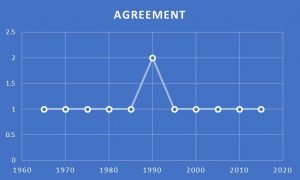 . . . I want to thank Professor Owens once again for his electrifying lecture on determining the outcome of any baseball season by crunching the data from a ten-game sample, reducing the number of games played by 152. Like so much breakthrough research, this also produced an unintended benefit: the freeing up of nearly 10,000 extra hours on TBS for reruns of The Big Bang Theory. I know we are all grateful.
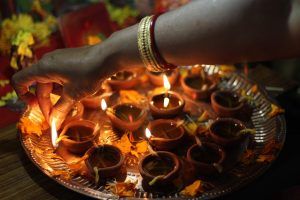 In October of 2014, a bunch of young men and women did their university proud. A couple of engineers, two finance graduates, a biology major, some finishing accounting and business degrees, and a clutch from the school of humanities and social sciences; Muslims mostly, two Christians, a lone Hindu, one Buddhist wannabe, and two oblivious to religion though aware of its place in other folks’ lives. They came together from Sahiwal, Karachi, Gilgit, Swat, Peshawar, Gujranwala, one from Quetta (non-Baluchi), and two from Delhi via the University of Texas. Though the majority of students and faculty stayed away, these young men and women with similar features and skin tones, in colorful flowing kurtas, chooridars, skinny jeans, funky T-shirts, and hijabs, got together to celebrate Diwali, a festival that celebrates Ram’s return from exile.