by Niall Chithelen
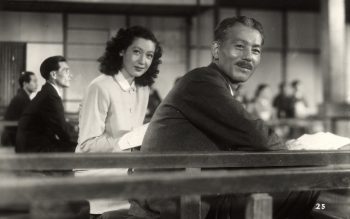
Throughout the film Late Spring (1949), the protagonist, Noriko, hides her emotions behind smiles. She smiles when happy, of course, but does so also through moments we know must be uncomfortable or sad. We take special notice, then, of the few moments in which Noriko’s face truly falls. She cannot smile through the news that her father, with whom she was living contentedly, might be remarrying. Once it seems her living situation will no longer be viable, Noriko agrees reluctantly to get married herself. On the day of her wedding, she sits, tentative in her finery, when her father comes to visit and compliments her. She smiles at him and then looks to the floor and her expression fades.
We might, as one film scholar does, see Noriko’s smiling as a sign she is a “modern girl” (moga). The film was made during the American occupation of Japan, and with the occupation and the postwar moment came cultural changes, new models and advertisements, fashionable women bearing congenial smiles. There are elements of Noriko’s life that suggest a certain modern-ness; she is wary of marriage, her professional skills are such that the work she used to do for her father Shukichi is now taken up by his Western-suited assistant, she wears Western-style clothing and has bobbed hair, she likes Gary Cooper, and she always seems to be smiling. Read more »
 In the next couple of months two of the largest democracies in the world—India and Indonesia—will have their national elections. At a time when democracy is under considerable pressure everywhere, the electoral and general democratic outcome in these two countries containing in total more than one and a half billion people (more than one and a half times the population in democratic West plus Japan and Australia) will be closely observed.
 There is a sense in certain quarters that both experimental and theoretical fundamental physics are at an impasse. Other branches of physics like condensed matter physics and fluid dynamics are thriving, but since the composition and existence of the fundamental basis of matter, the origins of the universe and the unity of quantum mechanics with general relativity have long since been held to be foundational matters in physics, this lack of progress rightly bothers its practitioners.


 I was struck by a sentence in Susan Orlean’s The Library Book: “If nothing lasts, nothing matters.” This line was part of a discussion of memory, the fear of being forgotten, and the value of passing things on to future generations. I share a passion for the idea of continuity between generations (and I highly recommend Orlean’s book), but ultimately I don’t think that something has to last to matter. Alan Watts, in his book This Is It, says that “This—the immediate, everyday, and present experience—is IT, the entire and ultimate point for the existence of a universe.” It’s not about connecting with anything but what’s here in front of me now. (Easier said than done, of course.)
 I teach two kinds of group exercise classes, and part of the certification processes for both disciplines devoted no small amount of attention to how to speak to your minions, uh, students.
 “…And now to introduce our second panelist: Martha. Martha does believe that academic philosophy is worth pursuing, and she has – of course – written a book about it. Martha, can you briefly summarize your argument?”


 My answering machine whirrs. From an echoing room, the chainsaw-voice shouts into a speaker phone:
 One of the philosophical tools that seems utterly obvious to me is the so-called “use/mention distinction”. Because it strikes me as so obvious, it is always baffling to me that people seem to have such trouble with it.
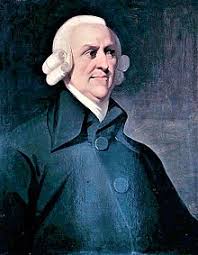 I just read Adam Smith’s The Wealth of Nations for the first time. Not every word. It’s over a thousand pages, and there are long “Digressions” (Smith’s term) on matters such as the history of the value of silver, or banking in Amsterdam, which I simply passed over. I was mainly interested in what Smith has to say about work, so I also merely skimmed some other sections that seemed to have little relevance to my research. Time and again, though, I found myself getting sucked into chapters unrelated to my concerns simply because the topics discussed are so interesting, and what Smith has to say is so thought-provoking. Reading the book is also made easier both by Smith’s admirably lucid writing and by the brief summaries of the main claims being made that he inserts throughout at the left-hand margin.