
by Joan Harvey

What made him a great poet was the unprotesting willingness with which he yielded to the ‘curse’ of vulnerability to ‘human unsuccess’ on all levels of human existence—vulnerability to the crookedness of the desires, to the infidelities of the heart, to the injustices of the world. —Hannah Arendt on Auden[i]
Sometimes we have to do the work even though we don’t yet see a glimmer on the horizon that it’s actually going to be possible. —Angela Davis
. . . something undaunted wants to move no matter how inauspicious the prospects, advance no matter how pained or ungainly. —Nathaniel Mackey
A man goes door to door, wearing his murdered son’s shoes, to ask voters to make him their state representative. His son, Alex, 27, had been gunned down in the Aurora theater shooting. The man, Tom Sullivan, is elected, even in a very conservative district, and shortly afterward sponsors an Extreme Risk Protection Bill to give law enforcement the ability to temporarily remove guns from people having a mental health crisis. He wears his murdered son’s leather jacket when he speaks on behalf of the bill. It’s too late for his son. But, he says, “I’m not doing this for Alex and my family, I’m doing it for yours. Watching your child’s body drop into the ground is as bad as it gets, and I’m going to do everything I can to make sure that none of you have to do that.” The bill passes. And then comes the campaign to recall Sullivan, organized by Rocky Mountain Gun Owners, a group who claims the NRA is a sellout, and whose executive director will get a cut of every dollar that the group raises. Republican Patrick Neville, Colorado House minority leader, is helping to organize these recalls.[ii] And this is only one of nine recalls proposed in Colorado.
In the film Knock Down the House, the three women profiled along with Alexandria Ocasio-Cortez all ran based on their experience with systemic violence. Amy Vilela of Nevada lost her daughter when a hospital refused to admit her because she didn’t have insurance. Paula Jean Swearengin of West Virginia lost many friends and family to cancer caused by coal mining. Cori Bush of St. Louis lived in close proximity to Ferguson. All these women ran tough campaigns against entrenched incumbents and all three lost their races. Read more »

 The Big Bang Theory has been one of the most successful sitcoms in TV history. Last month it ended. In many ways, it ended a long way from where it had begun; many commentators have noticed how the show
 The Doomsday Scenario, also known as the Copernican Principle, refers to a framework for thinking about the death of humanity. One can read all about it in a recent
 ![Henri Matisse created many paintings titled 'The Conversation'. This, from 2012, is of the artist with his wife, Amélie. [Hermitage Museum, St. Petersburg, Russia].](https://3quarksdaily.com/wp-content/uploads/2019/06/Matisse_Conversation-360x292.jpg)

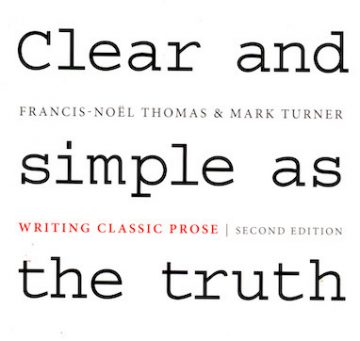 Books about how to write are so frequently described as life-changing and essential (usually by publishers, but sometimes by reviewers) that I was initially unmoved by enthusiastic reviews of Clear and Simple as the Truth: Writing Classic Prose, by Francis-Noël Thomas and Mark Turner. However, the praise seemed to focus on the fact that the book had changed the reviewers’ attitudes toward what writing is and how it works, and that interested me. I decided to get a copy, and I’m glad I did. The book describes and illustrates a particular style of writing but also, and perhaps more importantly, it really did give me a different framework for thinking about what style is and, yes, what writing is.
 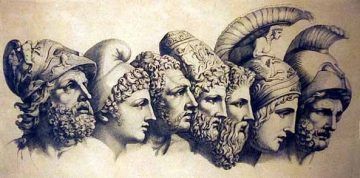 Did completing your taxes seem a Herculean task? Did cleaning your adolescent bedroom compare to mucking the Augean stables? Are you more jovial or saturnine by nature? Do you or anyone you know suffer from narcissism? Did you see the movie Titanic? Have you ever been hypnotized? Do you want to go on an odyssey? These questions are all so tantalizing, no?
 The relation between what is natural and what is morally good is a topic that has concerned philosophers from ancient times to the present. Those who view the part of a human being that belongs to the material world as sordid, unclean, and irrational have understood morality to require the suppression or the taming of nature; the angel in us must control the beast. This outlook is endorsed by Plato and is commonly found in Christian theology. Hobbes’ social contract theory, which presents moral life and political order as the way we escape the miseries of the state of nature, also takes morality and nature to be in certain respects opposed. Many others, though, have looked to nature for some sort of moral guidance. The Stoics viewed the implacable order observed in the heavens as a model for a serene human life. Defenders of rigid social hierarchies pointed to the successful arrangements in a bee hive. Critics of homosexuality argue that it is “unnatural,” while advocates of gay rights deny this. Appeals to what one finds in nature have bolstered social Darwinism, the subordination of women, arguments for and against slavery, egalitarianism, and the idea of universal human rights.

 The authority of scientific experts is in decline. This is unfortunate since experts – by definition – are those with the best understanding of how the world works, what is likely to happen next, and how we can change that for the best. Human civilisation depends upon an intellectual division of labour for our continued prosperity, and also to head off existential problems like epidemics and climate change. The fewer people believe scientists’ pronouncements, the more danger we are all in.
 Growing up, a lighter branded you as suspect to any Baptist worth his King James Version. Because really, other than smoking and setting houses on fire to incinerate the family within just for kicks, what did you need a lighter for anyway? If you wanted to light something righteous like a candle or the water heater, you reached for the box of safety matches next to the paprika in the spice cabinet. They had SAFETY written on the box in case you felt tempted to go astray. Lighters should have had Iniquity Equipment inscribed on them as far as we were concerned.

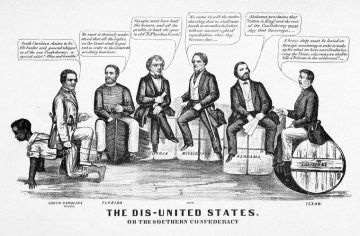 By the time Sherman’s armies had scorched and bow-tied their way to the sea, by the time Halleck had followed Grant’s orders to “eat out Virginia clean and clear as far as they go, so that crows flying over it for the balance of the season will have to carry their own provender with them,” and by the time Winfield Scott’s Anaconda Plan was finished squeezing every drop of life out of the Confederacy, there had to be those who wondered what possible logic would lead intelligent men like Jefferson Davis to make such a catastrophic choice.