by Philip Graham
 I discovered my ideal radio station by accident.
In the fall of 1979, my wife Alma and I took up a brief week’s residence in the Paris apartment of a friend, a pause before we’d fly to West Africa and then live in a small upcountry village in Ivory Coast for over a year. In those days, graduate students in anthropology often sought a Claude Lévi-Strauss benediction before heading off to their first fieldwork. On the nervous morning of Alma’s scheduled meeting with the founder of Structuralism, she needed a weather report to help her decide what to wear. In those pre-smartphone days, the radio by the bedside was the place to search for just that. I pushed the On button, but before turning the dial I paused at the unmistakeable voice of Randy Newman. What was he doing on a French radio station?
He was singing “I Think It’s Going to Rain Today.”
Alma and I laughed—we’d tuned to a song that predicted the weather! She looked out the window into the blue sky of that warm September day. “Well,” she said, “maybe we’ll take along an umbrella, just in case.”
A Chopin étude followed Newman’s song. Now my attention was more than caught—what sort of station was this? The Supremes’ “Baby Love” came on deck next, then sinuous Raï music from Algeria, and after that a French psychedelic band popped up whose name I still wish I’d caught, and so on. Every new song arrived as a surprise. That radio station, with its gathering of unlikes and frissons of unpredictability, had, I realized, the soul of an anthology.
I have always loved anthologies. Read more »


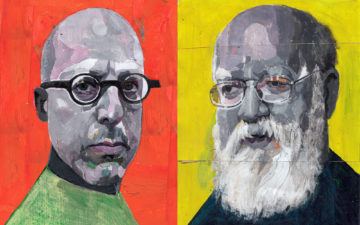
 I’ll return to that second crack once we’ve explored the first one. But why do that at all? Does free will matter to anyone but a couple of bickering philosophers? Of course it does! Sam Harris noted in his recent
 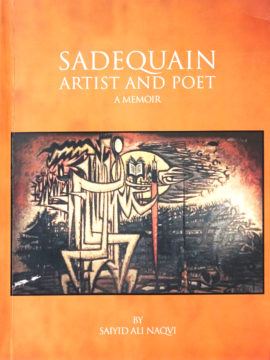 “Sadequain!” The very name is like a magic word that triggers a tumult of images in the mind. Arguably, no Pakistani artist has elicited more admiration, evoked more passion, and received more adulation than Saiyid Sadquain Ahmad Naqvi, the subject – and really, the hero – of the book “Sadequain: Artist and Poet – A Memoir” by Saiyid Ali Naqvi. In the world of art, be it painting, music, or literature, it is the pinnacle of achievement to be recognized by a single name – to need no further introduction. And rare indeed is the artist who achieves this distinction in his or her own life, as Sadequain did remarkably early in his career as an artist. And this delightful, beautiful, and insightful book shows why. Beginning with the earliest and formative years of Sadequain when he was not yet a legend, it takes the reader systematically through all stages of his life and his growth as an artist, laying bare both the immense determination and the perpetual restlessness of the artist’s genius.


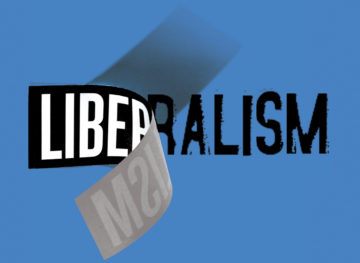 The world we live in is changing, and our politics must change with it. We are in what has been called the ‘anthropocene’: the period in which human activity is threatening the ecosystem on which we all depend. Catastrophic climate change threatens our very survival. Yet our political class seems unable to take the necessary steps to avert it. Add to that the familiar and pressing problems of massive inequality, exploitation, systemic racism and job insecurity due to automation and the relocation of production to cheaper labour markets, and we have a truly global and multidimensional set of problems. It is one that our political masters seem unable to properly confront. Yet confront them they, and we, must. Such is the scale of the problem, the political order needs wholesale change, rather than the small, incremental reforms we have been taught are all that are practicable or desirable. And change, whether we like it or not is coming anyway: between authoritarian national conservative regimes, which with all the inequality, xenophobia, or that of a democratic, green post-capitalism. The thing that won’t survive is liberalism.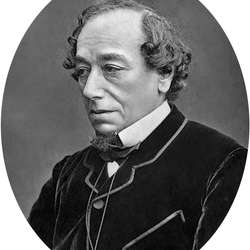
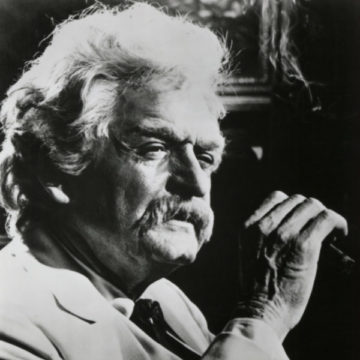
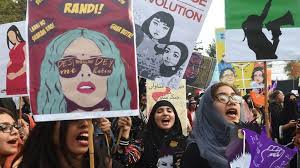
 Over recent times, many books have been published with the aim of writing women into history and crediting them for the achievements they have made to the benefit of humanity more broadly. Janice P. Nimura’s The Doctors Blackwell is in that genre of women’s history and she effectively narrates the biographies of the first two remarkable women to study and practice medicine in the United States: Elizabeth Blackwell and her younger sister, Emily.
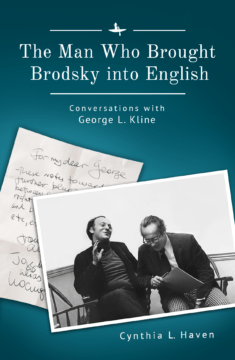 Cynthia, let me begin by asking you to describe your path to the book—a double path that led you to Joseph Brodsky and to George L. Kline.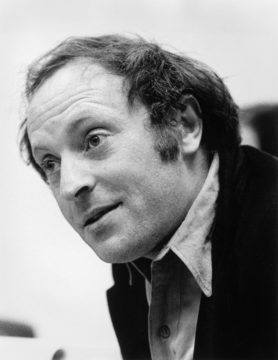
 Philosophy of science, in its early days, dedicated itself to justifying the ways of Science to Man. One might think this was a strange task to set for itself, for it is not as if in the early and middle 20th century there was widespread doubt about the validity of science. True, science had become deeply weird, with Einstein’s relativity and quantum mechanics. And true, there was irrationalism aplenty, culminating in two world wars and the invention of TV dinners. But societies around the world generally did not hold science in ill repute. If anything, technologically advanced cultures celebrated better imaginary futures through the steady march of scientific progress.