
by Ashutosh Jogalekar
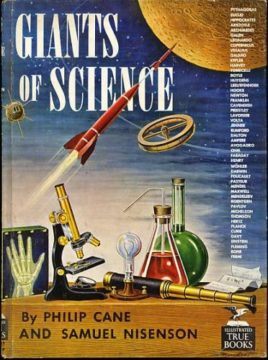 In many ways, the story of my life is the story of books that I have read and loved. Books haven’t just shaped and dictated what I know and think about the world but they have been an emotional anchor, as rock solid as a real ship’s anchor in stormy seas. As the son of two professors with a voracious appetite for reading, it was entirely unsurprising that I acquired a love of reading and knowledge very early on. The Indian city of Pune that I grew up in was sometimes referred to as the “Oxford of the East” for its emphasis on education, museums and libraries, so a love of learning came easy when you grew up there. For 35 years until their mandatory retirement, my parents both taught at Fergusson College in Pune.
The college which became one of the premier institutions of undergraduate education in India was founded in 1885 by prominent intellectuals who were active in the Indian independence movement. Named after the governor of Bombay, James Fergusson, the British allowed the college to remain largely autonomous and this autonomy allowed the college to experiment with its own blend of nationalism and modernity. Among many others, two prominent leaders of the independence movement, Bal Gangadhar Tilak and Gopal Krishna Gokhale, taught there. It was Gokhale who became an early mentor to Gandhi and who encouraged Gandhi to know his country better by traveling across it after the former lawyer returned to India from South Africa where he had lit the spark of his nonviolence movement. Read more »
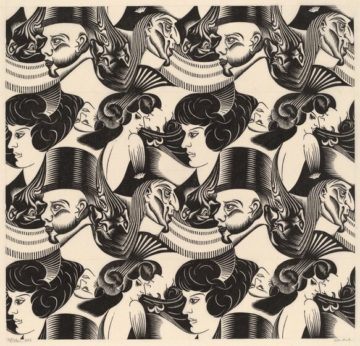

 At the 100th anniversary of John Rawls’ birth back in February, some of the most generous op-eds, whilst celebrating the brilliance of his thought, lamented the torpor of his impact. ‘Rawls studies’ are by no means the totality of political philosophy, but they are one of its most significant strands, and his approach has been dominant for the past 50 years. I’m an admirer of political philosophy, having happily spent much time and energy studying it, specifically looking at theories of deliberative democracy, an area with important connections to Rawls’ thought. That political philosophy does not have much to say that is of direct practical concern does not bother me, the sense that it is not just uninfluential, but is disconnected from the reality of the present moment does though.
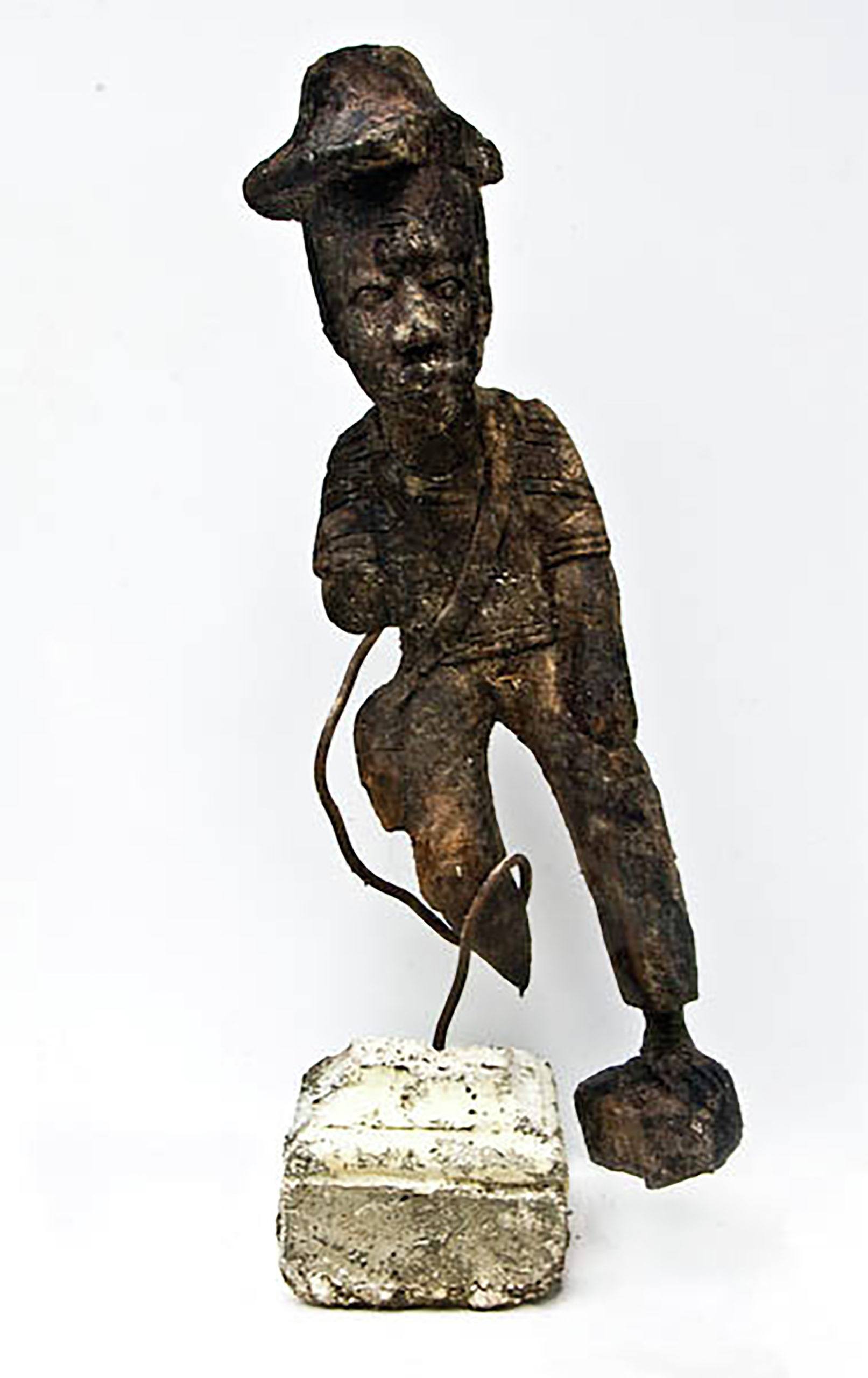 Anderson Ambroise. Rubble Sculpture.

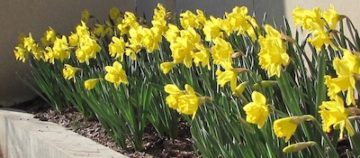 I don’t think I saw an actual daffodil until I was 19, although I had admired the many varieties I saw pictured in bulb catalogs and even—I hesitate to admit this—written haiku about daffodils (at 14, in an English class). When my first husband and I drove through Independence, Missouri, early in our marriage, I saw my first daffodils, a large clump tossing their heads in a sunshiny breeze. Wordsworth flashed upon my inner ear, and as I remember it, I recited “And then my heart with pleasure fills, and dances with the daffodils!” (If I did in fact say that, I’m sure I added the gratuitous exclamation point.) My husband, who was driving, gently asked me to return my attention to the map (I was navigating).


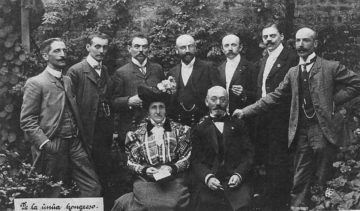 In 1887 Ludwik Zamenhof, a Polish ophthalmologist and amateur linguist, published in Warsaw a small volume entitled Unua Libro. Its aim was to introduce his newly invented language, in which ‘Unua Libro’ means ‘First Book.’ Zamenhof used the pseudonym ‘Doktor Esperanto’ and the language took its name from this word, which means ‘one who hopes.’ The picture shows Zamenhof (front row) at the First International Esperanto Congress in Boulogne in 1905.
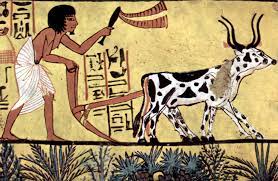 If, for a long time now, you’ve been getting up early in the morning, setting off to school or your workplace, getting there at the required time, spending the day performing your assigned tasks (with a few scheduled breaks), going home at the pre-ordained time, spending a few hours doing other things before bedtime, then getting up the next morning to go through the same routine, and doing this most days of the week, most weeks of the year, most years of your life, then the working life in its modern form is likely to seem quite natural. But a little knowledge of history or anthropology suffices to prove that it ain’t necessarily so.
 It’s official: Lilly Singh, the YouTube phenomenon,