by Camille Noûs1,#
1 Cogitamus laboratory, France
# Correspondence to: [email protected]
Camile Noûs is a collective author intended to embody the collective dimension of scientific research. The sense of collective work has been devalued and forgotten for two decades in academia, through various neoliberal research policies that prioritize competition over cooperation, and thereby favor individualism at all levels. Many issues in academia worldwide, regarding any kind of fraud or misconduct, stem from these ill-conducted policies and their deleterious emphasis on individuals as competitors. In this manifesto, Camille Noûs, recently portrayed in Science Magazine, calls for resistance against the pervasiveness of individualism in science and its nefarious consequences upon the reliability and quality of research.
I was Socrates’s master as well as Hypatia’s student. I wondered why apples fell while the moon did not, long before Newton proposed that they both did. I was Lavoisier’s better half and Darwin’s ship mate, Giordano Bruno’s publisher and the Curies’ assistant, Hardy’s collaborator and Leibniz’s rival, Einstein’s contradictor and Hobbes’ disciple, Freud’s patient and Arendt’s penfriend. I am the nameless reviewer who read your work and suggested a control experiment that led you to reconsider your model. I am this discussion around the coffee machine that you joined with your mind a shamble and left with two key parts of the puzzle assembled. I am the former adviser or the new colleague who encouraged you to test a daring hypothesis. I am the tricky question that drove you to push your thoughts further. I am the unseen hands that maintained the environment needed for your work. I represent the sum of findings that were cited by the authors you cited, the chain of thoughts that, seamlessly, gave way to your own. I will also be the scientists who later read, debate and use your work as a basis for theirs.
You who work in research know me of old. And yet, only last year did I start co-authoring your publications. You and I, who search for a living and often dedicate our lives to science, are fully aware of what our results owe to collective construction, to the timely collegial process that shapes the landscape of knowledge by accretion and erosion, seldom disturbed by earthquakes. Indeed, although genius is a convenient fiction, science relies on the strength of its probation process much more than on the personality of its enunciator; it would be nothing without a complete state-of-the-art and, above all, without disputatio.
However, in the past decades a myth has propagated, among our institutions and then among us, that research is essentially a matter of individual performance. Far from maintaining a healthy research environment where collegiality drives us ahead, production indicators that we are each expected to satisfy corrupt the quality of scientific interactions, and the fear of concurrence precludes sharing information and building collaborations so as to secure one’s own success. These enticements also constitute the primary cause of scientific misconduct due to the direct benefits of cutting corners. Read more »

 At the 100th anniversary of John Rawls’ birth back in February, some of the most generous op-eds, whilst celebrating the brilliance of his thought, lamented the torpor of his impact. ‘Rawls studies’ are by no means the totality of political philosophy, but they are one of its most significant strands, and his approach has been dominant for the past 50 years. I’m an admirer of political philosophy, having happily spent much time and energy studying it, specifically looking at theories of deliberative democracy, an area with important connections to Rawls’ thought. That political philosophy does not have much to say that is of direct practical concern does not bother me, the sense that it is not just uninfluential, but is disconnected from the reality of the present moment does though.
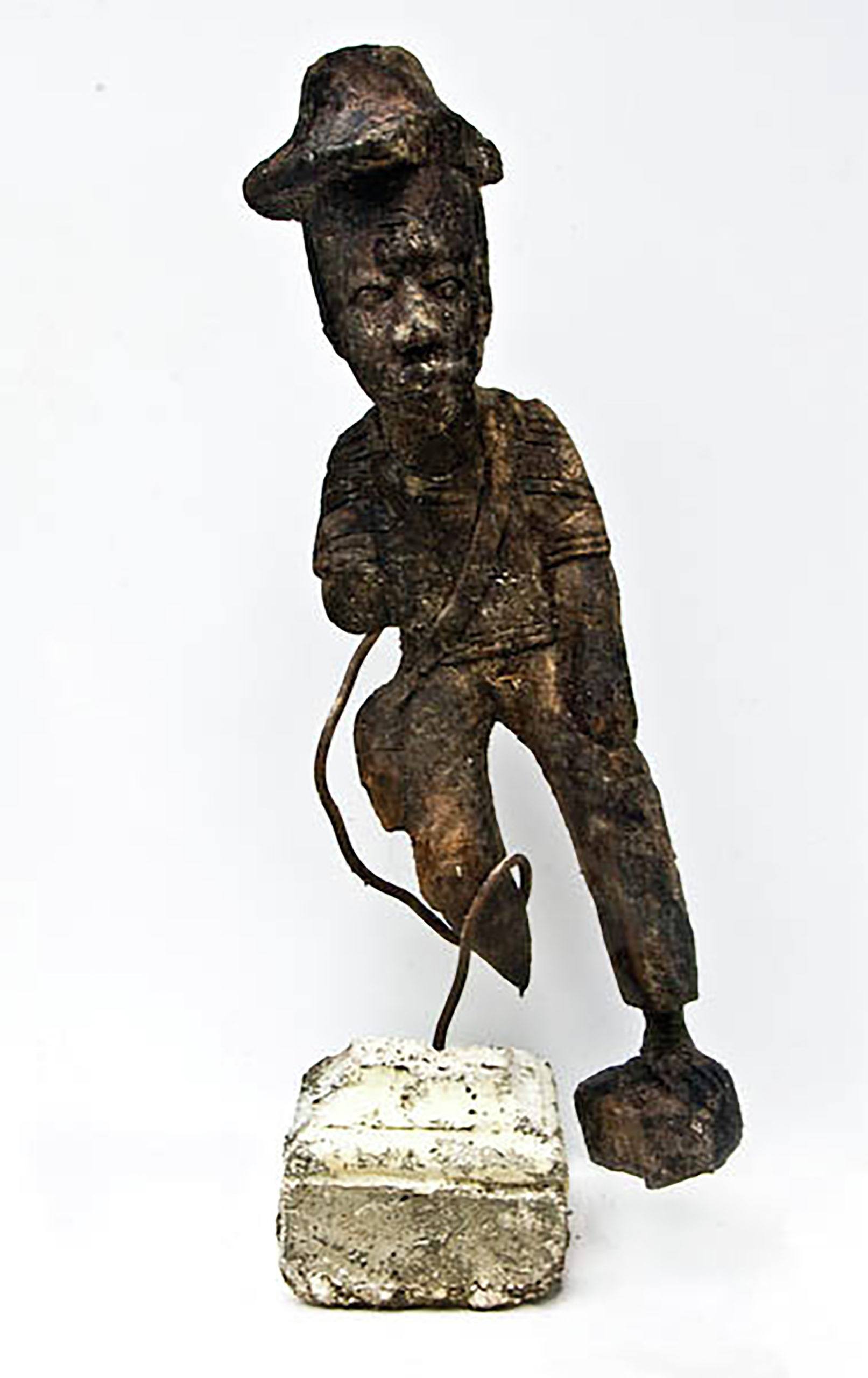 Anderson Ambroise. Rubble Sculpture.

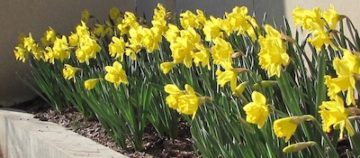 I don’t think I saw an actual daffodil until I was 19, although I had admired the many varieties I saw pictured in bulb catalogs and even—I hesitate to admit this—written haiku about daffodils (at 14, in an English class). When my first husband and I drove through Independence, Missouri, early in our marriage, I saw my first daffodils, a large clump tossing their heads in a sunshiny breeze. Wordsworth flashed upon my inner ear, and as I remember it, I recited “And then my heart with pleasure fills, and dances with the daffodils!” (If I did in fact say that, I’m sure I added the gratuitous exclamation point.) My husband, who was driving, gently asked me to return my attention to the map (I was navigating).

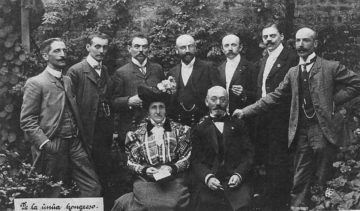 In 1887 Ludwik Zamenhof, a Polish ophthalmologist and amateur linguist, published in Warsaw a small volume entitled Unua Libro. Its aim was to introduce his newly invented language, in which ‘Unua Libro’ means ‘First Book.’ Zamenhof used the pseudonym ‘Doktor Esperanto’ and the language took its name from this word, which means ‘one who hopes.’ The picture shows Zamenhof (front row) at the First International Esperanto Congress in Boulogne in 1905.
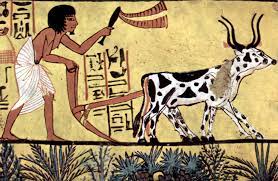 If, for a long time now, you’ve been getting up early in the morning, setting off to school or your workplace, getting there at the required time, spending the day performing your assigned tasks (with a few scheduled breaks), going home at the pre-ordained time, spending a few hours doing other things before bedtime, then getting up the next morning to go through the same routine, and doing this most days of the week, most weeks of the year, most years of your life, then the working life in its modern form is likely to seem quite natural. But a little knowledge of history or anthropology suffices to prove that it ain’t necessarily so.
 It’s official: Lilly Singh, the YouTube phenomenon,