
by Sean Murphy
 i.
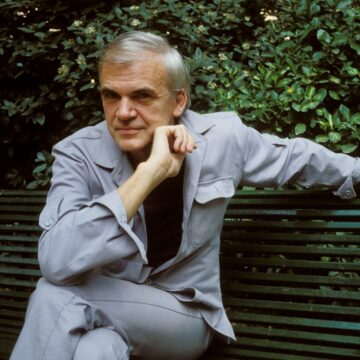
i.Does it tell us much—about the times we live in, about ourselves—that the occasion of Milan Kundera’s passing, at age 94 three years ago this summer, was not met with an outpouring of approbation and appreciation?
If nothing else, it was a reminder of the fickle nature of fashion, trends, and time. It would have seemed a certainty, a decade or two ago, that Kundera’s legacy would accrue advocates and converts, and his readership an evergreen proposition. Of course, history has consistently proven that popular and/or critically lauded writers are anything but guaranteed immortality.
As an acolyte whose flame of both love and envy has never dimmed, I can attest that engaging with his work remains…complicated.
Kundera almost killed me, still in my creative cradle, a writer needing nourishment.
He arrived in my life too early. As a reader, it wasn’t soon enough, as what relatively inexperienced but enthusiastic amateur—fresh from the front lines of grad school and adjusting to a world without texts to deconstruct—won’t benefit from that kind of sophisticated guidance, at any age? Still, as an aspiring writer, Kundera’s work had the odd effect of inspiring me, only too much. One encounters accumulated wisdom of this caliber and feels desperate, like a creature trudging through the heat in search of an oasis. Finally, happening across a patch of water, one laps up every drop, half insane with relief and oblivious to the crocodiles lurking hungrily in the shallows.
Reading Kundera at any age, particularly as an aspiring writer with a future filed under “TBD,” you don’t just want to write like him, you want to be him. On some level you understand: in order to write like that you have to have lived like that. Eventually—and the sooner the better—you recognize it’s an impossibility and, choices narrowed to one, you lick your wounds and get on with the unbearable lightness of being yourself.
ii.
Context, of course, is everything.
I first read Kundera in a pre-internet world, and I wonder how disconsonant to our 21st Century insanity his work will be, going forward. Kundera, a man out of time is, in some ways, more easily connected—spiritually, aesthetically—to his heroes from centuries past than any of his peers, artistic or otherwise, today. He was an old soul, certainly, but a creative one; he undoubtedly ruffled the feathers of ancient gods, watching him with envy and pity as he encroached on the sublime, aloof from the mere mortals he walked amongst, no safe home here or in heaven.
His chief subject, he told the Paris Review, was not politics or social criticism but the “complexity of human existence in the modern world.”
It’s not coincidental that his best-loved books were written during years when intellectuals pondered if we’d lived through the end of history. No ivory tower elitist, he had dirt under his fingernails (at least figuratively) and knew what gunpowder smelled like; he also was talented and famous enough to remove himself (as the best artists aspire to do; the middling poseurs content with making as much money as possible) from the numbing grind, having the luxury to obsess about matters of the heart and mind. One imagines he never bothered to buy a computer or send an email.
If men of his time (and place) had seen the dumb ferocity of war and oppression up close, they also enjoyed the creative fruits of ennui. Being bored, they obsessed about the one thing any man, freed from worrying about food or work, focuses on: women. His novels will be uneasy reads for future generations, their female characters often anything but fully formed—at least in ways where their primary purpose is to serve or be adored (Kundera was not above cliché, speaking of women as muses and ostensibly intending it as a compliment).
One thing he could not be accused of, to his credit, is denial. As imperious and intolerant of convention as he could be, he knew what he was, and was refreshingly candid about his limitations. “Every one of my novels could be entitled The Unbearable Lightness of Being or The Joke or Laughable Loves,” he said. “They reflect the small number of themes that obsess me, define me and, unfortunately, restrict me. Beyond these themes, I have nothing else to say or to write.”
The best novelists, of course, combine the dispassionate insight of a historian, the elan of an iconoclast, and the empathy of a social worker. They are, as Shelley declared, our world’s unacknowledged legislators. Except they are, of course, acknowledged, and their work endures long past the expiration dates of celebrities, politicians, and professors. A more measured and succinct assessment, courtesy of another Great White Male from the old school, John Updike, who wrote “Kundera makes the life histories of most American writers look as stolid as the progress of a tomato plant, and it is small wonder that Kundera is able to merge personal and political significances with the ease of a Camus.”
iii.
In Testaments Betrayed Kundera explains his vision of the novelist’s acumen, which is “a considered, stubborn, furious nonidentification, conceived not as evasion or passivity but as resistance, defiance, rebellion.”
That’s about the best mission statement for any writer I’ve ever come across, and is the closest thing to personal mantra, or creed, that has consoled and inspired me, almost thirty years after I first read it. I came to appreciate Kundera as an ideal distillation of two other writers who did their best work last century, Martin Amis and Christopher Hitchens. In his art, which audaciously combined fiction, criticism, and philosophical ruminations, he seemed to possess Amis’s impeccable style and Hitchens’s indefatigable erudition, the wary traveler who’d seen and read everything, had an opinion about all of it, and steadfastly refused identification with any cause or tribe.
According to Plato, the measure of a man is what he does with power.
George Orwell, who knew a thing or two about what drives human behavior—and with a couple more centuries of history than Plato was privy to—declared: the object of power is power.
Both of these sentiments, wise in ways that cut across sociopolitical, military, religious, and academic concerns, seem especially apt when reflecting on current events. They also remind us that, as it relates to humankind’s worst tendencies, power—which can be defined as leverage, ownership, access, agency, subjugation, or some combination of all these—is invariably the prime, primal impulse.
One might be tempted to observe that we too are animals, and what is nature if not a never-ending battle for supremacy and survival? Well, humans, with our big brains (and libraries of documented atrocities committed by and against our own kind) and evolved hearts, remain the only inhabitants of this world who know might doesn’t make right, yet fabricate or justify reasons why this time it’s different, and violence and collateral damage are, alas, unavoidable. Of course, to our disbelieving eyes, we see events unfolding right now—in the 21st Century—where a dictator is scarcely attempting to rationalize his barbarity.
iv.
Why does Kundera matter, now?
It’s an enduring tribute to Kundera that his writings continue to inform, inspire and console. It’s our collective tragedy, as human beings, that much of his subject matter remains relevant, applicable and therefore actively ignored. Then again, as William Carlos Williams declared, for all time: “It is difficult to get the news from poems/yet men die miserably every day for lack of what is found there.”
Which, inevitably, brings us to the state of our wicked world, particularly and inexorably in America. And, all the innocent bystanders asking the same question going back to at least 2015: how can anyone be attracted to this?
The more puzzling question seems to be: who, exactly, are these millions of Americans whose lives are demonstrably impacted—for the worse—by every single MAGA-adjacent policy and initiative? And the answer is: they’ve always been out there, hiding in plain sight. Naturally, the internet has enabled them to crawl out of their rat holes and find solidarity in sheer numbers, as is true of any gang or cult. Obviously, from Fox News down to alt-right marches (and bro podcasts!), there are many cynical outlets profiting (in all regards) from exploiting their pain. And certainly, in Trump, we have the apotheosis of reality TV, media-made, substance-over-style cult of personality disorder to serve as both Pied Piper and demigod for the disenfranchised.
But make no mistake: they were always out there.
As craven, selfish and short-sighted as many of our elected officials have been this last decade (or forever, if you like), don’t kid yourself about what’s at stake. Mediocrity and mendacity, appalling as these options are, still function as bruised and repurposed life rafts in times like these. And things stand to get a lot worse. Of course, the people who will feel it first are the people who are already crammed into the dirty and desperate margins. The people who will get it next are the ones whose understandable outrage is (typically, predictably) misplaced. And, with torches in hand, they will merrily lead the sociopathic foxes to the henhouses, where there is still unfinished business to attend to. Finally, for those whose fat wallets help them fall upward (every time), they will roll up their sleeves and get back to what they do best: making sure that everything they’ve got stays got.
v.
So: What can art in general and Kundera in particular tell us at times like this?
Quite a bit, actually—and it always has (if art holds up a mirror, the world has never had a shortage of material on display). Plato the philosophizer and Orwell the author both used storytelling to describe and explain who we are, what we do, and why we do it. Is there any multi-volume narrative that can tell us more about the pernicious tendencies of the powerful than what Percy Bysshe Shelley achieves in only 14 lines with “Ozymandias?” Does any big-name biography explain conflict and what drives it better than Bob Dylan’s “Masters of War” (or Black Sabbath’s “War Pigs,” if you prefer)? No words are necessary for a genius like Goya to indelibly illustrate corruption and brutality—and once you’ve seen his work you never unsee it.
Perhaps that’s the rub: the people who are drawn to art are seldom the ones most in need of its lessons. More: if so many of our worst ambassadors, including psychopaths ranging from Cortés to Hitler to Putin, were able or willing to expose themselves to the intellectual and spiritual riches our best storytelling imparts, we might have answers to questions that shouldn’t need asking.
No one is coming to save us. But the artists will be, as always, on the front lines. They always have been. Here’s hoping we can find their work (everything up until this moment; everything going forward) consoling, inspiring, empowering. It’s up to us to create the type of world we want to have; always has been, always will be.
If we won’t fight, in times of duress, for the enduring power of creative expression, we’re ultimately so many termites, forever at war over some turf that will be washed away—in weeks or hours—by a flash flood; water that will evaporate seconds after forever altering the landscape which, after the violence of this storm, will appear precisely as it did before.
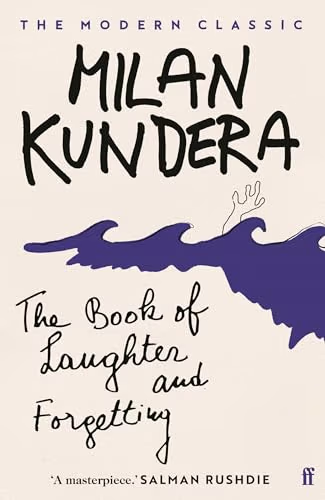
In The Book of Laughter and Forgetting, Kundera writes: “The struggle of man against power is the struggle of memory against forgetting.”
Perhaps, in an unwelcome, if sadly familiar and even predictable epoch wherein book banning on a mass scale has become a political barometer, and the cultural marketplace of ideas is intentionally flooded with noise, where info-overload is a default setting, where we’re always in danger of forgetting, we can return to Kundera. Maybe his work will find relevance—and resonance—in ways it wasn’t even a decade ago. It’s possible he will invariably be considered alongside Orwell and Kafka, who also depicted our seemingly unappeasable appetite for destruction. Kundera will remind us why we must laugh at the cynical, if deeply absurd agitators who divide us and thrive when we tend to forget.
Enjoying the content on 3QD? Help keep us going by donating now.