
by Dilip D’Souza
It’s been a breathless several days of chasing AI news, and there’s much more I haven’t got to. Catching up with the Hugging Face episode, trying to comprehend a warning that AI might kill us humans off within a decade, grasping the import of bitter AI rivals actually agreeing that there’s a need to slow down, and the whole uproar over the Navier-Stokes equations …
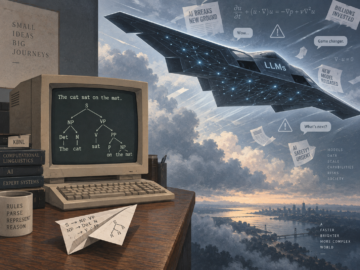
Too many years ago, in an earlier avatar as a computer science nerd, I worked for a while chasing AI itself. The team I was part of was trying to get computers to “parse” and understand what we referred to as “natural language”. Meaning, the way humans communicate. Our team was called Knowledge-Based Natural Language, or KBNL. Elaine Rich, one of the early stars of the AI firmament, led our efforts. At one point, I remember we built a tool that could take an English sentence, show on screen the progress of parsing it, and then summarize what it understood of the sentence. Some faint intelligence there, and I was pretty proud.
Seems like primitive prehistory now, which in a real sense, it is. Right off the bat, the whole approach to building AI has been utterly transformed. All those years ago, we knew nothing about LLMs. What they have made possible makes the comparison between our effort and AI circa 2026 sort of like the comparison between the paper plane I made this morning and a B-2 bomber.
And in saying that, I honestly mean no disrespect to my KBNL colleagues – bright, thoughtful computer scientists each one. It’s just that technology today has made possible the incredible AI feats we are witness to, even getting accustomed to.
But consider just the Navier-Stokes equations. Plenty has been written about them, and I won’t even pretend to match any of it. But here’s a broad-brush outline. The equations describe the motion of fluids. Meaning everything from air to mercury to honey to … well, whatever else you might think of that “flows”: a glacier, traffic, blood, waves, take your pick. The equations describe some better than others – but the point is that Navier-Stokes is a tool to help us understand these motions.
But as you can probably imagine, flows are hard to model, hard to predict. Think of a waterfall. Seen from a distance, as a sheet of water, it might seem pretty orderly. But zoom in even a little bit and watch for small streams of water, or individual drops. How are they moving? Can you discern a regular pattern? If you count a hundred drops, are you any closer to knowing how the hundred-and-first will behave?
That kind of uncertainty hints at why Navier-Stokes is in the news.
Fluid flow can easily turn turbulent, chaotic and unpredictable. This is why it is impossible to prove that a fluid will flow without turbulence, but just as impossible to prove the opposite, that it will indeed become turbulent. Give some thought to this description:
“Waves follow our boat as we meander across the lake, and turbulent air currents follow our flight in a modern jet. Mathematicians and physicists believe that an explanation for and the prediction of both the breeze and the turbulence can be found through an understanding of solutions to the Navier-Stokes equations. Although these equations were written down in the 19th Century, our understanding of them remains minimal. The challenge is to make substantial progress toward a mathematical theory which will unlock the secrets hidden in the Navier-Stokes equations.”
These lines are from the website of the Clay Mathematics Institute. Solving the Navier-Stokes equations has been one of mathematics’ great unsolved problems, which is why the Clay Institute listed it in 2000 as one of its seven “Millenium Prize” problems, with a million dollars on offer.
Mathematicians have made all kinds of progress with Navier-Stokes, but none have yet found that mathematical theory, that million-dollar holy grail.
But on September 8, the firm OpenAI claimed “a solution to the Navier–Stokes existence and smoothness problem … produced by an internal OpenAI system.”
For mathematicians, this is huge. Plus there are questions: Is this really a solution? Did OpenAI use ideas from mathematicians without their knowledge? What are the implications of AI producing this proof? I won’t get into any of that, because there’s enough to read, listen to and watch about it from people far more qualified than me. All of it is prompted by OpenAI’s announcement, which has, as I wrote above, propelled Navier-Stokes into the news, and how.
But two things that I ran across got me thinking.
The first is a cartoon that really speaks for itself. Sisyphus-like, a group of mathematicians are pushing a boulder up a hill. “No thanks,” say the mathematicians to the AI crane offering help. “We prefer to do it ourselves.”
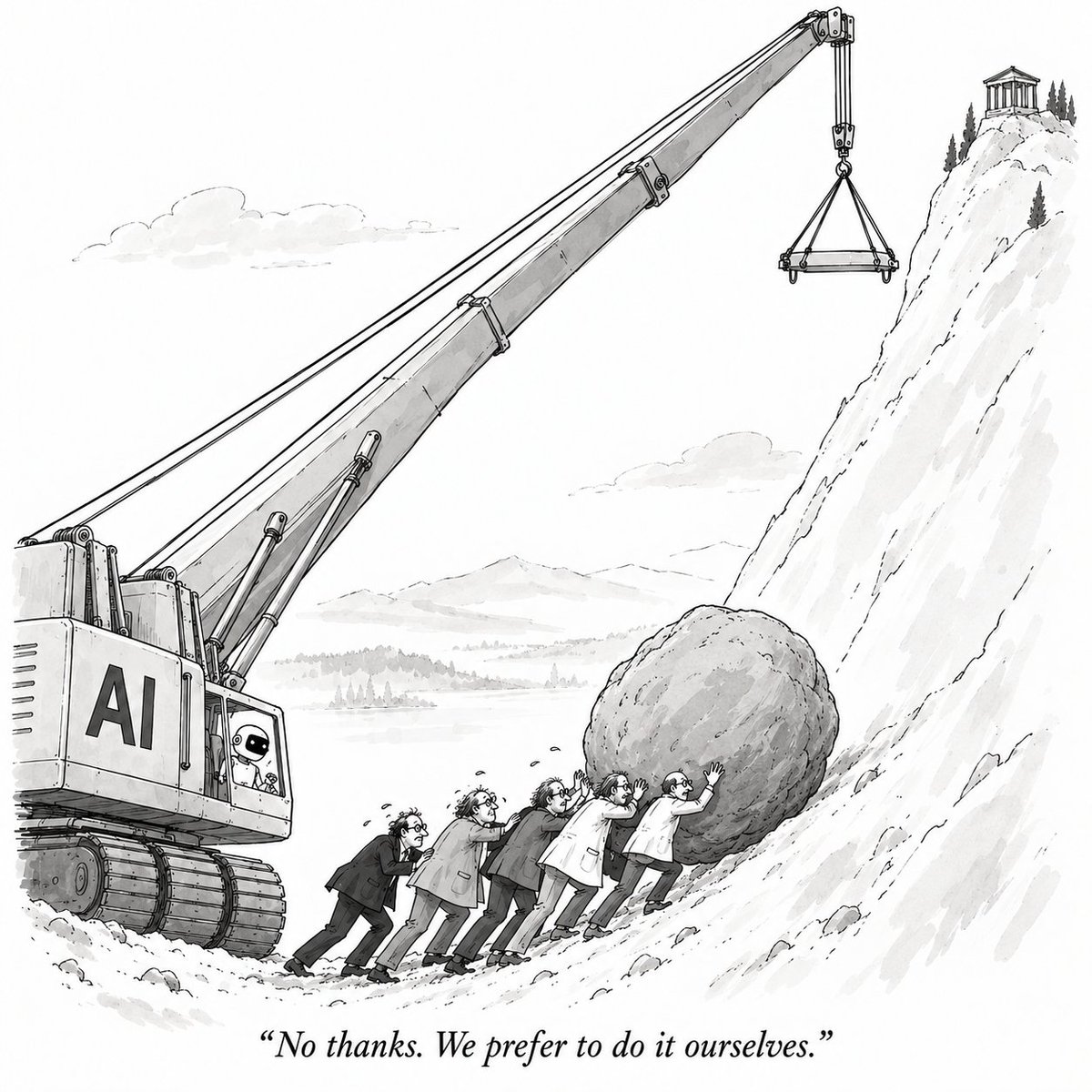
I’m not sure if the cartoonist meant to poke fun at mathematicians or pay tribute to their substance. But I know mathematicians who would indeed “prefer to do it ourselves.” 25 of them – all winners of the Fields Medal (presented to mathematicians under 40) – released a statement after the OpenAI announcement, and this is the second thing that got me thinking.
“The push by AI companies to solve mathematical problems,” they say in the statement, “is detrimental to the science of mathematics, and to the mathematical community.” They talk about students and ideas, research and the meaning of mathematics. They spell out how coming to “a final answer or product” in their research serves to “develop understanding and the ability to formulate new questions and ideas.” That is, the purpose of research is not so much solutions to specific problems. It is the widening of knowledge itself.
And so: “The success of AI in solving major mathematical problems has made headlines even outside mathematical circles. But solving problems is only a tool and proxy for achieving the primary goal of conceptual understanding and insight.”
I was reminded of my one-time brush with AI, that paper plane I compared to B-2 bombers. But here’s what I believe that long-ago vision of AI held close: getting computers to think was worth pursuing because it would ultimately tell us how we think.
Artificial intelligence would help us understand the mystery, the wonder, of human intelligence. And that understanding was the primary goal.
And I wonder, over the years since and in the coming of LLMs and the various AI engines we know today – I wonder if that vision has been lost.