
by Mark R. DeLong
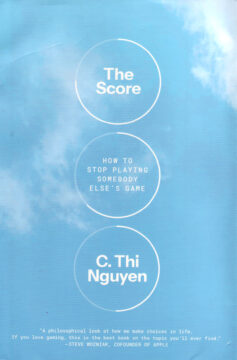 C. Thi Nguyen’s The Score: How to Stop Playing Somebody Else’s Game (Penguin, 2026; bookshop.org) arrived in my mailbox just in time. I was feeling that finally, after months of practice and oven-play, I was about done “perfecting” a bread. At the beginning of 2025, I had resolved to “perfect three bread recipes.” I wound up the year with just one so-called perfect bread, and the second was in the process of getting there. The second bread? The French baguette. But what I was pulling out of the oven in December 2025 and January 2026 was a distant cousin—a pleasingly plump version of the slim, stick-like baguette. I could hear the French baker cry, Monsieur, the bread you bake is not le baguette classique. N’est-ce pas? But the baker’s tears wouldn’t move me; my perfect “baguette” could not be a mere footnote to a rigid standard. (Some probably would call my version a bâtard, but that word of course means “bastard” and I shy from it, even though my perfect bread turned out to be a real bitch to discover.) I found that Nguyen’s book gave shape to the story I tell myself of the year-long experience with beguilingly simple, quite sticky, and enormously challenging (and fun) calculations I made for the best bread in the world.
About halfway through the book, Nguyen lays out a particularly tight relationship between rules—”algorithmic rules” in particular—and recipes. My baking experience had resonated through the preceding chapters, but in that section of the book Nguyen tightened the connection.
“My mother was an excellent cook,” he writes. “She learned to cook not from cookbooks and recipes, but from her family and friends in Vietnam.” But, unlike his mother, Nguyen learned from cookbooks: Julia Child’s for French cooking and Marcella Hazan’s for Italian, both of them sources for recipes in a format that we today almost intuitively understand: standardized measures, quite precise and ordered instructions, and assumptions of cooking skill that embrace even the novice cook or baker. Nguyen continues his story: “So on one visit home, I asked my mom to teach me my very favorite Vietnamese dish: hot and sour catfish soup…. What she gave me wasn’t anything I could follow; it was nothing like a recipe at all. It seemed to me, at the time, like this vast and disorganized ramble, a weird organic messy flowchart of possibilities and decision and judgment calls.” After a bout of confusion, Nguyen came to see that in fact his mother had given him a recipe (not, as he curtly said to her, some “Third World bullshit”). The contrast of her “organic messy” recipe and his rigid modern expectation revealed to him some of the effect that modern recipes had on the experience of cooking: “These precise, modern recipes had, in a weird way, disrupted my sense of what cooking was and could be,” he recalls. “I had come to assume that cooking—real cooking—had to proceed via an algorithm. I had refused to accept that real cooking might involve a messy and organic decision space, full of a thousand decision points and judgment calls.”
Before this epiphany, his understanding of “real cooking” had been “value captured”—defined by the rules and regimented modes of modern recipes. (It’s worth knowing that Nguyen was a food writer before he became a philosophy professor at the University of Utah.)
Having seen the effect of modern recipes, Nguyen renewed his understanding of “real cooking.” It ended up going beyond mere adherence to algorithmic rules, which, followed properly (an easy thing if the recipe is good), focus entirely on a good and a uniform product. Rules focus attention on products; they flatten the process of making the products, and so it is with recipes and cooking. Modern recipes, because of their algorithmic and standardized framework, drain the process of cooking of freedom, some skill, and a certain joy. And the process of cooking, Nguyen wryly notes, takes more time than eating, which should tell you something about where values should truly lie.
Nguyen once encountered four identical ratatouille dishes in close succession, even though ratatouille is a dish that has an extremely wide range of tastes, textures, with various dishes that each reveal “its own soul.” Ratatouille is challenging and beautiful for chefs because of that great variety, and that breadth of possibility made the four identical dishes suspicious. The odds were against it, unless…. Yes, unless everyone was using the same recipe, as if that algorithmic rule defined the correct, culinary-authorized version. “I asked my friends, and it turns out that every single one of them had used the exact same recipe,” he writes. “It was from The New York Times, and it was the first recipe that showed up when they googled ‘ratatouille recipe.'”
In my bread quest, I too searched around for a recipe that was perfect, but I quickly threw aside the constraints of the rules I found online. They didn’t suit my peculiar vision, and since I have always been one to color outside the lines, departing from the heavy handed rule of the recipe was easy. The baker often learns that even her flops are delicious, thank goodness. I discovered the same during my months-long quest for the “perfect” baguette, which ended up with a bâtard-like loaf. My scope broadened; what baking the baguette meant as a process and as an experience grew in importance. Baking became more than executing a set of precise steps. It became an experiment and an experience. I gladly devoured my “mistakes” along the way.
Of course, more than an explainer of recipes
Henry Ferrell pointed out that The Score is “a book that absolutely ought not work, for the same structural reasons that bumblebees ought not be able to fly.” But he also enthusiastically affirms that the book flies with zest and grace. “I would not have believed that a book about metrics could be a joyful and delightful book. The Score not only manages that extraordinarily difficult trick, but makes it look easy.” I agree with Ferrell, and I think that the book’s success comes from Nguyen’s astute organization of the whole work and pithy examples, not to mention its readable style.
Nguyen’s book is a delight to read in part because of the wide selection of anecdotes and examples he draws on to illustrate what could be some pretty dry philosophical concepts. The range of games—his academic specialty in philosophy—is itself a rich landscape of examples. I felt the urge at about page one hundred to fall back to the beginning of the book and just count and catalog the games he describes, but I realized that my categorizing and counting would probably contrast with how Nguyen would want his book to be read and digested. Counting and categorization, tied as they are, also emerge as paradoxical activities that undergird ambiguous scoring and the darkly threatening specter of “Metrics.” Counting and categorization gain their power from their clarity and standardization—both very useful and powerful qualities in deciding actions, especially actions that are broadly executed. But they also harbor sets of values and biases, which Nguyen carefully and entertainingly explains, and those values shape experience, shape the world, and also challenge individual’s freedom and meaning.
He often explains through the use of conceptual pairings, that in their comparison and contrast clarify aspects of metrics and scoring systems. For example, he distinguishes forms of beauty: “process beauty” and “object beauty”; the kinds of rules (following Lorraine Daston): “principles,” “models,” and “algorithms”; the kinds of categories, a necessity in order to count, which is at the core of metrics: “natural categories” and “social categories”; the difference of “striving play” and “achievement play.” Perhaps most importantly, throughout the book he maps out differences between having a “goal” and having a “purpose”—and how metrics can confound the two.1The final words of the book, in the acknowledgements, hat-tips Nguyen’s graduate school mentor: “And to my graduate school adviser, Barbara Herman, who may not have realized it, but set my whole life on a new course when she casually, in the middle of a graduate seminar, said: ‘Of course there’s a difference between a goal and a purpose. When you’re playing cards with your friends, your goal is to win, but your purpose is to have fun.’ “ Each of these distinctions Nguyen illustrates with real world examples and personal anecdotes, as every good philosopher and teacher should. Those distinctions (and there are many) unfold within the book quite methodically, since Nguyen uses an overarching metaphorical framework to help readers through his points. “It might be hard to keep track of all the moving parts [of the book’s overall argument], so let me offer a mnemonic aid,” he writes.
One device we cognitively limited human beings use, when faced with the astonishing complexity of the world, is to create myths—to personify, in some easy-to-remember figures, the forces of the world. In an earlier era, we had the Four Horsemen of the Apocalypse—War, Famine, Plague, and Death. These embodied the crucial forces that shaped an earlier era. We still need myths to understand the world, but the world has changed. So let me introduce a new set of myths, for our new age: the Four Horsemen of the Bureaucracy.
The final two-thirds of the book reveal the identities of the Four Horsemen (and I won’t spoil the book by naming them here).
The Four Horsemen of the Apocalypse are fearsome creatures, and their darkness perhaps overwhelms Nguyen’s Four Horsemen of the Bureaucracy, simply because the awesome powers of Nguyen’s Horsemen can actually serve human purposes. The powers of metrics allow for broad material abundance and greater flexing of powers of production and human creativity and industry. But they exact a price: they simplify and flatten the world and human experience. They stifle. They “drive us down into grueling optimization.” The Score explicates the awesome powers and the often terrible price—the individual human cost that the Horsemen exact when people suffer “value capture” and allow metrics replace their core values.
And so, The Score presents perilous balances that play out in everyone’s life: a desire for simplicity and clarity amidst and against the richness and subtlety of real life; the liberating qualities of games and play amidst and against the anonymizing powers and existential threats of metrics. Nguyen’s book in effect lays out the challenge that metrics pose to human fulfilment and meaning. His resolution of the tensions forks in the end, leaving readers to resolve the challenge. That ambiguous ending of the book I have come to see as a quiet invitation to play a game that might reveal and liberate readers from the seductions of metrics.
The Score is one of those few books that find application in many areas of personal and professional life. Well written and joyous, it’s one to read and savor. But prepare: you may want to take up fly-fishing, yo-yoing, or rock climbing after reading it.
I’ll stick with finding my next perfect bread. But there is one game that I want to try: Spyfall, described on pages 30 – 33.
For the bibliographically curious. Note Farrell’s last note at the bottom of the post. “There is a great essay to be written about how Nguyen’s ideas about games intersect with ‘Moneyball.’ This is not that essay.” Someone should write that one! Henry Farrell, “The Median Voter Theorem Is a Clarity Trap,” Programmable Mutter, January 7, 2025, https://www.programmablemutter.com/p/the-median-voter-theorem-is-a-clarity. Nguyen’s home page: C. Thi Nguyen, Objectionable, https://objectionable.net/. The articles listed under https://objectionable.net/philosophy/ often relate to parts of the book.
Enjoying the content on 3QD? Help keep us going by donating now.
Footnotes
- 1The final words of the book, in the acknowledgements, hat-tips Nguyen’s graduate school mentor: “And to my graduate school adviser, Barbara Herman, who may not have realized it, but set my whole life on a new course when she casually, in the middle of a graduate seminar, said: ‘Of course there’s a difference between a goal and a purpose. When you’re playing cards with your friends, your goal is to win, but your purpose is to have fun.’ “