
by Marie Snyder
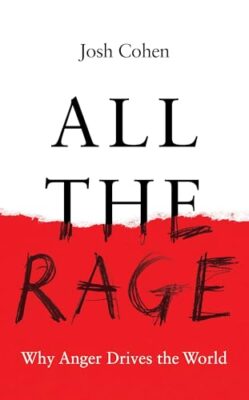 How can we possibly approach the world today without being in a constant stage of rage? Philosopher and psychoanalyst Josh Cohen’s All the Rage suggests how to make this feeling more useful to us. He writes from a range of perspectives, everything from political uprisings to the patients in his office, and from how rage plays out in the world to how it manifests in our own minds, all with a thread of climate change activism throughout. Ideas are illustrated with examples from fictional characters, historical figures, and his own family. It hardly seems possible to do all that in just 195 pages, yet the book is a thought-provoking and entertaining read, comfortably shifting from micro to macro issues to explore four kinds of rage.
SOME DEFINITIONS
In day-to-day conversations, we use “rage,” “anger,” and “aggression” almost interchangeably. We do the same for “emotion” and “feeling” and for “drive” and “instinct.” The book uses these terms more precisely, so a bit of a glossary might be useful. The order of events that occurs when we’re outraged becomes important. Cohen explains that aggression is often the way we respond directly to a stimulus, and anger is what happens after that first spark of action, when we choose to hold it back. He explains it succinctly in an interview with The Philosopher:
“Aggression is a kind of stimulus response. It’s what we do with a provocation, which might be an injury; it might be a humiliation, an insult of some kind, something that arouses us to retaliation. Aggression is the way that we get rid of that load of stimulus in action. … Anger is a way of holding on. Feelings are ways of holding on to stuff. When we can’t bear to feel something we instead discharge it in action. … Anger is something that you’re left with when action is unavailable to you or perhaps when you try to take the experience to a higher level, i.e. to maintain it in the consciousness as something to experience and process psychically rather than discharge in an action. That’s why psychoanalysis tends to think of anger as a human achievement.”
It’s not the case that we’re insulted, then feel anger, and then rationally decide to act or not act, even if it sometimes feels like that. Instead, the impetus to act is immediate following an enraging stimulus, and the restraint is what leads to the feeling of anger. I think that’s the idea. It’s counterintuitive to me, so it’s useful that it was repeated a few times in the book.
Instinct is biological knowledge that ensures attainment of vital needs, e.g. a newborn’s hunger is satisfied by rooting.
Drives are more complex. Freud defined them as “a source of stimulus from within the organism” (xxi). Because it’s internal, the source is constant and inescapable: “It is in the nature of the drive, Freud says, never to achieve full satisfaction” (xxxv). Drives provoke us to want to do something beyond what’s necessary for basic survival and animate humans and only humans, but they fail to satisfy. For example, aggression and libido.
Emotions are how we instinctively, unconsciously seek to ensure our preservation. They’re reflexive (e.g. disgust at maggoty meat provokes us to turn away), and are outwardly directed and public in nature. All animals have emotions.
Feelings map our reactions by producing images and ideas about them. They enable us to create novel responses to stimuli (e.g. disgust at maggoty meat, but then use it in an art project), and are inwardly directed and private. We have to be conscious in order to have feelings. “Feeling comes after drives, not before” (xv), and “action never exhausts feelings” (xxxv).
Aggression is the action of a drive, an automatic response to a stimulus in an attempt to meet our needs for survival through an “effort to exert dominance” (xi). It includes self-assertiveness and acquisitive actions and competitive efforts. It’s a goal-oriented drive to overcome an obstacle or achieve control, directed at a narrow aim, often urgent: We have to win this race, make dinner, get this raise, right now. Frustrated or blocked aggression can turn inward to become anger. Aggression is necessarily unsatisfiable: the drive gets recharged over and over.
Anger is a feeling that’s self-reflective. Its internal nature means it “can be concealed from the world, and even from oneself” (xi). It’s the aggression that returns back inside either because it couldn’t be used effectively, or because we intentionally stopped it. “Our persistent failures to remedy the insistent dissatisfactions of daily life give rise to that state of agitated enervation we call anger” (xx).
Rage is an emotion that’s made visible at the threshold of action. It’s at the mid-point between anger and aggression, but there’s not always a neat division between rage and anger. Cohen says,
“Rage is for me the kernel of anger. When you get to rage, you’ve realize something truthful about anger, which is that it’s given to excess, to feed off itself like a rolling stone, gathering more momentum as it goes.”
How we deal with our feelings of anger makes a difference in our demonstrations of aggression, and it appears they don’t get resolved through mere discharge. The four types of rage Cohen explores illustrate why we have problems personally and politically, and he offers strategies to change course. I’ll focus primarily on how we’re personally affected by our own anger to try to ground the ideas. This is just the gist of each; the book has many more examples to illustrate each layer.
 RIGHTEOUS RAGE
Righteous rage comes from the unshakable conviction that we’re right! That’s likely a familiar feeling to most of us, and yet, “How reasonable is it to think of other people’s rage as rabid delusionality and one’s own as entirely consistent and justified?” (17). Aggression is narrow focusing, urgent, and energizing, so it can provoke us to double down on our position and become blind and deaf to alternative perspectives. It makes us feel certain, which can feel really good, like we’ve stumbled on a Truth that must be fought for. This certainty insulates us from the vulnerabilities of doubt, but it’s often short-lived. I think we can likely all think of times we’ve experienced times of obstinance and later had to acknowledge our error.
He uses examples of the Hulk and Othello, but also Trevelyan, the husband in Anthony Trollope’s 1869 novel He Knew He Was Right, whose jealousy destroyed his marriage. Trevelyan punished his wife with acts of aggression for his own unfounded suspicions, but it just makes him more angry:
“The problem with knowing one is right is that it requires precisely what does not happen: that the parties in the wrong realize this and say so. In the absence of such real-world satisfaction, Trevelyan has to fall back on increasingly vivid fantasies of an act that will finally consummate his anger” (25).
In real life we have incels who believe their crimes are justified because of what they’ve suffered from being rejected by women. Cohen quotes Hannah Arendt on this: “Suffering whose strength and virtue lie in endurance, explodes into rage when it can no longer endure” (34). However, this category also includes people who are trying valiantly to solve a problem against all odds, unable to see why so many people oppose them, such as revolutionaries singularly focused on the wrong path.
Another interesting thread throughout is the Freudian idea that psychic illness is the “repudiation of femininity” (39), of any openness or receptivity. “Rightness coats a place in a masculine armour…sealing it off from encounter or change. … The integrity of armour, however illusory, is a matter of literal survival” (40). We need to get better at recognizing that this righteousness, which gives us such intense focus and energy, might be sending us down a wayward path. From Lao Tzu: “When they think that they know the answers, people are difficult to guide” (ch. 65).
FAILED RAGE
Failed rage is the most common form of rage, which we can see in positive thinkers and people who actively try to “manage” their anger. “Most of us are liable to swallow anger more often than we act on it” (45), but suppression can become cruel: “Anger is never so ugly as when it’s denied an outlet” (46). Undischarged rage can present in another guise, like exaggerated politeness or moroseness, or induce a state of repression where we become unaware of the anger (52). More than just annoying to deal with in others, this pent-up anger can also become vulnerable to emotional and political manipulation.
When our drives fail to be satisfied, they turn into feelings, and it’s painful to carry feelings without release. Anger only exists in animals with reason and temporal awareness because it’s from being required to live “at a distance from our aggression.” To be civilized, we try to refrain from having fights or humping in the street the way other animals might do. Shoved underground in attempts to manage feelings instead of feeling them, they show up as shame. He uses an example from non-fiction books, The Managed Heart (1983) by Arlie Russell Hochschild, which explores the effect of flight attendants being forced into false pleasantness, and Barbara Ehrenreich’s book Smile or Die (2009), on the problem with positivity in self-help movements and the injunction to get rid of any negative people. We can also see this frustrated rage through the rise of misunderstood versions of Stoicism and Buddhism.
Failed rage is the result of forced calm in our culture. An interesting side effect of this is seen online where “eruptions of public rage are a new kind of pornography” (65). But any vicarious satisfaction we might get from watching a random fight in a grocery store is ineffective. He draws on Peter Sloterdijk’s Rage and Time, and quotes him in part here:
“Revolutionary action is that optimal moment when affect and drive, or feeling and action, unfold in perfect harmony …. For this to occur, dispersed local currents of anger must be ‘banked’, deposited in a single ‘bank of rage’ that ‘draws its force from an excess of energy that longs for release’ (85).
For rage to be useful, we need to be able to hold and bank it instead of dispersing it in actions as “impotent rage without harmony.” Instead we calm it, rationalizing it away:
“If I’m not as angry as I ‘should’ be about the climate emergency, it’s because somewhere I’ve intuited how insupportable my anger and grief might be if I gave myself over to it fully, if I really let myself know about the precariousness of our own and our children’s future” (94).
I think Sartre’s “classic intellectual” might fit here: the petition-signers who don’t want to get their hands dirty. We’re bothered by the world and denounce atrocities, while part of us knows we benefit from maintaining them. We’re conscious of this contradiction, but not yet ready to truly revolt.
CYNICAL RAGE
Rage that’s cynical in nature comes from charlatans, emotional predators, and demagogues. It can also happen in transference in therapy when patients redirect old feelings of anger onto the therapist, or in relationships when we project older relationship dynamics onto a current situation and get unreasonably enraged. Anger can be “wildly promiscuous” (97), always looking for a landing spot. We play hot potato with it, giving to others as fast as we can, but we can also hold it:
“The capacity to stay with anger as a purely internal state is what prevents the rush into blind action. We lash out in hot verbal or physical aggression when we can no longer represent our anger to ourselves, when we can no longer bear the pressure it is exerting on our minds.” (97).
If we can get enough mental distance from anger to be curious, then it can promote self-reflection, when our behaviours can collaborate with the mind instead of overriding it.
Corrupt politicians know many injustices against us are impossible for us to get redressed, leaving us in a state of perpetual dissatisfaction, which can morph into aggression, like on January 6th. It’s there in the MRA slogan “f*ck your feelings,” a demonstration of their rejection of any feminine tendency towards care. “The mirth has a paradoxical effect of at once amplifying the rage and calling it into doubt” (128). We see it in passive aggression and jokes that license aggression that’s not typically permitted. It’s seen in the obsession with reversing any equity gained by the women’s movements. A great example might be Nick Fuentes’ comment earlier this month:
“Our number political enemy is women because women constrain everything, every conversation, every man, everything. They have to be imprisoned. They are the ones that are hurting the fertility rate. They’re the ones making us sympathetic to poor people, which are also brown people.”
Cynical rage is a political resource that’s used by providing disgruntled people with an illusion of certainty. He uses the example of Steve Bannon drawing in incel and MRA groups. Cohen writes:
“The incel shooter excitedly imagines he’ll terrorize women into submission to male authority, but his actions produce only grief and horror. The utopia of straight white male supremacy he and his online cheerleaders hope for is never achieved. The cynic’s promises are revealed in all their craven emptiness” (132).
With his clients, removing the certainty of a guaranteed outcome can prevent cynicism, and avoiding setting goals for someone more fully helps them find their own internal compass. Acknowledging and not demonizing anger allows it to be present without causing harm.
“To tell someone in the grip of a tormenting fury that you’re willing to receive and listen to [their anger] and think with him about it for as long as necessary … creates a world for him which didn’t previously exist, in which someone else recognizes and is curious about his inner life and wants to help reflect it back to him, to give it shape and meaning” (135).
Just being willing to listen to someone’s rage creates a new world for people as anger can slowly turn to grief for the relationship or past they couldn’t have. If we can listen to the rage, then we can speak truth to power. In a world in which the EPA “repealed” the scientific finding that GHGs threaten human life, it’s Greta Thunberg who has a “proper reaction” to the political process around climate, and is able to speak the truth that others have calmed or distorted their rage.
USABLE RAGE
We can use the energy that rage brings us by creatively fostering love and justice.
“If anger could be a means of fostering love and justice rather than closing it down, it would need to start from an embrace rather than a denial of one’s own vulnerability and self-doubt, along with a real curiosity about the other, not excluding what might be making them angry. Only at this point, I suggest, will rage become usable” (xli).
The story associated with this category is an ancient tale, One Thousand and One Nights in which a clever bride, Scheherazade, uses the power of a good cliffhanger to avoid being killed by her jealous husband, who previously slaughtered a succession of virginal wives after their wedding night. The storytelling provides a space that pulls her husband “out of his claustrophobic certainty and into new regions of strangeness and curiosity. … If anger is to serve as more than the emotional prelude to aggressive action then it must be disarmed of the self-certainty that propels it” (141). Confronted with their own vulnerability, the angry characters in the stories from previous chapters “chose destructive consequences of false certainty rather than bear the inevitable pain of not knowing” (151). They’d rather believe an enraging lie than sit in that uncomfortable limbo of precarious control. Transitioning to feeling means that the emotion finds a footing in ideas and words, not reactions.
Elena Ferrante’s The Lost Daughter (2006) is also explored here to show an honest expression of buried feeling. “Once you make that blind passage from feeling to action, you’ve given up on the use of the anger because you’ve given up on bearing the load.” Ferrante’s protagonist can bear the load. “They do this by recognizing the relationship between the rage that they lean into and the neighbouring emotions around it.” The positivity movement tries to distract or soothe anger, and corrupt politicians try to tap into the aggression, but instead we can delay the anger, to let it exhaust itself, in order to listen to what it wants and find other emotions tagging along.
“Anger becomes less rigidly defensive at the point it makes contact with neighbouring emotions like sadness and anxiety. … Simply put, it is the difference between insulting the other person and telling them honestly why you feel hurt and angered by them” (168).
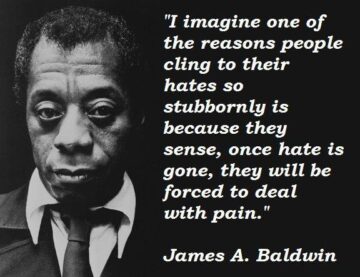
Anger is a felt sense of care or love; we don’t get mad at things we don’t care about. James Baldwin points the way to anger that “breaks out of the sterile rage of the unhearing monologue or rant, placing anger instead on the plane of love” (173). Cohen’s discussion of the burden of shame inherent to the role of a colonial police officer evokes an image of an ICE agent: “blind action dissociated from desire or intent or from any feeling at all beyond a compulsive pressure to kill the other” (175). Baldwin explains the dissociated rage is dissociated from “the force and anguish and terror of love” (176). It’s a fleeing from reality, not just from the reality of the situation and the history behind it, and our cultural dependence on our history of violence and exclusion, but also how it feels to partake in atrocities. It’s an action that’s divorced from personal responsibility from a rationalization that they are compelled by people in command or by the victim or by the aggression itself. Cohen brings it home by illustrating with an example of yelling at a fellow motorist from the safety of his own moving vehicle:
“If I didn’t default so quickly to yelling, I might be forced to feel something more than a reflexive anger. Lurking beneath that reflex would be, perhaps, feelings of impotence and anxiety, some resentment, and even envy. … There is a rich but disavowed personal history of feeling that is concealed even beneath the trivial, unseen event of my yelling at a person who can’t hear me” (179-80).
We have to be willing to give up the “deafness of the dictator” that might say: I, alone, have developed a certainty from my necessarily limited knowledge and experience. Knowing we can have anger and express it in harmless ways can prevent it from being used to manipulate us. With more acceptance of receptive femininity to embrace vulnerability and acknowledge our interdependence, we can disarm the certainty that is creating blinders that keep us disconnected to ourselves and others. With enough distance from rage to be curious about what lies beneath, we can hold and bank our anger to put it to good use.
Enjoying the content on 3QD? Help keep us going by donating now.