
by Mark R. DeLong
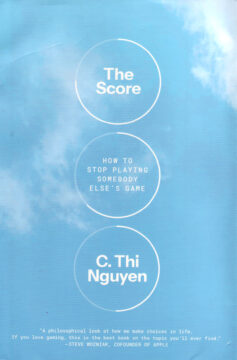 C. Thi Nguyen’s The Score: How to Stop Playing Somebody Else’s Game (Penguin, 2026; bookshop.org) arrived in my mailbox just in time. I was feeling that finally, after months of practice and oven-play, I was about done “perfecting” a bread. At the beginning of 2025, I had resolved to “perfect three bread recipes.” I wound up the year with just one so-called perfect bread, and the second was in the process of getting there. The second bread? The French baguette. But what I was pulling out of the oven in December 2025 and January 2026 was a distant cousin—a pleasingly plump version of the slim, stick-like baguette. I could hear the French baker cry, Monsieur, the bread you bake is not le baguette classique. N’est-ce pas? But the baker’s tears wouldn’t move me; my perfect “baguette” could not be a mere footnote to a rigid standard. (Some probably would call my version a bâtard, but that word of course means “bastard” and I shy from it, even though my perfect bread turned out to be a real bitch to discover.) I found that Nguyen’s book gave shape to the story I tell myself of the year-long experience with beguilingly simple, quite sticky, and enormously challenging (and fun) calculations I made for the best bread in the world.
About halfway through the book, Nguyen lays out a particularly tight relationship between rules—”algorithmic rules” in particular—and recipes. My baking experience had resonated through the preceding chapters, but in that section of the book Nguyen tightened the connection.
“My mother was an excellent cook,” he writes. “She learned to cook not from cookbooks and recipes, but from her family and friends in Vietnam.” But, unlike his mother, Nguyen learned from cookbooks: Julia Child’s for French cooking and Marcella Hazan’s for Italian, both of them sources for recipes in a format that we today almost intuitively understand: standardized measures, quite precise and ordered instructions, and assumptions of cooking skill that embrace even the novice cook or baker. Nguyen continues his story: “So on one visit home, I asked my mom to teach me my very favorite Vietnamese dish: hot and sour catfish soup…. What she gave me wasn’t anything I could follow; it was nothing like a recipe at all. It seemed to me, at the time, like this vast and disorganized ramble, a weird organic messy flowchart of possibilities and decision and judgment calls.” After a bout of confusion, Nguyen came to see that in fact his mother had given him a recipe (not, as he curtly said to her, some “Third World bullshit”). The contrast of her “organic messy” recipe and his rigid modern expectation revealed to him some of the effect that modern recipes had on the experience of cooking: “These precise, modern recipes had, in a weird way, disrupted my sense of what cooking was and could be,” he recalls. “I had come to assume that cooking—real cooking—had to proceed via an algorithm. I had refused to accept that real cooking might involve a messy and organic decision space, full of a thousand decision points and judgment calls.”
Before this epiphany, his understanding of “real cooking” had been “value captured”—defined by the rules and regimented modes of modern recipes. (It’s worth knowing that Nguyen was a food writer before he became a philosophy professor at the University of Utah.)
Having seen the effect of modern recipes, Nguyen renewed his understanding of “real cooking.” Read more »