
by Marie Snyder
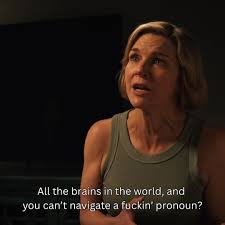 The recent show Pluribus has got me thinking differently about the kind of ideal state that might be a laudable direction and how to get there. The show is overtly about a hive mind interconnection, that started with a lab-leaked experiment, which affects almost all of the world except for 13 people who have natural immunity. We follow the trajectory of one of these anomalies, Carol, who gives them their titular name, not for “many,” a direct translation, but as her own invention: “the plural of succubus.”
There will be no significant spoilers here; this isn’t about the show specifically, but about its depiction of a perfectly efficient and seemingly happy and altruistic society. Is Carol the last one left in the cave, or is she the only one who’s on the outside?
The hive all works together effortlessly as one, with a prime directive to do no harm, as they distribute food worldwide with the utmost equity. They don’t step on bugs or swat flies. They will eat meat if it’s already dead, but they won’t kill it themselves. They also won’t pluck an apple from a tree. They don’t interfere with life. They can’t lie overtly. It’s all very pleasant. The hive won’t harm a living body; however, they didn’t mind obliterating the human spirit of 8 billion people without explicit consent, rendering their ethics questionable.
Connections to the show have been made with AI and Covid, so it may be useful to keep in mind that the show was originally written over ten years ago. If looking for authorial intent, those aren’t necessarily parallels. At that link, the lead of the show, Rhea Seehorn said she originally asked if it’s about addiction, and it’s not that either. There’s an element of just exploring human nature and what brings us happiness, and she likes journalists who “want to talk about philosophical questions about what this is bringing up for them. And we’re hearing all these different things. It’s wonderful.” I’m game!
Plato argues that the products of painters and poets, and likely filmmakers fit here too, are “but imitations thrice removed from the truth, and could easily be made without any knowledge of the truth, because they are appearances only and not realities” (Republic, Book III). There is the Truth, then the builder’s truth, then the artist’s rendering of it. There’s another layer as well: the viewer is then four times removed from reality as we bring their own ideas to our interpretation of the artist’s representation. The story line of the show is vague enough and meaty enough to be provocative of myriad perspectives.
So Happy Together
First, I wonder about the joy of learning and curiosity and discovery. The setup suggests that having the sudden knowledge of all the minds currently in the world, we would be content. We’ll just know to do the right thing. However, we know that having a shared knowledge on a scientific or philosophical conundrum doesn’t always create agreement or morality. People can have tons of knowledge and still choose to do wrong. So it mustn’t just be the ability to access the same facts and logic that creates the tranquility. Maybe it’s the ability to share one another’s feelings. If we could immediately feel the pain of suffering of others when we pollute or feel others going hungry when we decide not to let food rot in our fridge, then that might make us more planetary-minded. Something like that. Except the hive doesn’t appear to really experience empathy in a typical way either. Like bees, they’re just singularly minded to protect the hive. They don’t make ethical decisions.
Personally, I get so much joy from learning, and figuring things out, and being surprised by things, that I’m not convinced I’d be happier knowing it all. It’s the figuring that brings joy. I’m in the middle of one of the hardest jigsaw puzzles I’ve ever done. It would give me no pleasure to know where the pieces go. The contentment from finishing only comes with the struggle and surprises in the doing. Despite their brilliance, their contentment feels closer to an old-school frontal lobotomy.
Their argument for the superior pleasure of the hive is that they “know what it’s like to be like you — alone, suffering — but you’ve never been like us.” This is pretty much John Stuart Mill’s argument for the superiority of intellectual pleasures over bodily:
“If I am asked what I mean by difference of quality in pleasures, or what makes one pleasure more valuable than another, merely as a pleasure, except its being greater in amount, there is but one possible answer. If one of the two is, by those who are competently acquainted with both, placed so far above the other that they prefer it, even though knowing it to be attended with a greater amount of discontent, and would not resign it for any quantity of the other pleasure which their nature is capable of, we are justified in ascribing to the preferred enjoyment a superiority in quality so far outweighing quantity as to render it, in comparison, of small account.” (Utilitarianism, II 5)
They’ve been outside the hive and inside it, and inside is better, despite the drawback of losing all individuality. I’d like to hear from one who tried being an individual again before I sign up. And despite loving to read and write and think and argue, I’m not positive I’d choose them if it meant giving up all sensory pleasures.
We relate to Carol as an outsider. Unlike the mere difficulty fitting in during high school or in the neighbourhood, she is literally outside the mind of the people around her, and it’s understandably infuriating. In her attempts to convince others like her that this is all clearly bad, she’s the Cassandra of the story as most of them focus on the benefits of the system: Is it really so bad to have finally found a way to have world peace, efficient food distribution, no waste, no prejudice of any kind, perfect conservation of resources shared among all, no need for money, and a Buddhist’s lack of attachment to possessions and people?
I wavered while watching it.
Who are You?
We definitely value our individuality, and it’s a human rights violation to suddenly wipe that away for billions of people without their explicit consent. But even for the baker’s dozen of leftovers, our individuality is partly made up of how people react to us. We find who we are relationally. It’s not just that we want to feel special, but that we need to feel seen. Surrounded by a unified collective damages that potential. We need to find ourselves and where we are in conjunction with others before we can let go of the sense of self, otherwise joining isn’t a profound dissolution of self into the oneness of the universe; it’s an assimilation to improve the production line.
Yet I also get that there’s something really enticing about this level of efficiency and worldwide equity.
It boils down to what we’re doing here, and what we think we should be doing here. In this fictional world, we could have contentment of the community, or we could have the trials and tribulations of individual striving, remorse, and devastation, with occasional successes. Are we here to play a part in the world or to elevate ourselves above the fray? Is it just too boring to be world-centric?
According to Plato, and later B.F. Skinner, the crux of the difficulty with making ethical choices, or even with making wise but selfish choices that will benefit us the most, is the art of measurement.
“The same magnitudes seem greater to the eye from near at hand than they do from a distance. This is true of thickness and also of number, and sounds of equal loudness seem greater near at hand than at a distance. If now our happiness consisted in doing, I mean in choosing, greater lengths and avoiding smaller, where would lie salvation? In the art of measurement or in the impression made by appearances? Haven’t we seen that the appearance leads us astray and throws us into confusion so that in our actions and our choices between great and small we are constantly accepting and rejecting the same things, whereas the metric art would have canceled the effect of the impression, and by revealing the true state of affairs would have caused the soul to live in peace and quiet and abide in the truth, thus saving our life?’ Faced with these considerations, would people agree that our salvation would lie in the art of measurement?” (Plato’s Protagoras)
The hive seems to have solved this completely. They effortlessly follow the long-term goals of the community. Yet the loss is too profound to accept as ideal. It’s not just a loss of individual identity, but of authentic connection.
Imagine No Possessions or Countries
In one episode reminiscent of Groundhog’s Day, Carol tries various ways to cope with her loneliness. The turning point for her seems to be a piece of art. There are a lot of other things going on with this particular painting, but the relationship to aesthetics is interesting on its own. The hive appreciates things based on an amalgamation of views, not on individual feeling, so pulpy romance novels are as praised as Shakespeare. Without individuality, and without a longing for symbolic representations of ourselves, we have no connection to the creations of others. That’s one way our humanity is lost in this scheme.
If I were in Carol’s shoes, I would be an archivist. Not just to record the events as they happened, but to save all the stories. I’d be hunting through homes for diaries and journals, and childhood paintings and grocery lists to demonstrate the uniqueness of the human spirit in a museum. But for whom?
We’re different from bees and their singular purpose because of our drive to find others who actually get us. At my dinner table this Christmas, nobody else had seen the show, so that potential thread to them was cut short. The holidays make it more overt how much we get tied together from the outfits, objects, songs, and shows that we’ve played over and over for decades. The internet helps us find others with similar obscure interests, mundane or profound, for better or worse. Art is more than a diversion; it’s an indication of identity. What if our discriminating taste for better and worse just went away? Without difference and conflict we’re just polite service workers that nobody gets to know at any depth. We delineate ourselves by dancing against one another; superficial cheeriness gives us nothing of significance to push up against.
Without the desire for individual possessions we have no theft, and no desire to have anything more than we need, but we also lack a symbolic means to demonstrate who we are as a way to find connections. We do an ongoing courting dance to find each other by displaying our things as a shortcut. We also lose any sense of culture without significant objects passed down and cherished through generations.
Despite our behaviours to the contrary, particularly at this time of year, we largely understand the problems with rampant consumerism. The proliferation of unnecessary trinkets harms the environment in their consumption, distribution, and elimination. Individually, we’re sitting with the bills to pay. So for the sake of the planet, and for our own financial and mental health, we need to pare it down to a few exquisite pieces that are kept forever. But for thousands of years we’re made it clear that we suck at the art of measurement. We want all the things in the most convenient way possible despite how much harm it causes the world and the people we haven’t met. We need to consume less and distribute resources much more equitably, and worry less about having what we want and more about everybody having what they need. Absolutely. But I’m not sure we can without some kind of serious brain manipulation.
Love the One You’re With
I also wonder how well we could cope with never hoping to be special to anyone again. Total lack of discrimination means it doesn’t matter to anyone that Carol’s a lesbian, but it also doesn’t matter that she’s Carol. But, for me, the story brings up a different question: How long can we tolerate the loneliness born of our integrity before capitulating to the other side? How long can people who are avoiding Covid or AI or air travel or beef or plastic bags or unnecessary purchases, or whatever difficult ethical stand they’re taking, maintain their stance before they decide to join the party? At some point it becomes necessary to find people on-side. Luckily, where there’s no local community, social media helps with that. In the real world, people are able to find others like them to spur them on, for better or worse. This show elucidates the importance of even a tiny group of like-minded people to help us stay on whatever path we’re walking. Even just one other person.
Ideally, of course, we’d have some sort of middle ground worldwide: less consumption and travel, and more masks in hospitals. If just one person refuses to participate in the hive for moral integrity, that has a negligible effect that dies with them. We already see that if just a small group does the thing that will help humanity survive longer; it’s hard to feel confident it makes enough difference to be worth it. If I’m the only one masking in a crowded store, that does little to reduce transmission. If I’m the only one there willfully limiting my purchases to necessities, using a cloth bag, and walking home to house kept at 19 degrees all winter, the consumption machine will keep chugging along. Staying the course requires letting go of outcomes and expectations of change and continuing to do what we believe is right because it’s right. But it can be a lonely path. It’s hard enough to find connection without being quite so different.
A gift-giving holiday can really bring out these kinds of conflicts. It can be hard to explain the importance of individual choices against the attempts from others to envelop us into the festivities without somebody feeling slighted or judged or belittled. “Sorry, but I can’t afford it,” is easier to manage than, “It’s just not right to fly back and forth to see the cousins again this year.” It’s especially difficult to stay the course without offending anyone in the process. Hoping to influence others is a whole other ballgame. Last winter, Mel Gibson insisted climate change is a hoax while his house burned down in the California fires, and US leaders are currently promoting a rhetoric of “fear the vaccine, not the virus” leading to a return of measles. Imagine trying to speak up to that without a community at your back.
A final underlying interpretation provoked by Pluribus: we may have been granted free will through the chemicals swimming in our brain, but I don’t believe we have accepted it and the responsibility that comes with intentional actions. We would rather be tossed hither and thither by influencers or questionable leaders because measuring well ourselves is so much more effort. Even better, just let something program us to do good so we don’t have to think at all. Are they more content in the hive because removing free will removes all those pesky decisions to be made? That’s the very thing that makes us human, and it needs to be reclaimed.
Enjoying the content on 3QD? Help keep us going by donating now.