
by Barbara Fischkin
Cousin Bernie’s Own Memoir Surfaces Years After His Death
(a.k.a Cousin Bernie, Free-Range Professor-Part Three)
As much as I loved my late Cousin Bernie, I figured that in regard to my own memoir, I was done with him. Cousins are great but those two earlier chapters—on just one cousin—were more than enough.
Then… I heard from Bernie.
A heavenly nudge.
Years after his death, I believed I could identify his voice with its gravelly Brooklyn twang, slightly tempered by a slower drawl acquired during decades in the Midwest.
“There is a lot more to write about me. And if it is about me, then it is also about you.”
I wish I could report that this actually came from the afterlife.
Nope.
It came from the post office.
Joan Hamilton Morris, Cousin Bernie’s widow, mailed his unpublished memoir to me, after she found it while moving to a new assisted living residence. That was about a month ago. I never knew it existed. Now, I had it in hand—Cousin Bernie’s memoir, written quietly in an adult education class he took after retiring as an honored professor of Psychology and Mathematics at a public university in Indianapolis, Indiana.
I flipped through the typewritten, hard copy pages, stopping early at a description of my Grandpa Phillip. He had died before I was born and all I knew about him, from my parents, was that he had been a handsome, drunken, sporadically employed, womanizer who beat his sons and his long-suffering wife, Grandma Toby. Nice. Grandma Toby died young. Grandpa Phillip subsequently romanced a new bevy of women and then, sort of made up for past sins by marrying one of them.
Despite being decades apart in age, Bernie was my first cousin. This explains why we had the same paternal grandparents. Except, unlike me, he had known them. And so, thanks to Cousin Bernie, I read about a different version of Grandpa Phillip. And learned more about Grandma Toby, too.
In Bernie’s words, which I will quote later in this chapter, Grandpa Phillip taught him to operate the first phonograph he had ever seen. The records were operatic recordings and from the first notes Bernie knew he loved opera. This small scene, with its huge lifetime implications, reminded me that one person can have more than one persona. This was true of Grandma Toby, too.
More on Cousin Bernie’s Memoir
That Cousin Bernie was a highly-educated professor in two disciplines, did not necessarily mean he could write a memoir. (I can hear him laughing.) Which is perhaps why he took that adult education class. Some of his memoir is great, including dialogue, sense of time and place. But, like all writing, it needed editing. His teacher wrote short comments. Most were wildly complimentary. Alas, they did not provide clues on improved organization or suggestions on making the whole piece more readable. Perhaps this is why, as far as I know, Cousin Bernie never published it. A good editor is hard to find.
Nevertheless, the words he wrote filled in blanks I had wondered about for years. They also invited me to giggle along with him. Case in point: I now know about at least one post-coital lecture the ever-delightful Bernie delivered to his wife, whom we all called Joanie: “My lovely wife tells the story that early in our marriage, after some loving, we rolled apart and I tried to discuss the accomplishments of Galileo. In January 1993, we will celebrate our 24th wedding anniversary.” His teacher’s comment: “A miracle, given this.”
Below are more excerpts from Cousin Bernie’s memoir, the ones I found particularly touching and informative. As I typed them onto a Word document, I realized that he was, in his missive from beyond, correct to insist that a memoir about him would also be a memoir about me. I found his unpublished words so rich with detail and this drove me to the conclusion that one more chapter would not do. So please stay tuned, in the months to come, for Cousin Bernie, parts four and five. I need to add more of his words about his childhood with an institutionalized mentally ill mother—and about the healing that came during his adult years. My memoir needs to reach back beyond my birth to my father’s family history and the genetic, cultural and psychological background of this side of my family. I need to write about where my father’s family came from and how its family histories contributed to the story I tell about my own life. I have already done much of this with my mother’s side of the family. But I knew so little about my father’s side. With Cousin Bernie’s memoir, I am learning more.
The Grandparents Cousin Bernie and I Shared
Although my paternal grandmother was called Toby in America, I am guessing she was named Tovah, which means “good” or “goodness,” back in the old country. She and my grandfather came from a small town—probably a shtetl— in the sprawling Pale of Settlement where the majority of Eastern European Jews were required to live. Their shtetl was near Minsk, now the capital of Belarus. Grandma Toby’s marriage to Grandpa Phillip was arranged and, apparently, not a match made in heaven. The bride was not a great beauty and from the start, her good-looking husband found her unattractive. Nevertheless, they had two sons in the shtetl and two more and a daughter, later in America, in the Brownsville section of Brooklyn.
Before the family grew to its ultimate size, my grandfather was thrilled when he was permitted to immigrate to America ahead of Grandma Toby and their children. Life as a Brooklyn “bachelor” chasing many women seems to have suited him. My parents told me he was deeply disappointed when his wife and sons joined him in America. In his waning years my father wrote his own unpublished handwritten memoir—memoir-writing seems to be in our DNA. About his own childhood with Grandpa Phillip and Grandma Toby, my father wrote: “I was born, the first in America to a father and mother I was ashamed of and ignored most of the time. My father was a drunkard. My mother was diabetic. Our family life was horrible…for no cause, my two younger brothers and myself and my mother received many blows from him.”
In reading my father’s memoir years ago I was surprised by the sentence that followed: ‘In later years, though, he mellowed and was well thought of by many people.” This is not something I remember my father saying to me. About his mother, my Grandma Toby, my father wrote: “My mother was a sick woman all her life. She died at 54. Doctors were hopeless, as she always ignored them and she took her insulin intermittently. Yet, at heart she was a mother. We seldom had money and moved every few months…I do remember hearing about the time when I was in high school and we lived on Osborn Street, near Dumont Avenue. She walked into my friend’s delicatessen store and asked for a pastrami sandwich for my ‘Dovidele.’ My delicatessen friends were charmed and never let me forget it.” About both his parents, my father wrote: “I was unfeeling then…may God forgive me.”
Bernie paints a sweeter, if still imperfect picture, of the life my paternal grandparents lived. I am grateful for this alternate memory:
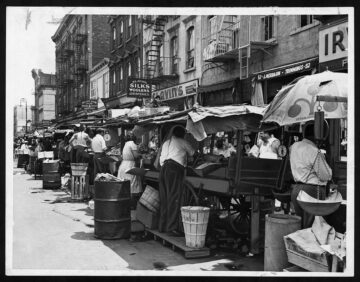
“It was a warm, sunny day in June. My mother, my sister, age four in the light stroller, and myself, age 6, set out to visit my maternal grandparents, Toby and Phillip Fishkin, who lived about two miles away from us…As my mother pushed the stroller, with me sometimes holding the sidebar, we went into a somewhat poorer neighborhood…As we got close to Thatford Avenue, the perpendicular street on which my grandparents lived, there were more and more fruit and vegetables for sale from pushcarts, some open, some covered with canvas canopies…on Thatford Avenue we walked half a block to the home of my grandparents. It was darker once we went inside the front half-glassed door. We walked about twenty feet to a set of stairs, my mother carrying my sister and me carrying the stroller. Behind the wall on the left was a store-front Negro church. It was quiet this time but I remembered that on earlier visits I could hear the congregation in a sort of encouraging murmur, commenting on what the leader was preaching, I remembered hymns and a chorus of handclapping and accompanying organ music.
“This time both my grandparents were home. We had entered a fairly large, bright kitchen. The kitchen table and the four-burner stove on slight legs were of white porcelain. The shelves of the open cupboard smelled of white oil-cloth.
“Against the wall to the right of the table was the bulky short ice-box. It was dark oak and had bright brass hinges and latches. I guess my grandfather carried a block of ice up every few days. The smaller compartment below the ice container held the staple of the household: a wide mouthed earthenware crock of chicken fat. Within the frozen congealed yellow fat were delicious bits of fried chicken skin and fried onion. In the days before cholesterol, saturated and unsaturated fat concerns, a generous layer of this concoction on heavy pumpernickel or rye bread plus a glass of tea was a great repast. For some reason the tea had to be filtered through a Domino lump of sugar held in the mouth. I remember the ice-box because I still have a scar at the top of my pinky, left over from the time I got it caught on the hinge side of the door as my mother closed it.
“There was a half step separating the kitchen from a darker living room-dining room. Beyond that was a large bedroom where my three uncles slept and a second smaller bedroom that belonged to my grandparents. Another uncle, Morris, became an electrician, was married and did not live here. Of my three other uncles David and Sam worked, wandering from job to job, while Jack was finishing high school. Grandpa was a clothes presser in a nearby clothes finishing shop, when there was work.
“I never knew my Grandmother Toby well. In this country, I had the impression that she had given up. Five children and a husband and a new world were a bit too much. She was sloppy, ate food about to rot from pushcarts outside and kept sucking on Luden’s cough drops. A few years later she developed diabetes, decided to save money by forgoing her insulin injections and became a complete paralytic for the rest of her life.
“Grandpa Phillip must have done most of the housework. These were the days before home electric clothes washers and dryers, There always seemed to be mounds of neatly folded clothes on the round pedestal dining room table. I would bury my head in the pile and inhale the Octagon laundry soap.
“Then one day I discovered an entrancing, miraculous delight. There in the dark corner was a mahogany console phonograph. My grandfather showed me how it worked. When I wound the crank, placed a quarter inch thick disc on the turntable and lowered the needle, sound came from the record, human voices and music filled the room. I was enthralled by the voice of Amelita Galli-Curci. I understood Tonio’s sobs as Enrico Caruso sang the prologue to Leoncavallo’s Pagliacci, the clown whose heart was aching.”
More To Come
I know that Cousin Bernie’s heart ached for years. It began with that institutionalization of his mother, in a string of mental hospitals, which started when he was only ten. He and his sister Gertie, were cared for by their mother’s mother, an Orthodox woman and a strict disciplinarian. I think they would have preferred living with Grandma Toby— and her pushcart adventures—and with Grandpa Phillip and his operatic phonograph. As for me, I will keep these new memories of those grandparents I never knew close to my heart as, in the months to come, I will relate more of Bernie’s written memories, particularly those regarding how he found happiness as a professor in the Midwest and even more happiness with the former Joan Hamilton, the wife he never thought he would be lucky enough to find.