
by Marie Snyder
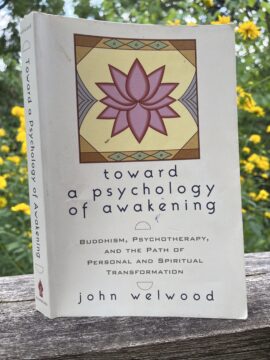 In my last post of meditation, I suggested that there’s not a lot of harm that comes from meditation and mindfulness training, so maybe it doesn’t need the kind of scientific scrutiny that we might expect from a clinical drug trial. However, in Toward a Psychology of Awakening (2000), Buddhist psychotherapist John Welwood documents three traps: spiritual bypass, narcissism, and desensitising, that arise in part because we’ve leant too far to either psychology or spirituality instead of using both. He also discusses them in brief in a paper, “Principles of inner work: Psychological and spiritual” (1984).
Both psychotherapy and spirituality are about “developing a new kind of loving relationship with one’s experience,” and both help us break free from our conditioned reactions. But spirituality doesn’t address our early mishaps that affect our perceptions, and psychotherapy doesn’t address the need to transcend our personal feelings.
When he first trained as a therapist, Welwood was concerned that psychotherapy has a narrow view of human nature, but then realized how much it can help once we no longer demand answers from it. It can help free people from negative childhood conditioning, particularly from dismissive or engulfing parenting, by working with our needs, scripts (now narratives), fears, self-respect, etc. A lot of us don’t learn how to exist in the world well. Welwood claims that part of the problem is the “breakdown of extended families and tight-knit communities” so that children just get influenced by parents or just one parent instead of many people providing a variety of ideas that can help a child figure out where they fit in the group. As far as I understand this point, with only one or two major influences, children might accept lessons without question, then have to “spend a good part of their lives freeing themselves” from this singular impact in order to find their own sense of self. It’s somewhat unintuitive, but a larger group influence helps a child find their individual self by differentiating from others more clearly at a younger age. But whether we find it at 5 or 50, it’s necessary to have this “stable self-structure” before trying to go further. Read more »
 Before I met Hayat Nur Artiran, I had only had a raw understanding of what female selfhood may look like, a notion I have been attempting to refine in my writings over many years. Here, at the Mevlevi Sufi lodge in Istanbul, I received a lifetime’s worth of illumination about the power of the spirit in the company of Nur Hanim, beloved Sufi Hodja and the President of the Sefik Can International Mevlana Education and Culture Foundation. A researcher, author and spiritual leader on the Sufi path known as the Mevlevi order (based on the teachings of Maulana Jalaluddin Muhammad Balkhi Rumi, known in the West simply as the poet Rumi), Nur Hanim’s accomplishments shine a light on an ethos that has transformed hearts for nearly a millennium. More instrumental than personal achievement in this case, is the Sufi substance and finesse that Nur Hanim has nurtured in the running of this Mevlevi lodge. Spending a day here, on my most recent visit to Istanbul, I came to experience what I had thought possible, based on my Muslim faith, but had never witnessed before: men and women coexisting, learning, working and serving in harmony, a place where one forgets the ceaseless tensions between genders, generations, ethnicity, or those caused by differences in religious beliefs or the self-worshipping individualism that has become the insignia of modernity.